Long before dynasties rose along the Nile…
before pyramids touched the sky…
the people of ancient Kemet (Egypt) were already contemplating a profound question:
𓋹 What sustains life — and what continues beyond it?
𓋹 From this contemplation emerged the Ankh — 𓋹 — a symbol both simple and immeasurably deep.
Its form is intentional.
The loop above represents eternal life — the unseen, the infinite, the breath of spirit.
The cross below represents the earthly plane — embodiment, humanity, lived experience.
Together, they form a union: spirit and matter intertwined.
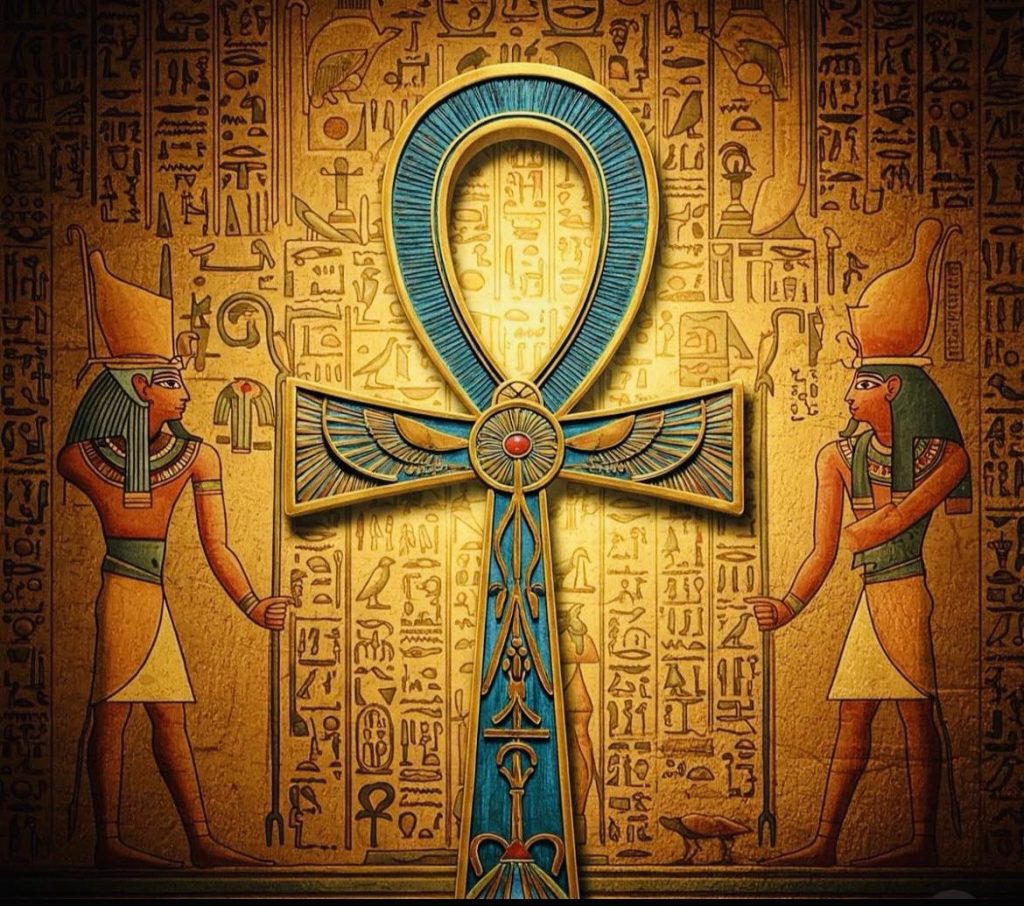
𓋹 In temple reliefs, gods are shown offering the Ankh to pharaohs — not as magic, but as meaning.
𓋹 It symbolized the sacred breath — the life force — passed from the divine into the human.
𓋹 To hold the Ankh was to remember:
𓋹 Life is not random.
It is cyclical.
It is continuous.
It moves between worlds.
Pharaohs wore it not merely for protection, but as a reminder that leadership required alignment with Ma’at — truth, balance, and harmony. Eternal life was not a reward; it was a responsibility to live in coherence.
Over centuries, the Ankh came to represent:
𓋹 The unity of masculine and feminine
𓋹 The harmony of heaven and earth
𓋹 The continuity of life beyond physical form
𓋹 The sacred breath that animates all beings
Even today, it remains one of humanity’s oldest declarations of hope:
𓋹 That life does not end.
𓋹 That spirit endures.
𓋹 That’s what we do in this world echoes beyond it.
𓋹 When you see the Ankh, you are not looking at a charm. 𓋹
You are looking at a philosophy.
𓋹 A reminder that you carry both earth and eternity within you. 𓋹