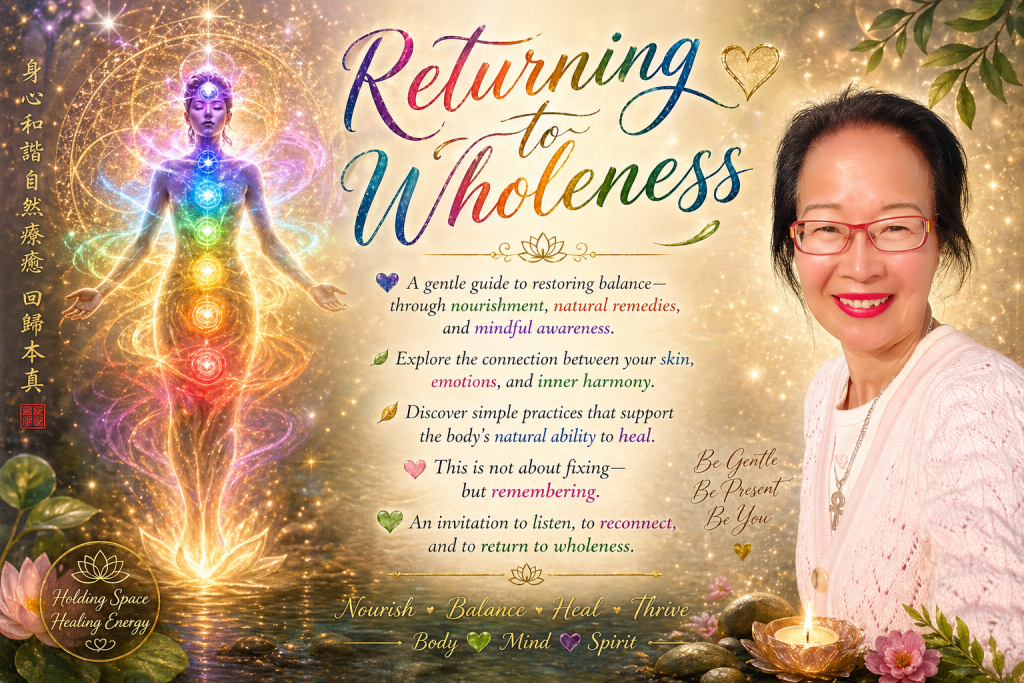
In modern life, people are often taught to search outward for healing—new methods, stronger remedies, more complex systems.
Yet what Huangdi Neijing quietly reminds us is something far simpler:
The body is already trying to maintain itself. What we call “self-healing” is not a special ability to acquire, but a natural tendency of life to return to balance.
👉 The real question is not: How do we become stronger? But rather: How do we stop disrupting what is already working?
1. Understanding the Foundation: What is “Zheng Qi”?
The classic phrase says: “When upright energy is preserved within, no external disturbance can invade.”
In everyday language, this means:
👉 The body functions smoothly (no blockage, no chaos)
👉 Internal rhythms align with natural cycles
👉 Energy is not constantly depleted by stress or excess
👉 When these conditions are present, the body exists in order.
👉 Illness, then, is not random—it is often the result of disrupted order.
2. Seven Practical Steps to Restore the Body’s Order
These are not techniques to “fix” yourself, But ways to return to what the body already understands.
Step 1: Restore Sleep Rhythm (The Priority)
Go to bed and wake up at consistent times
Reduce stimulation at night (light, screens, emotional intensity)
👉 Why it matters: Sleep is the body’s primary repair window. Without it, recovery cannot stabilize.
Step 2: Let the Breath Slow Down
Spend a few minutes each day in quiet breathing
Do not force—just observe and soften
👉 Common sense insight: Breathing directly influences the nervous system. A slower, deeper rhythm signals the body: it is safe to repair.
Step 3: Simplify Your Diet
Avoid overeating
Reduce excessive stimulation (too sweet, greasy, or cold)
👉 The key is not perfection, but this: Do not overload the body continuously
Step 4: Allow Emotions to Move
Feel without suppressing, But also, without repeatedly amplifying
👉 Why this matters: Chronic emotional tension keeps the body in “defense mode,” instead of “repair mode.”
Step 5: Reduce Mental Overconsumption
Limit repetitive thinking
Create small spaces of mental quiet
👉 In simple terms: Overthinking = continuous energy drain, Healing requires available energy, not constant expenditure.
Step 6: Move the Body Gently
Choose moderate, consistent movement
👉 The goal is: Circulation, not intensity
Step 7: Build a Stable Daily Rhythm
Eat at regular times
Maintain consistent routines, Avoid constant disruption of your schedule
👉 The body thrives on: Predictability, stability, and rhythm
3. A Clarification About “Healing Ability.”
Many people ask: “When will my self-healing ability activate?”
A more grounded answer is: It is already active—when it is not being interrupted.
Wounds close on their own
Fatigue restores itself
👉 Your role is not to command healing, But to stop interfering with it.
4. From “Trying to Heal” to “Allowing Recovery”
There is a subtle but important shift: From: “I must fix myself.” To: “I allow my body to recover.”
The first often creates tension and pressure. The second creates the conditions where healing can actually occur.
5. A Gentle Calibration
When speaking about “energy” or “healing,”
It is easy to drift into extremes: Over-mystifying the process, Or trying to control it too forcefully
A steadier perspective: Healing is gradual, physical, and observable
👉 It does not require a special identity or status
👉 It is closer to returning to normal, not entering something extraordinary
6. Closing: Order Is Already Within You
The body is not a broken machine in need of constant fixing.
It is a living system, continuously adjusting itself.
When you:
👉 Sleep with rhythm
👉 Breathe with ease
👉 Live with moderation
👉 Allow emotional flow
👉 Reduce internal strain
You are not “creating health.” You are simply removing the obstacles to it.
If you wish to begin, start with something small: A slower breath. An earlier night of rest.
👉 Order does not arrive all at once— It returns quietly, through ordinary choices.