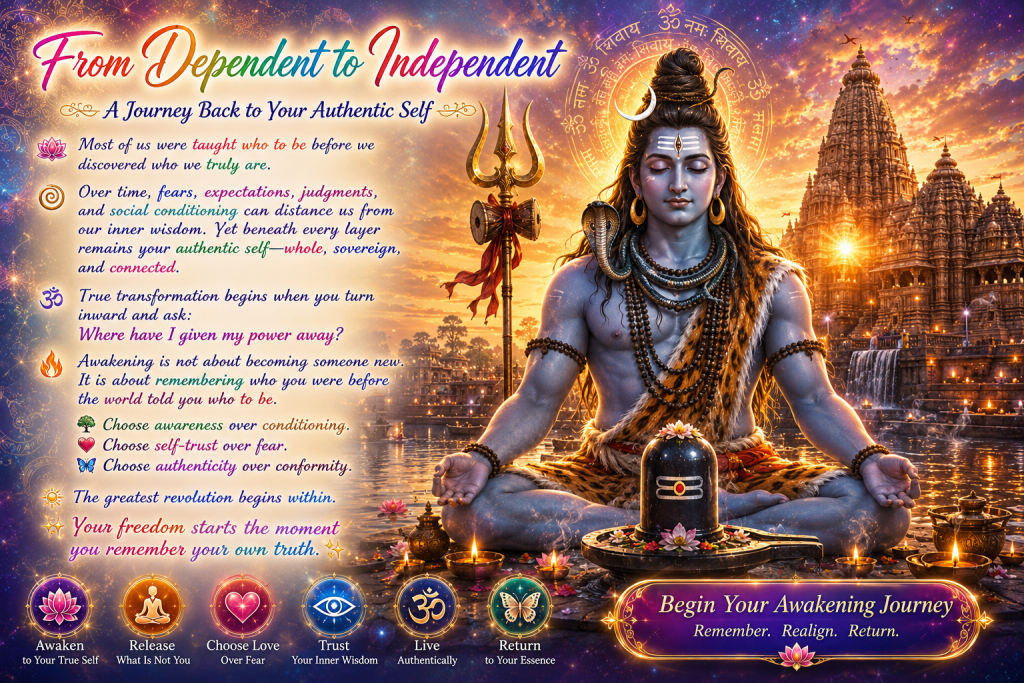
For many people, the word “God” immediately brings to mind the image of a divine being existing somewhere beyond the physical world—separate from humanity, residing in heaven, or watching over creation from afar.
Yet some of the most ancient spiritual teachings of India offer a perspective that is both profound and transformative.
The Vedas and the yogic traditions that emerged from them describe a deeper possibility:
What if the greatest spiritual journey is not about finding God outside of ourselves, but awakening to a higher state of consciousness within ourselves?
This ancient understanding invites us to explore one of the most revolutionary ideas in spiritual history—that divinity is not merely a being to worship, but a state of awareness that can be realized.
🕉️ Beyond the Image of God 🕉️
Throughout history, Shiva has often been portrayed as a deity sitting atop Mount Kailash, adorned with a crescent moon, a serpent around his neck, and immersed in deep meditation.
These images carry symbolic meaning, yet the ancient yogis understood Shiva on a much deeper level. In yogic philosophy, Shiva represents pure consciousness—the unchanging awareness that exists beneath all thoughts, emotions, perceptions, and experiences.
🪷 Consider your own experience for a moment 🪷
- Thoughts constantly arise and disappear.
- Emotions shift from joy to sadness, excitement to disappointment.
- The body ages and changes.
Life circumstances continually evolve. Yet there is something within you that has quietly witnessed every stage of your life.
- The same awareness that observed your childhood experiences is still present today.
- The same witnessing presence that notices your thoughts is not itself a thought.
- The same awareness that observes your emotions is not the emotion.
- The yogis pointed to this ever-present witnessing consciousness and called it Shiva.
Not as a distant deity. But as the deepest dimension of our own being.
🕉️ The Difference Between the Mind and Awareness 🕉️
One of the most important teachings within the Vedic and yogic traditions is the distinction between the mind and awareness.
Most people spend their lives completely identified with their thoughts.
- When a thought arises, we assume it is who we are.
- When fear appears, we become fear.
- When anger appears, we become anger.
- When anxiety appears, we become anxiety.
Yet the sages observed something remarkable.
- If you can observe a thought, then you cannot be the thought itself.
- If you can witness an emotion, then you cannot be the emotion itself.
🪷 The observer is distinct from what is being observed 🪷
This realization forms the foundation of meditation and self-inquiry. As awareness becomes clearer, a person begins to experience a profound inner freedom.
- Thoughts continue.
- Emotions continue.
- Life continues.
But they no longer completely control one’s state of being.
Like clouds passing through the sky, experiences come and go while awareness remains unchanged. This stable, spacious presence is what the yogis referred to as Shiva consciousness.
🕉️ Why Mastering the Mind Matters 🕉️
The ancient yogis did not teach that spiritual growth required escaping the world.
Rather, they taught that true freedom arises when the mind no longer dominates our experience.
A restless mind constantly pulls attention into memories of the past or worries about the future.
It creates endless stories, fears, judgments, attachments, and inner conflict.
- When left unconscious, the mind becomes a prison.
- When understood and mastered, it becomes a powerful tool.
The goal of yogic practice was therefore not to destroy the mind but to place it in service of higher awareness.
Just as a skilled rider guides a powerful horse, awareness learns to guide the mind rather than being carried away by it. As this mastery develops, clarity, compassion, resilience, and wisdom naturally emerge.
🕉️ The Science of Mantra 🕉️
One of the most misunderstood aspects of the Vedic tradition is the use of mantra.
To an outside observer, mantra may appear to be simple repetition of sacred sounds or words. However, the ancient yogis viewed mantra as a sophisticated inner technology. In Sanskrit, the word mantra is often interpreted as:
Manas = mind
Tra = instrument, vehicle, or tool
A mantra is therefore a tool for working with the mind.
The sages discovered that sound has a direct influence upon human consciousness.
Modern science increasingly confirms that sound affects brain activity, breathing patterns, emotional states, and the nervous system.
🍀 The yogis explored this relationship thousands of years ago 🍀
They observed that specific sounds could help calm mental activity, focus attention, regulate breathing, and cultivate inner stillness.
- The purpose was never blind repetition.
- The purpose was transformation.
Through conscious practice, mantra gradually shifts the quality of attention from scattered thinking toward greater presence and awareness.
🕉️ The Universe as Vibration 🕉️
Another foundational insight of Vedic wisdom is the understanding that existence itself is fundamentally vibrational.
Ancient seers described creation as emerging from primordial sound and vibration. The sacred syllable AUM (OM) became a symbol of this cosmic principle.
While modern physics uses different language, it also reveals a universe composed of dynamic fields, frequencies, and patterns of energy.
The Vedic sages perceived a similar truth through direct contemplative experience. Because consciousness and vibration were seen as interconnected, sound became a bridge between ordinary awareness and expanded states of consciousness.
This is why sacred chanting, mantra, music, and breath practices became central elements of spiritual development.
- The goal was not religious conformity.
- The goal was inner alignment.
🕉️ Awakening the Shiva State 🕉️
Perhaps the most powerful insight offered by the Vedas is this:
💖 Spiritual realization is not about becoming something you are not. 💖
💖 It is about recognizing what has always been present. 💖
- The awareness you seek is already here.
- The stillness you seek is already here.
- The peace you seek is already here.
Yet it is often hidden beneath the constant movement of thought, emotional conditioning, and identification with external circumstances.
The sages taught that through meditation, self-observation, ethical living, devotion, breathwork, and mantra, the clouds gradually part.
💖 As they do, awareness begins to recognize itself. 💖
This recognition is what many yogic traditions describe as awakening.
- Not acquiring something new. But remembering something ancient.
- Not reaching a distant destination. But coming home to one’s deepest nature.
🕉️ The Relevance for Humanity Today 🕉️
In today’s world, people are surrounded by endless stimulation.
Notifications. News cycles. Social media. Stress. Distraction. Mental overload.
Many people feel disconnected from themselves while being constantly connected to everything else.
The wisdom of the Vedas offers a timeless reminder:
- Peace is not found by controlling the external world.
- Peace emerges through understanding the inner world.
The sages understood that lasting freedom does not come from changing every circumstance.
It comes from discovering the awareness that remains steady through all circumstances.
Whether one calls it Shiva, pure consciousness, the witnessing presence, higher awareness, or simply inner stillness, the invitation remains the same.
💖 To turn inward 💖
💖 To observe 💖
💖To awaken 💖
And to discover that beneath the noise of the mind exists a deeper intelligence that has been present all along.
- The ancient yogis did not merely ask, “Do you believe in God?”
- They asked a deeper question: “Can you awaken to the awareness that has been witnessing your entire life?”
Perhaps that question remains just as relevant today as it was thousands of years ago.
For the Vedas suggest that the ultimate spiritual journey is not about seeking the divine somewhere else.
🙏🏻 It is about recognizing the divine consciousness already present within. 🙏🏻