In today’s world, many people are searching for peace in increasingly noisy places. We scroll through endless information, consume countless opinions, and seek answers from every direction. Yet despite all of this stimulation, many still feel restless, overwhelmed, or disconnected from themselves.
The ancient yogis, sages, and contemplative traditions understood something profound: The quality of our outer life is deeply influenced by the condition of our inner world.
And one of the most powerful ways to cultivate that inner world is through the conscious use of sound, breath, silence, and attention.
For thousands of years, sacred chanting, mantras, devotional music, and breath practices have been used not merely as religious rituals, but as practical tools for calming the mind, opening the heart, and deepening awareness.
Their purpose was simple:
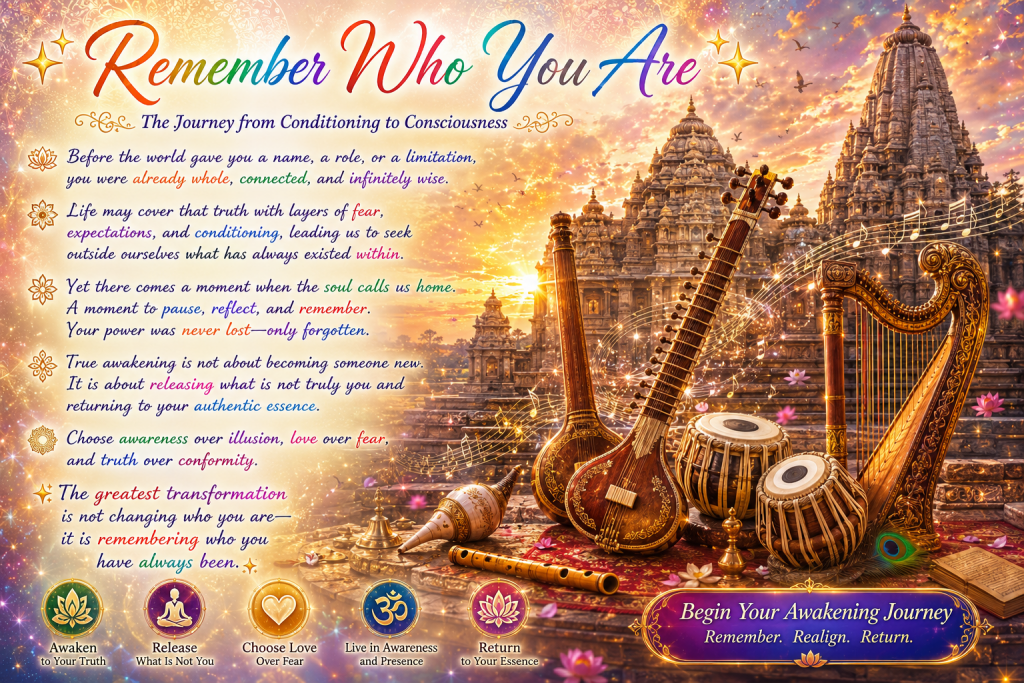
To help human beings remember the stillness that already exists within them.
🕉️ Why Sound Has Such a Powerful Effect 🕉️
Have you ever noticed how a piece of music can instantly change your emotional state?
- One song can energize you.
- Another can bring tears to your eyes.
- Another can create peace and relaxation.
🕉️ Sound affects the nervous system directly. 🕉️
It influences breathing, heart rate, emotional patterns, and mental activity.
The ancient yogis discovered that certain sounds, when repeated consciously, could help shift attention away from constant thinking and into a state of presence.
Rather than trying to force the mind into silence, they used sound as a bridge into silence.
🕉️ The Purpose of Mantra 🕉️
Many people mistakenly believe mantras are magical words that automatically create miracles.
Traditional yogic teachings describe something subtler.
- A mantra is not about convincing the universe to give us what we want.
- A mantra is a tool for refining consciousness.
When repeated with sincerity and awareness, a mantra can:
🕉️ Focus attention 🕉️ Calm mental chatter 🕉️ Regulate breathing
🕉️ Create emotional balance 🕉️ Increase concentration 🕉️ Open the heart 🕉️ Cultivate inner stillness
🕉️ The real transformation happens within the practitioner 🕉️
🪷 Three Simple Mantras for Beginners 🪷
🕉️ 1. OM (AUM)
Perhaps the most famous mantra in the world. The ancient sages viewed OM as the primordial vibration underlying all existence.
Practice: Sit comfortably. Take a slow breath in.
Exhale while chanting: Aaaa-Uuuu-Mmmm, Allow the sound to vibrate through the body. Repeat 7–21 times.
Benefits: Calms the nervous system, Encourages presence, Creates mental clarity, Helps settle emotional turbulence
🕉️ 2. So Hum
This mantra means: “I am That.”
It points toward the unity between individual consciousness and universal consciousness.
Practice: As you breathe naturally: Inhale silently: So
Exhale silently: Hum, Continue for 5–20 minutes.
Benefits: Deepens meditation, Anchors awareness in the breath
Reduces overthinking, Cultivates inner peace
🕉️ 3. Om Namah Shivaya
One of the most beloved mantras in yogic traditions.
It is often translated as: “I bow to the divine consciousness within.”
Practice: Repeat aloud or silently: Om Namah Shivaya
Allow the rhythm to become gentle and natural.
Benefits: Encourages humility, Promotes inner balance, Supports self-inquiry, Helps cultivate devotion and reverence
🕉️ Sacred Music as Meditation 🕉️
Not everyone connects deeply with silent meditation. For some people, music opens the heart more naturally. Sacred music can become a moving meditation.
- The goal is not to analyze the music.
- The goal is to allow yourself to receive it fully.
You might: Sit quietly and listen. Place your hand on your heart. Observe your breathing. Allow emotions to arise and pass naturally.
Sometimes healing occurs simply by allowing yourself to be present with beautiful sound.
🪷 Breath: The Bridge Between Body and Mind 🪷
The yogis observed that the breath reflects the condition of the mind.
- When we are anxious, breathing becomes shallow.
- When we are calm, breathing becomes slower and deeper.
By consciously changing the breath, we can influence our mental and emotional state.
🙏🏻 Simple Coherent Breathing Practice 🙏🏻
Try: Inhale for 5 seconds, Exhale for 5 seconds, continue for 5–10 minutes.
No force. No strain. Just a smooth, steady rhythm.
Benefits: Regulates the nervous system, Reduces stress, Increases emotional resilience, Creates mental clarity
🕉️ A Simple Daily Practice 🕉️
You do not need hours each day. Even 15–20 minutes can create meaningful change.
Morning Practice: Sit comfortably. Take several slow breaths. Chant OM 7 times.
Practice So Hum breathing for 5 minutes. Sit quietly for 3–5 minutes.
Evening Practice : Listen to sacred music. Practice coherent breathing. Repeat a mantra that resonates with you. End with gratitude.
Consistency matters more than intensity.
🙏🏻 Choose teachers and music that genuinely resonate with you rather than following trends. 🙏🏻
💛 The Deeper Purpose 💛
It is important to remember that chanting, mantras, music, and breathwork are not goals in themselves.
🕉️ They are gateways 🕉️
The ancient sages were not interested in creating impressive spiritual experiences. They were interested in helping people discover what remains when the noise settles.
- Beneath the thoughts.
- Beneath the emotions.
- Beneath the constant activity of the mind.
🙏🏻 There is a quiet presence. A stillness. A witnessing awareness. 🙏🏻
Some traditions call it Shiva. Some call it Spirit. Some call it Pure Consciousness. Some simply call it Peace. The name matters less than the experience.
What matters is learning how to return to that inner sanctuary again and again. Because the greatest gift of these practices is not that they help us escape life.
💛 It is that they help us meet life with greater clarity, compassion, balance, and wisdom 💛
🕉️ Sacred sound calms the mind 🕉️
💛 Conscious breathing steadies the heart 💛
🕉️ Stillness reveals the wisdom within 🕉️
And perhaps that is why these ancient practices have endured for thousands of years:
✨🙏💛 They remind us that the peace we seek is not somewhere else. It is waiting to be rediscovered within us. ✨🙏🏻💛