A Pilgrimage Through Tibet, the Ancient Silk Road & the Sacred Landscape Within
 The world doesn’t need more tourists. It needs more conscious pilgrims
There comes a moment in every life…
…when seeing more places is no longer enough.
- When collecting experiences no longer satisfies the soul.
- When success quietly gives way to a deeper question:
Who am I becoming?
- Perhaps that question has brought you here.
- Perhaps something within you is calling you beyond another vacation…
…toward a pilgrimage.
Not to escape life—but to return to it with greater presence, wisdom, and compassion.
Why This Pilgrimage?
 This is not a sightseeing tour.
This is not a race to check destinations from a bucket list.
It is an invitation to slow down…
- to breathe…
- to listen…
and to rediscover the quiet wisdom that has always lived within you. Together, we will walk among some of humanity’s most sacred landscapes:
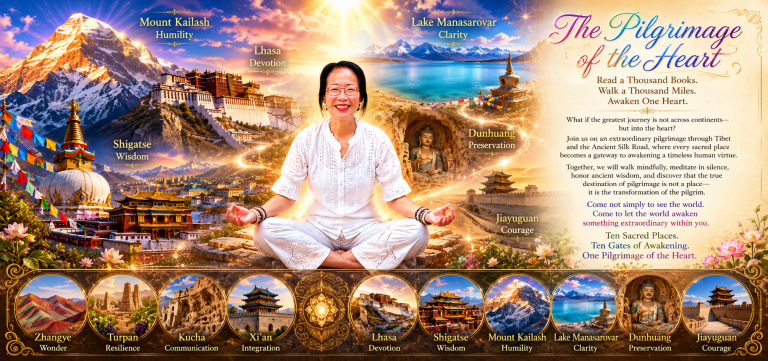
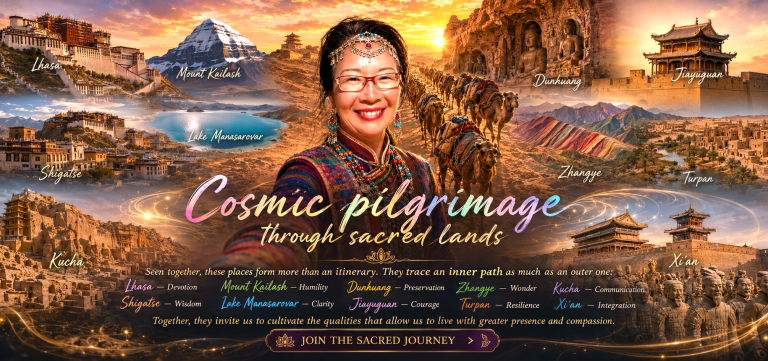
 Lhasa Jokhang Temple Sera, Drepung & Ganden Monasteries Mount Kailash Lake Manasarovar Dunhuang Jiayuguan Zhangye Turpan Kucha Xi’an
Yet these places are only the outer pilgrimage. The real journey happens within.
The Greater Pilgrimage
Every sacred place reflects a sacred quality waiting to awaken inside us.
Lhasa — Devotion
Shigatse — Wisdom
Mount Kailash — Humility
Lake Manasarovar — Clarity
Dunhuang — Preservation
Jiayuguan — Courage
Zhangye — Wonder
Turpan — Resilience
Kucha — Sharing Wisdom
Xi’an — Integration
By the time we return home… we discover that the greatest distance we have traveled was never across Asia.
It was from the mind…back to the heart.
Why I Am Called to Walk This Path
I was born in China. China is not simply a country I have visited. It is my homeland.
For more than two decades, it shaped my language, culture, and earliest understanding of life. Later, life carried me across twenty-three countries and through some of the world’s great spiritual civilizations.
One of the most transformative chapters of my life was a one-hundred-day solo pilgrimage through India, Nepal, and China. That journey inspired my book, Travelling Inwards, published by Hay House.
But the greatest lesson was never found in a book. It was discovered :
- Through walking.
- Through silence.
- Through meditation.
- Through meeting extraordinary people.
- Through allowing every journey to reshape the person who was walking it.
After eighteen years of Vipassana meditation and decades of exploring sacred lands around the world, I no longer believe pilgrimage is about reaching a destination.
I believe it is about remembering who we truly are.
That is why I created Returning to the Source of the Heart.
Not to lead people.
But to walk beside them.
A Community of Conscious Pilgrims
Imagine traveling with people who are less interested in taking the perfect photograph, and more interested in becoming more compassionate human beings.
People who value silence as much as conversation. Meditation as much as movement.
Presence as much as planning. Who understand that every sunrise can become a prayer.
- Every mountain can become a teacher.
- Every step can become an offering.
This is the community we are creating. Not a tour group.
A circle of conscious pilgrims
 Our Shared Intention
As we walk together, we will cultivate:
 Presence instead of distraction.
Gratitude instead of consumption.
Curiosity instead of certainty.
Compassion instead of judgment.
Wisdom instead of information.
Together we honor the sacred lands that welcome us. We respect the cultures that have preserved them. And we return home carrying something far more valuable than photographs.
We return home carrying a transformed heart
 A Blessing for Our Magnificent Earth
Every generation is asked an important question.
 How will you leave the world better than you found it?
Perhaps our answer begins with how we walk.
- When we walk gently upon sacred ground… we remember how to walk gently upon the Earth.
- When we cultivate peace within ourselves… we naturally bring more peace into our families, our communities, and the world.
May every mindful step become a blessing.
May every breath become gratitude.
May every act of kindness ripple far beyond this pilgrimage.
- For our magnificent planet Earth.
- For all living beings.
- For generations yet to come.
An Invitation
If your heart has been quietly longing…
- for silence instead of noise…
- for meaning instead of distraction…
- for wisdom instead of certainty…
- for community instead of isolation…
perhaps this pilgrimage has already begun. I warmly invite you to walk beside me.
Not because I know the way. But because we can discover it together.
- One mindful step.
- One open heart.
- One sacred journey at a time.
Return to the Source of the Heart
Walk the Sacred Earth. Awaken the Heart. Become a Blessing for the World.