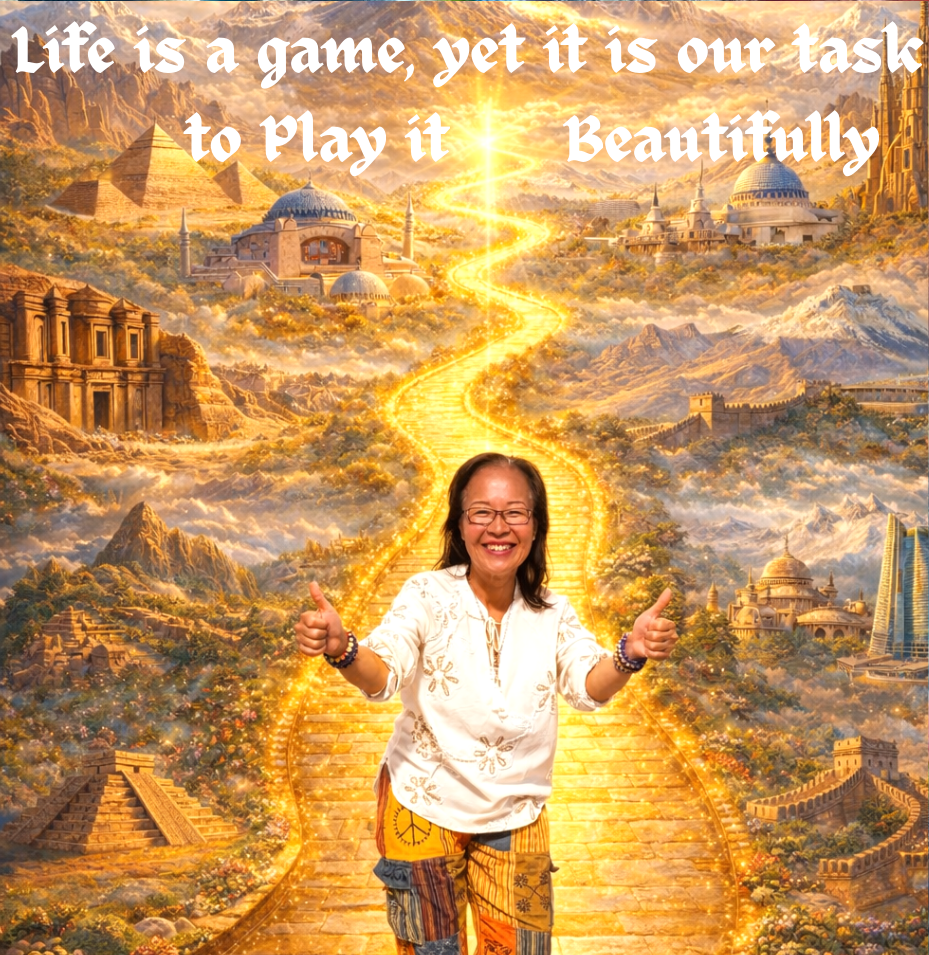
“Life is a game, yet it is our task to play it beautifully.”
This metaphor does not suggest triviality. A game is structured, bounded, rule-based, and participatory. It requires presence. It demands engagement. It contains uncertainty. To call life a game is to recognize that we are not passive spectators—we are participants inside a dynamic field of choices, constraints, and creative response.
The word yet is important. It softens the metaphor. Life is not only a game. It carries consequences, relationships, and impact. But within its unpredictability, we are invited to approach it with the intelligence and artistry of a skilled player.
To “play beautifully” is not to win at all costs. It is to move with integrity, creativity, and grace within the given rules of embodiment—time, mortality, limitation, interdependence.
A beautiful game is not defined by the scoreboard. It is defined by the quality of participation.
If we look closely, a game contains several elements:
Rules (natural law, cause and effect, social contracts)
Players (other beings with agency)
Challenges (obstacles, uncertainty)
Strategy (discernment and adaptability)
Skill development (growth through repetition)
Feedback (consequence and learning)
To embrace the play is to accept these elements without resentment.
Techniques to Embrace the Play
1. Adopt the Player’s Mindset
A skilled player does not complain about the board. They study it. Instead of asking, “Why is this happening?” ask, “What move is available now?” This restores agency.
2. Separate Identity from Outcome
In games, losing a round does not erase the player. Practice viewing setbacks as feedback, not as definitions of self-worth. This reduces fear and increases experimentation.
3. Train Daily Micro-Skills
Every game rewards practice. Emotional regulation, listening, patience, and strategic thinking—these are trainable capacities. Small daily disciplines compound into elegance over time.
4. Cultivate Playfulness Without Naivety
Playfulness is not denial. It is flexibility. When we hold circumstances lightly, we become more creative in response.
5. Learn the Rules of Energy
Attention is currency. Time is finite. Relationships are multipliers. Protect your energy as a wise player protects resources.
Producing an Impactful Game
If life is a game, you are both participant and designer of your inner experience. To create a game that enriches your soul, consider these grounded steps:
Clarify the Objective Beyond Ego
What does “winning” truly mean for you? Status? Or coherence? If the objective is inner alignment and contribution, decisions shift. Choose a definition of success that expands rather than contracts you.
Design Meaningful Quests
Games thrive on missions. Create projects that stretch you—learning a new craft, deepening a relationship, contributing to the community. Purpose transforms repetition into progression.
Choose High-Quality Teammates
No meaningful game is solitary. Surround yourself with those who elevate your thinking and challenge your blind spots. Mutual refinement strengthens the field.
Upgrade Through Reflection
After each major experience, review the “round.” What worked? What misfired? Reflection turns experience into wisdom.
Integrate Light and Shadow
Every game includes tension. Avoiding difficulty weakens skill. Lean into manageable challenges. Growth occurs at the edge of comfort.
Anchor Expansion in Service
A game focused solely on personal gain becomes hollow. When your growth supports others—through kindness, mentorship, creativity—the game gains depth and sustainability.
There is also discernment required. If the metaphor begins to inflate into grandiosity—if one imagines themselves uniquely chosen or above the rules—the game becomes distorted. Beautiful play is humble. It respects shared reality and interdependence.
Expansion of the soul, if we use that phrase carefully, may simply mean increased coherence between intention, action, and impact. It is the widening of capacity to love, to perceive complexity without collapse, to remain steady in uncertainty.
Playing beautifully, then, is a practice of alignment:
Align thought with truth.
Align action with values.
Align ambition with contribution.
Align effort with compassion.
The game is not about control. It is about participation.
And if at times the metaphor feels heavy or confusing, return to something simple: breathe, notice the present move available, act with integrity in that move.
✧ ✧ ✧✧ ✧ ✧✧ ✧ ✧✧ ✧ ✧✧ ✧ ✧✧ ✧ ✧