Introduction
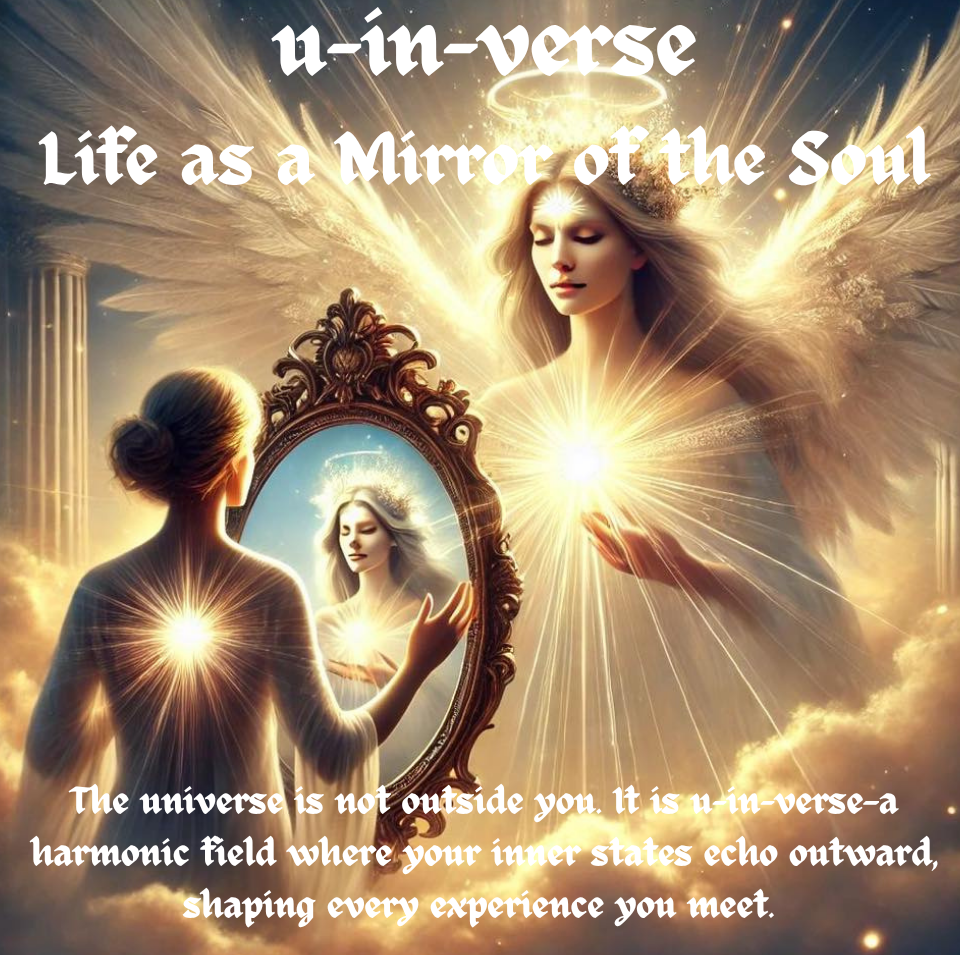
What if the life you are experiencing is not happening to you, but through you?
What if every relationship, challenge, inspiration, and conflict is a mirror—revealing the architecture of your own consciousness?
There is a profound insight hidden within the idea that we do not see others as they are; we see them as we are.
When we understand this deeply, life stops feeling random and begins to feel participatory.
We move from reaction to responsibility, from projection to creation.
This article offers a grounded framework and practical tools to help you embody this mirror principle—so you may create a different experience of life, not by force, but by coherence.
The Mirror Principle
Every perception is filtered through memory, belief, emotion, and expectation.
When you admire someone, that admiration reveals a latent quality within you.
When you feel triggered by someone, that reaction reveals an unintegrated aspect of yourself.
This does not mean others are illusions. It means perception is participatory.
You are not simply observing reality—you are co-shaping it through interpretation.
When projection becomes conscious, it becomes power.
From Projection to Participation
Most of our suffering comes from unconscious projection:
• We assume others are the source of our discomfort.
• We assume external circumstances determine our emotional state.
• We believe change must happen “out there” before we can feel peace “in here.”
But when we reclaim projection, something shifts:
• Triggers become teachers.
• Admiration becomes activation.
• Conflict becomes integration.
A different life begins when perception becomes conscious.
Practical Tools for Embodied Transformation
Tool 1: The Projection Journal
For 30 days, observe strong emotional reactions—both positive and negative.
Ask yourself:
• What quality am I attributing to this person?
• Where does this quality exist within me?
• Is it expressed, suppressed, or underdeveloped?
Write honestly. No judgment. Just awareness.
Clarity dissolves distortion.
Tool 2: The Mirror Breath Reset
Before important conversations or decisions:
1. Inhale slowly for 4 seconds.
2. Hold gently for 4 seconds.
3. Exhale for 6 seconds.
4. Repeat three times.
During the exhale, silently affirm:
“Let me see clearly. Let me respond, not react.”
This interrupts unconscious narrative loops and stabilizes perception.
Tool 3: The Identity Audit
Sit quietly and reflect:
• Who am I trying to be in order to be accepted?
• Whose expectations am I carrying?
• What version of myself feels most authentic and coherent?
Notice how much identity is built around how you believe others see you.
Then gently release what no longer resonates.
Authenticity is coherence in action.
Tool 4: The One-Day Mirror Experiment
For one full day, assume everyone you encounter is reflecting something about you.
At the end of the day, journal:
“What did today reveal about my fears, strengths, insecurities, and gifts?”
Do not aim to judge yourself. Aim to inner stand yourself.
Creating a Different Life Experience
A different life does not begin with new circumstances.
It begins with a new perception.
When you:
• Reduce projection,
• Increase self-awareness,
• Respond instead of react,
• Align actions with authentic values,
Your outer world gradually reorganizes.
Relationships shift.
Opportunities change.
Stress decreases.
Clarity increases.
This is not mystical inflation. It is psychological and relational coherence.
The Purpose of Expansion
True growth is not about superiority or spiritual status.
It is about increased responsibility and compassion.
When you see clearly, you blame less.
When you project less, you love more.
When you integrate more, you fear less.
Consciousness does not expand upward in hierarchy.
It stabilizes inward through alignment.
And alignment changes experience.
Conclusion
You are not separate from what you perceive.
The world reflects the structure of your inner life.
When you change the lens, you change the landscape.
Begin gently.
Observe honestly.
Integrate patiently.
A different life is not created by becoming someone new.
It is revealed by remembering who you already are—without distortion.
The Mirror Teaching of the Buddha
“I am not what you think I am; you are what you think I am.”
— Attributed to the Buddha
Whether spoken exactly in these words or not, this teaching captures a profound truth found throughout Buddhist philosophy:
We do not see reality as it is. We see it as we are.
Another teaching attributed to the Buddha reminds us:
“With our thoughts, we make the world.”
And again:
“All that we are is the result of what we have thought.”
These statements are not mystical poetry alone. They are practical instructions.
When we judge someone harshly, we are often reacting to an unhealed part of ourselves.
When we deeply admire someone, we are recognizing a dormant strength within our own being.
When we feel invisible, unseen, or misunderstood, we may be projecting onto others the very distance we hold within ourselves.
The Buddha’s wisdom invites us into radical self-honesty—not self-blame, but self-awareness.
Instead of asking:
“Why are they like this?”
We gently ask:
“What is this moment revealing about me?”
This shift is life-altering.
It moves us from victimhood to authorship.
From reactivity to responsibility.
From unconscious repetition to conscious creation.
How to Live This Teaching Daily
1. When you feel hurt, pause before reacting.
Ask: “What belief inside me is being touched?”
Often the pain reveals an old story asking to be rewritten.
2. When you feel admiration, claim it.
Say inwardly: “That quality lives in me too.”
Then take one small action that expresses it.
3. When conflict arises, choose curiosity over certainty.
Instead of defending your identity, explore what part of you feels threatened.
Growth hides there.
4. When you succeed, acknowledge the inner alignment that made it possible.
Confidence grows from ownership, not comparison.
A More Human Way to Relate
This teaching does not make us perfect. It makes us present.
You will still feel anger.
You will still feel fear.
You will still misunderstand and be misunderstood.
But instead of spiraling into blame, you begin to inquire.
Instead of collapsing into shame, you begin to integrate.
Instead of waiting for the world to change, you begin to change your participation in it.
And slowly, quietly, your world reorganizes.
Not because you forced it.
But because you became coherent within it.
A Heartfelt Invitation
If you want a different life experience, begin with this simple commitment:
For the next week, treat every strong emotional reaction as a mirror—not an enemy.
Let it teach you.
Let it soften you.
Let it strengthen you.
A different life is not found in a new city, a new relationship, or a new identity.
It is found in a new relationship with your own perception.
As the Buddha taught in many ways:
The transformation of the world begins with the transformation of the mind.
And that transformation begins in small, courageous moments of awareness.