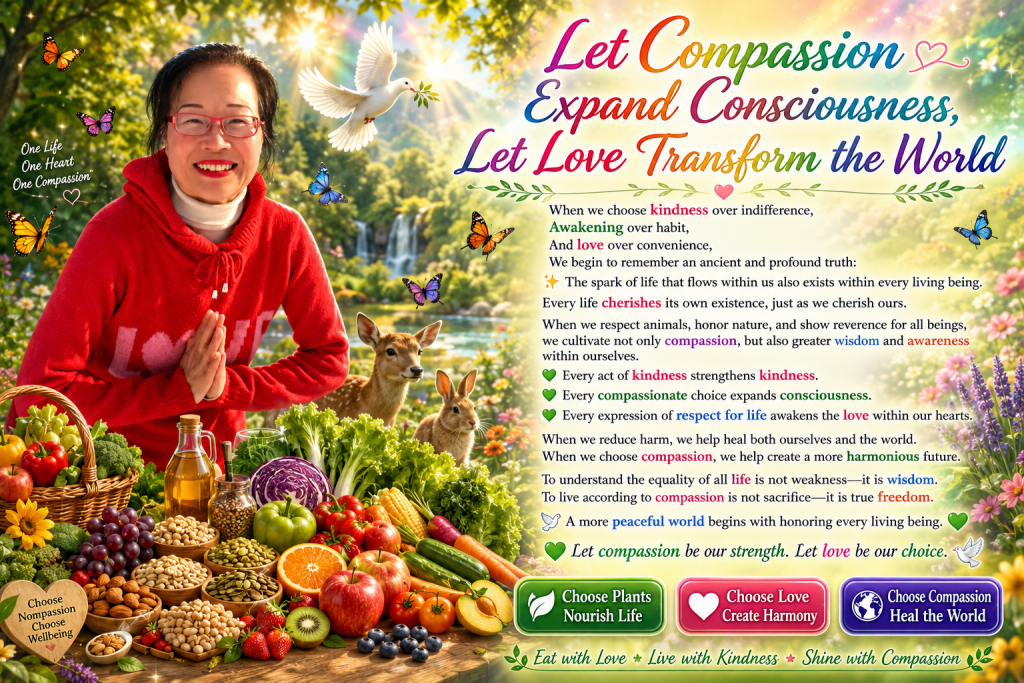
💚 A Spiritual Reflection on Animals, Consciousness, and the Journey Back to Our True Nature 💚
Throughout history, humanity has been taught many things about what is necessary for survival, success, and health. Some of these teachings have served us well. Others deserve thoughtful examination.
Whether through cultural traditions, advertising, social expectations, family customs, economic interests, or selective information, human beings are constantly influenced by the ideas surrounding them. Most of us inherit beliefs long before we consciously choose them.
This is especially true when it comes to our relationship with animals.
For generations, many people have accepted the consumption of animals as normal, natural, and necessary. Yet throughout the ages, spiritual teachers, mystics, sages, and enlightened beings have repeatedly invited humanity to ask a deeper question:
What effect does our treatment of other living beings have upon our own consciousness?
This question reaches beyond nutrition. It touches the very nature of compassion, awareness, and spiritual evolution.
💚 The Invisible Conditioning of Humanity 💚
Human beings are born into systems of belief.
We learn what to eat, what to wear, what to value, and what to consider normal from the cultures around us. Few people consciously decide to eat animals after deeply investigating the ethical, spiritual, environmental, and psychological implications. Most simply inherit the practice.
This does not mean people are intentionally deceived. Rather, it reminds us that social conditioning is powerful. History shows that societies have often accepted practices that later generations questioned or abandoned. Therefore, wisdom requires us to continually examine our assumptions.
The spiritual path begins when we ask: “Have I chosen this consciously, or have I simply inherited it?”
Awakening often starts where unquestioned habits end.
💚 The Ancient Understanding of Interconnected Life 💚
One of the most universal teachings found throughout the world’s wisdom traditions is that life is interconnected. Although expressed in different ways, many traditions point toward the same truth:
- What we do to others affects ourselves.
- Compassion elevates consciousness.
- Harm creates separation.
- Love restores unity.
The ancient Indian scripture teaches:
“There is nothing more precious to a living creature than his own life. Therefore, he who kills an animal kills himself. Or, he who slays an animal slays himself.”
This statement is not merely about physical actions. It speaks to an inner reality.
- When we become indifferent to the suffering of another being, we may weaken our own capacity for empathy.
- When we honor life, we strengthen our connection to it.
The spiritual masters of many traditions recognized that consciousness is shaped by what we repeatedly think, feel, and do.
💚 Ahimsa: The Principle of Non-Harm 💚
Among the most profound teachings in Eastern spirituality is Ahimsa, the principle of non-violence toward all living beings.
Ahimsa is central to Hinduism, Buddhism, Jainism, and many yogic traditions.
It teaches that every act of unnecessary harm creates ripples that extend beyond the visible world. According to these traditions, violence first wounds the victim, but it also affects the consciousness of the one who participates in it.
This does not mean a person becomes “bad” for eating animals. Rather, it suggests that our choices influence the qualities we cultivate within ourselves.
- Every act of kindness strengthens kindness.
- Every act of compassion strengthens compassion.
- Every act of reverence for life deepens our awareness of life’s sacredness.
💚 What Buddha Taught About Compassion 💚
The Buddha taught that all sentient beings seek happiness and wish to avoid suffering. His teachings encouraged practitioners to cultivate Metta—loving-kindness toward all beings without exception.
Buddhist meditation often includes reflections such as:
“May all beings be happy. May all beings be free from suffering. May all beings live in peace.”
These prayers do not distinguish between humans and animals. The deeper one develops compassion, the more difficult it becomes to ignore the suffering of any creature.
From a Buddhist perspective, spiritual development is not measured by what we believe. It is measured by the degree to which our hearts become free from cruelty, hatred, and indifference.
💚 The Jain Vision: Radical Reverence for Life 💚
Among the world’s religions, Jainism perhaps carries non-violence to its highest expression. Jain sages taught that every living being possesses intrinsic value and that spiritual progress depends upon minimizing harm wherever possible.
The Jain worldview invites humanity to see life through the eyes of another creature.
- Imagine wanting to live.
- Imagine fearing death.
- Imagine loving your family.
- Imagine seeking safety.
Animals experience these realities too. When this understanding becomes real, compassion naturally expands.
💚 Jesus and the Spirit of Mercy 💚
Although scholars debate historical details surrounding diet in the ancient world, the teachings of Jesus consistently emphasize mercy, compassion, and love.
Jesus taught: “Blessed are the merciful, for they shall obtain mercy.” — Matthew 5:7 He repeatedly demonstrated concern for the vulnerable, the forgotten, and those without power.
For many Christian mystics throughout history, spiritual growth has involved expanding the circle of compassion beyond humanity alone.
Their question was simple: If God is love, how can we express that love more fully in our relationship with all creation?
💚 The Yogic Understanding of Food and Consciousness 💚
Yogic traditions teach that food influences not only the body but also the mind.
Ancient yogic philosophy classifies foods according to the qualities they encourage within consciousness.
Plant-based foods are often described as promoting clarity, balance, peace, and spiritual awareness. This perspective is rooted in spiritual observation and practice rather than modern laboratory science.
For thousands of years, yogis, monks, and meditators have reported that diets centered on non-violence support inner stillness and heightened sensitivity.
Whether one accepts these teachings literally or symbolically, their message is profound:
The more consciously we eat, the more consciously we live.
💚 The Inner Conflict We Rarely Discuss 💚
Many people love animals. They admire their intelligence, recognize their emotions, and care about their wellbeing. Yet many of these same people also participate in systems that result in animal suffering.
This can create an internal tension. Psychology refers to this as cognitive dissonance—the discomfort that arises when actions and values are not fully aligned. When people move toward choices that better reflect their compassion, they often describe feelings of:
Relief, Inner peace, Greater integrity, Emotional clarity
The spiritual traditions would describe this as living in greater harmony with one’s conscience.
💚 Breaking Free from the Habit of Separation 💚
The deepest challenge facing humanity may not be cruelty itself. It may be separation.
- When we see ourselves as separate from nature, we exploit it.
- When we see ourselves as separate from animals, we ignore their suffering.
- When we see ourselves as separate from one another, conflict arises.
But when we recognize the interconnected nature of life, a different possibility emerges.
- Compassion becomes natural.
- Kindness becomes intuitive.
- Service becomes joyful.
- The illusion of separation begins to dissolve.
💚 When We Liberate Animals, We Liberate Ourselves 💚
Many spiritual seekers have observed a profound principle:
The freedom we extend to others becomes the freedom we discover within ourselves.
- When we reduce unnecessary harm, we often experience a deepening of conscience.
- When we choose compassion, we strengthen compassion.
- When we honor life, we become more aware of the sacredness of our own existence.
This is why many spiritual traditions teach that kindness toward animals is not merely an ethical choice. It is a spiritual practice.
🙏 A practice that gradually transforms the heart.
🙏 A Call to Conscious Awakening
This message is not about guilt, condemnation, or judgment. Every person is on their own journey of understanding. Rather, it is an invitation to examine inherited assumptions and explore a deeper relationship with life. Ask yourself:
- What kind of world do I wish to create?
- What values do I want my actions to reflect?
- How can I reduce unnecessary suffering?
- What choices bring me into greater harmony with my conscience?
The answers may be different for each person. Yet one truth echoes through the wisdom traditions of humanity:
💚 Compassion expands consciousness 💚
When we choose kindness over indifference, awareness over habit, and love over convenience, we begin to remember something ancient and profound:
That the same spark of life which lives within us also lives within every creature.
And when we honor that shared life, we do not diminish ourselves.
🌱 We awaken 🌱
For in the end, the path to a more peaceful world may begin with a simple realization:
Every being treasures its life, just as we treasure ours.
🙏 To recognize this is not weakness. It is wisdom 🙏
🙏 To live according to it is not sacrifice. It is liberation 🙏