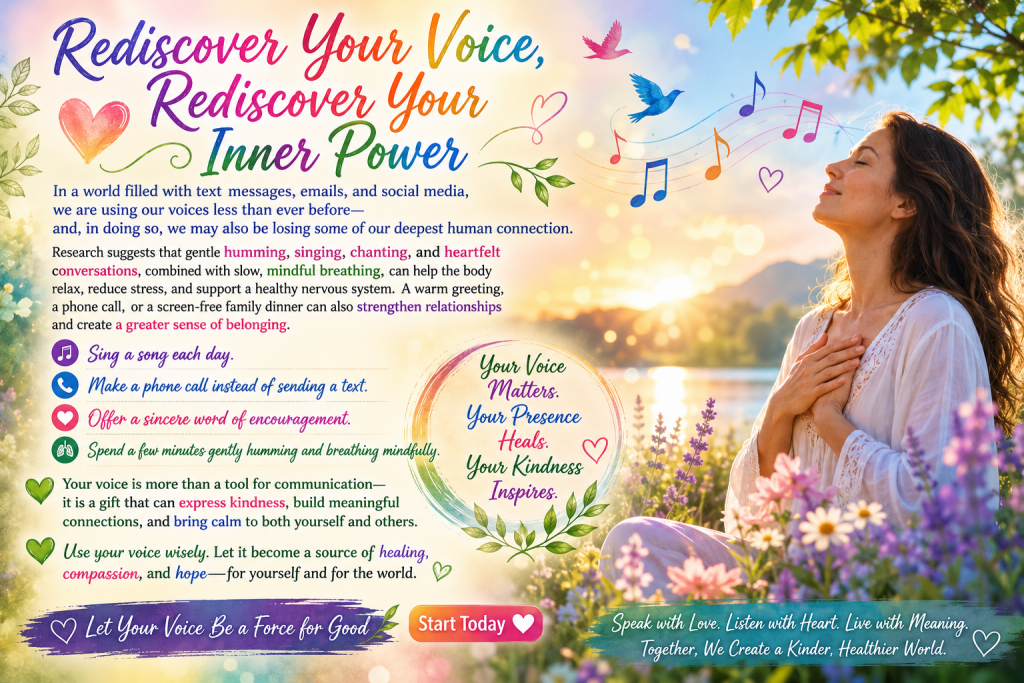
“Sometimes, the medicine we are searching for has been within us all along—in our breath, our voice, and our ability to connect with one another.”
In today’s digital world, we communicate more than ever, yet many people feel more disconnected than ever before.
- We send text messages.
- We reply to emails.
- We communicate through social media.
- We leave voice notes instead of having conversations.
Families often sit around the same dinner table, each looking at a different screen.
Ironically, while technology has made communication faster, it has not necessarily made us feel more deeply connected.
One of the most overlooked gifts we possess is something we use every day: Our voice.
Recent scientific research, together with ancient contemplative traditions, suggests that using our voice—especially through humming, chanting, singing, and meaningful conversation—may positively influence our nervous system, emotional well-being, and sense of connection.
🧠 The Vagus Nerve: A Bridge Between Body and Mind 🧠
The vagus nerve is one of the longest cranial nerves in the body. It connects the brain with many organs, including the:
Throat 🔆 vocal cords 🔆 heart 🔆 lungs 🔆 digestive system
It plays an essential role in the parasympathetic nervous system, sometimes called the “rest and digest” system. When vagal activity is healthy, we may experience:
✔ a slower heart rate
✔ calmer breathing
✔ improved digestion
✔ greater emotional regulation
✔ a stronger sense of safety and relaxation
Scientists often refer to this as higher vagal tone, which is associated with resilience and well-being. Although no single exercise can guarantee a specific improvement, practices that support relaxation may help many people.
🎙️ Why Humming May Be Helpful 🎙️
When you hum, several things happen at once.
① Gentle Vibration Around the Throat
Humming creates vibration in the throat and vocal tract, where branches of the vagus nerve are located. Researchers are exploring whether these vibrations contribute to relaxation, though the exact mechanisms are still being studied.
② Slower, Deeper Breathing
Humming naturally lengthens the exhalation. Longer, slower exhalations are known to support parasympathetic activity, helping many people feel calmer.
③ Resonance in the Sinuses
Research has shown that humming can dramatically increase nitric oxide production in the nasal passages. Nitric oxide helps support:
healthy blood flow 🍀 nasal airflow🍀 normal immune function in the airways
④ Focused Attention
Like many contemplative practices, humming gently anchors attention. Instead of chasing thoughts, the mind begins following vibration. The body becomes quieter. The nervous system often follows.
🙏 Ancient Wisdom Meets Modern Science 🙏
Long before neuroscience existed, many spiritual traditions discovered the calming power of sound.
🧘♂️ Buddhist chanting
🎙️ Gregorian chants
🕉 Hindu mantras
🫀 Sufi devotional singing
☯️ Taoist vocal breathing practices
Each tradition, in its own way, recognized that intentional vocalization can support concentration, emotional balance, and a sense of connection.
Today, researchers are investigating some of the physiological effects that may help explain why these practices have endured for centuries.
🧠 What About Bhramari (Bee Breath)? 🧠
One traditional yogic practice is Bhramari Pranayama, often called the “Bee Breath.” It involves:
- inhaling gently through the nose
- exhaling while producing a smooth humming sound
Some variations also involve lightly covering the ears, which can make the internal vibration more noticeable.
Small studies suggest Bhramari may reduce perceived stress and promote relaxation. However, claims that it increases effects by a specific percentage (such as “300%”) are not supported by strong scientific evidence. Its benefits are likely due to a combination of slow breathing, focused attention, and vocal vibration.
☀️ Does the Exact Frequency Matter? ☀️
You may encounter claims online that there is one precise frequency that optimally stimulates the vagus nerve. At present, there is no scientific consensus identifying a single “best” humming frequency for vagal stimulation. Instead, the most practical advice is:
✅ hum comfortably
✅ keep the sound gentle
✅ extend your exhalation
✅ avoid straining your voice
Consistency appears to be more important than chasing a particular pitch.
🎙️ A Simple Four-Minute Daily Humming Practice 🎙️
You don’t need special equipment. Just your breath. And your voice.
Minute One : Sit comfortably. Relax your shoulders. Take slow nasal breaths.
Minute Two : Begin humming softly on the exhale. Choose a comfortable pitch. Feel the vibration around your lips, face, and throat.
Minute Three : Allow each exhale to become slightly longer. Do not force it. Simply let the humming flow.
Minute Four : Stop humming. Sit quietly.
Notice: your breathing, your heartbeat, your mental state, without judgment.
🎙️ Beyond Humming: The Healing Power of Human Conversation 🎙️
Perhaps the greatest lesson is not only about humming. It is about reclaiming our voice.
When we speak with kindness, listen with presence, and share authentic conversations, we nourish something that no text message can fully replace.
- A warm conversation with a friend.
- A family meal without phones.
- A heartfelt “How are you?” followed by genuine listening.
These simple acts calm more than the nervous system.
- They strengthen relationships.
- They build trust.
- They remind us that we belong.
🎙️ Our Voices Are Becoming Quieter 🎙️
Modern life encourages silent communication.
Typing. Scrolling. Emoji reactions. Quick replies. Yet our nervous systems evolved through face-to-face interaction.
Hearing another person’s tone, laughter, compassion, and warmth communicate safety in ways that written words often cannot.
Your voice carries emotion, presence, and humanity. It is far more than a tool for exchanging information.
🎙️ Simple Ways to Use Your Voice More Each Day 🎙️
Try incorporating one or two of these habits:
- Spend a few minutes humming each morning.
- Sing along with your favorite music.
- Read a page of a book aloud.
- Call a loved one instead of sending a text.
- Share one screen-free meal with family or friends.
- Practice slow, mindful breathing while humming.
Join a choir, chanting group, or community singing event if that interests you. The goal is not to perform. It is simply to reconnect with your voice.
🎙️ A Final Reflection 🎙️
Long before smartphones, long before emails, long before social media, human beings healed, learned, comforted, and loved one another through their voices. Perhaps our voices were never meant to become secondary to our screens.
💚 Every conversation is an opportunity to connect.
💚 Every song is an opportunity to uplift.
💚 Every gentle hum is an invitation to slow down.
Sometimes the most profound healing begins not with doing more, but with remembering something beautifully simple.
- Breathe deeply.
- Use your voice.
- Listen with your heart.
You may discover that one of the most powerful instruments for calming your mind and reconnecting with others has been with you since the day you were born.
🎙️ Your own voice 🎙️