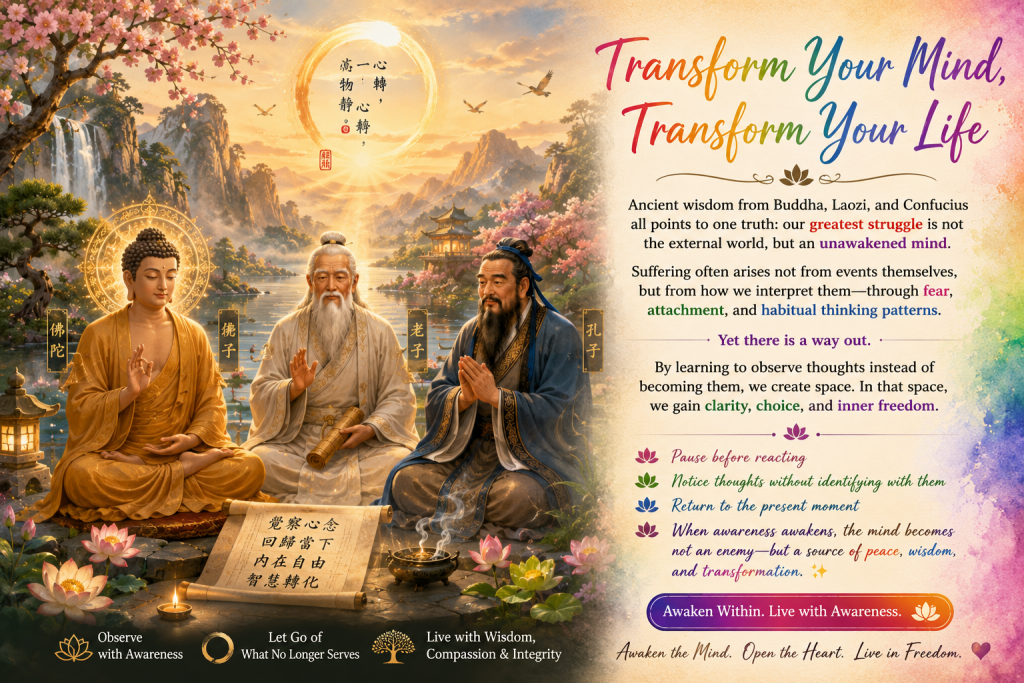
In traditional Chinese philosophy and Eastern spiritual wisdom, there is a shared core insight:
The deepest source of human suffering is often not the external world, but the activity of one’s own mind.
In modern terms, we might say: our greatest struggle often happens within our own thinking mind. This is not a rejection of thought itself, but a reminder of something deeper:
When the mind is not observed, it can become the very source of suffering.
Buddha, Laozi, and Confucius each point to the same essential truth from different perspectives: inner awakening is more important than external control.
🙏 The Buddha’s Perspective: The Mind Creates Experience 🙏
One of the central teachings in Buddhism is: “All phenomena arise from the mind.”
This means that our experience of reality is largely shaped by how the mind interprets it. External events themselves do not necessarily create suffering. Rather: Attachment 🐞 aversion 🐞 illusion 🐞 fear 🐞 craving
transform neutral experiences into pain and distress. Therefore, the Buddha emphasized:
🧠 True practice is not about changing the world but understanding the mind. 🧠
- Without awareness, the mind becomes like a runaway chariot—driven by anxiety, desire, and grasping.
- With awareness, however, the mind begins to settle, and suffering naturally decreases.
🧘♂️ Laozi’s Perspective: Excess Thinking Disrupts Natural Harmony 🧘♂️
The Tao Te Ching teaches: “In pursuit of knowledge, one gains every day; in pursuit of the Way, one loses every day.”
Laozi is not rejecting thinking itself, but pointing out that:
- excessive analysis
- excessive control
- excessive judgment
can disconnect us from the natural flow of life. His idea of wu wei (non-forcing) does not mean doing nothing, but rather: not being driven by compulsive thought and mental resistance.
- When the mind becomes overly active, inner peace is disturbed.
- When we return to naturalness, clarity and wisdom emerge on their own.
☯️ Confucius’ Perspective: Self-Cultivation Begins with the Mind ☯️
Confucian teaching focuses not on escaping the world, but on refining the inner self through daily life.
Confucius spoke of “self-discipline and returning to propriety,” which refers to:
- becoming aware of desires
- regulating emotional reactions
- restoring balance in behavior
Because when a person is controlled by impulses and emotions, judgment becomes distorted. Thus, Confucius emphasizes:
True cultivation is the ability to govern one’s inner responses rather than being governed by them.
🧠 Why Is “the Mind Our Greatest Enemy”? 🧠
From the intersection of ancient wisdom and modern psychology, we can understand this as:
① Thoughts shape our experienced reality
The same situation can be interpreted as: an opportunity, or a threat
The difference is not the event, but the interpretation.
② Automatic thinking repeats old patterns
The brain often replays: past trauma, failure memories, fear-based predictions
These may not reflect reality yet feel real.
③ Emotions reinforce thoughts
Fear generates fearful thoughts. Anxiety produces more anxious narratives.
This creates a self-reinforcing cycle.
④ An unawakened mind becomes an inner battlefield
Without awareness: thoughts conflict with thoughts, emotions clash with emotions, past influences the present, The mind becomes a field of internal struggle.
🙏 The Shared Solution from the Three Teachings 🙏
Despite different languages, Buddha, Laozi, and Confucius point toward the same direction:
🪷 Buddha: Awareness (Observing the Mind)
To see thoughts without becoming them.
☯️ Laozi: Natural Flow (Non-forcing)
Not being pulled by compulsive mental activity.
🕉 Confucius: Self-Cultivation
Bringing one’s behavior and reactions back into balance.
🫀 How to Move from Mental Reactivity to Inner Clarity 🫀
Here are practical approaches:
① Observe thoughts instead of following them
Practice saying:“A thought is arising.”
Rather than: “This is reality.” This creates space for awareness.
② Distinguish facts from interpretations
Ask: What actually happened? What am I adding through my thinking?
Much suffering comes from confusion between the two.
③ Pause before reacting
When emotion arises, pause for three breaths.
This turns reaction into choice.
④ Reduce mental noise
Not by suppressing thoughts, but by reducing repetitive unconscious thinking such as: replaying the past, worrying about the future, self-criticism loops
⑤ Return to the body and present moment
The body is an anchor to reality: breath, sensations, movement
The present moment is always more real than thought.
🧠 Conclusion: The Real Enemy Is Unawareness 🧠
Buddha, Laozi, and Confucius all point to one essential truth: Suffering does not arise from the world, but from an unobserved mind.
When the mind operates unconsciously, it can feel like an enemy:
- generating fear
- reinforcing attachment
- amplifying problems
- distorting reality
But when awareness arises, the same mind becomes:
- a source of wisdom
- a center of stability
- a field of clarity
- a gateway to freedom
✨ The deepest transformation is not controlling the mind, It is seeing the mind clearly, without being controlled by it.
When this happens, the external world may remain the same—but the world you experience within completely changes.
💚🧠💛🫀💜💚🧠💛 💙🫀💜💚🧠💛 💙🫀💜💚🧠💛🫀💚