🧘♂️ This morning, while meditating, I suddenly noticed that my mind was unusually restless. 🧘♂️ My body was sitting there, but my mind seemed to have travelled somewhere far away. 🧘♂️ Instead of blaming myself or forcing my mind to become quiet, I began observing my body and my inner responses.
In that moment, I suddenly recognized a habit I had not fully noticed before:
Every morning, almost the first thing I do is reach for my phone.
The moment I open it, thousands of messages, notifications, news stories, videos, and pieces of information immediately enter my consciousness. My brain has barely awakened, yet the noise of the world has already entered. I begin to feel:
- “I don’t have enough time.”
- “I need to quickly see what is happening.”
- “I can’t miss anything.”
And so, my mind begins chasing.
- One message after another.
- One video after another.
- One piece of news after another.
My attention is constantly being pulled in different directions.
🧘♂️ When I finally sit down to meditate, I realize that my body is here, but my thoughts have already flown in every direction. At that moment, I understood something important:
The phone itself may not be the greatest problem. The deeper issue is that we have gradually handed over our attention—and sometimes our sense of control—to it.
🪷 The Phone May Be Taking the Most Precious Thing We Have—
Our Attention 🪷
The phone itself is not evil. It can help us stay connected with family members who live far away. It can help us work, learn, read, create, navigate, and access important information. What deserves our attention is something deeper:
Have we moved from using our phones to being used by them?
When we reach for our phone whenever we have a free moment, when silence makes us uncomfortable, and when we feel compelled to check the screen while eating, walking, waiting, or even talking with someone we love, perhaps it is time to pause and ask ourselves:
“Do I truly need my phone right now, or has my brain simply become accustomed to seeking the next stimulation?”
This is not necessarily a matter of weak willpower.
Modern smartphones and social-media platforms use mechanisms such as notifications, infinite scrolling, recommendation algorithms, and immediate feedback to capture and maintain our attention. Therefore, phone dependency should not simply be viewed as a failure of self-discipline.
👉 We are living in an age where our attention is constantly being competed for.
👉 We must therefore relearn something essential: How to reclaim our attention.
🪷 Information Is Bringing the World Closer, Yet People May Be Drifting Further Apart 🪷
This is one of the deepest things I have noticed. Our phones have brought the world closer than ever before. Within seconds, we can see what is happening on the other side of the planet. But perhaps we should also ask:
As the world becomes closer to us, are we becoming further away from the people right in front of us?
- We sit around the same dinner table while each person looks down at a screen.
- We meet friends but constantly check notifications.
- We spend time with our children while our attention is being pulled toward the phone.
- We talk with our partner while secretly waiting for the next message.
Technology allows us to connect with people far away. But without awareness, it can also cause us to overlook the people who are right beside us. The most precious things in life are often not found on a screen.
They are found in a sincere look.
- A meaningful conversation.
- A meal shared with family.
- A hug from a friend.
👉 The warmth of morning sunlight.
👉 The feeling of wind moving through nature.
And that moment when we finally become quiet enough to hear our own inner voice.
Blue Light: Why Can Nighttime Screen Use Affect Sleep?
Phones, tablets, and computer screens emit visible light that includes short-wavelength blue light. Blue light itself is not “toxic.”
In fact, exposure to natural light during the daytime—including blue wavelengths—is an important signal for maintaining our normal circadian rhythm and alertness.
The concern is what happens when we receive bright light late at night.
Our brains may interpret that light as a signal that it is still daytime.
Research suggests that exposure to bright screens in the evening can suppress the normal release of melatonin, delay the body’s internal clock, and make falling asleep more difficult. Therefore, the issue with nighttime phone use is not simply “blue light.”
It also involves: Screen brightness. How long we have used the device. The information we consume before bed. Emotional stimulation from social media. Stress caused by news and work messages. And the tendency to delay bedtime because we continue scrolling.
Blue Light and the Eyes
Long periods of staring at a phone screen can contribute to:
Eye strain. Dry or irritated eyes. Temporary blurred vision. Headaches or visual discomfort.
One important reason is that we tend to blink less when concentrating on screens.
At present, there is not sufficient evidence to conclude that ordinary exposure to smartphone screen light directly causes permanent retinal damage.
So there is no need to fear the words “blue light.” A more practical approach is to reduce prolonged, close-up, uninterrupted screen viewing.
Blue Light and the Brain
Blue light plays an important role in regulating the body’s circadian rhythm. During the day, this can be beneficial.
At night, however, excessive exposure to bright screens may interfere with our biological clock and keep the brain more alert than we want it to be. Therefore, what we need to protect is not only our eyes. We also need to protect our:
Attention. Sleep rhythm. Emotional stability. Ability to recover mentally.
Blue Light and Sleep Quality
If you habitually scroll on your phone before going to bed, you may find that you:
- Feel sleepy later.
- Take longer to fall asleep.
- Sleep for fewer hours.
- Have a mentally overactive mind before bedtime.
- Feel less refreshed the next day.
And the problem may not be blue light alone. If you are reading upsetting news, stressful messages, stimulating videos, or constantly comparing yourself with others before bed, your body may be lying in bed while your mind remains in a state of constant reaction. Therefore, true nighttime recovery is not simply about switching on a “night mode.”
It is about: Giving your brain permission to step away from the world.
🪷 We Don’t Need to Abandon Technology—We Need to Change Our Relationship With It 🪷
I don’t believe we need to completely reject technology.
Technology can serve humanity. But technology should not become our master.
We can create a healthier relationship with it:
I use my phone; my phone does not use me.
This is a profound shift in awareness.
🙏 Give Yourself the First Hour of the Day 🙏
Starting today, try a simple experiment:
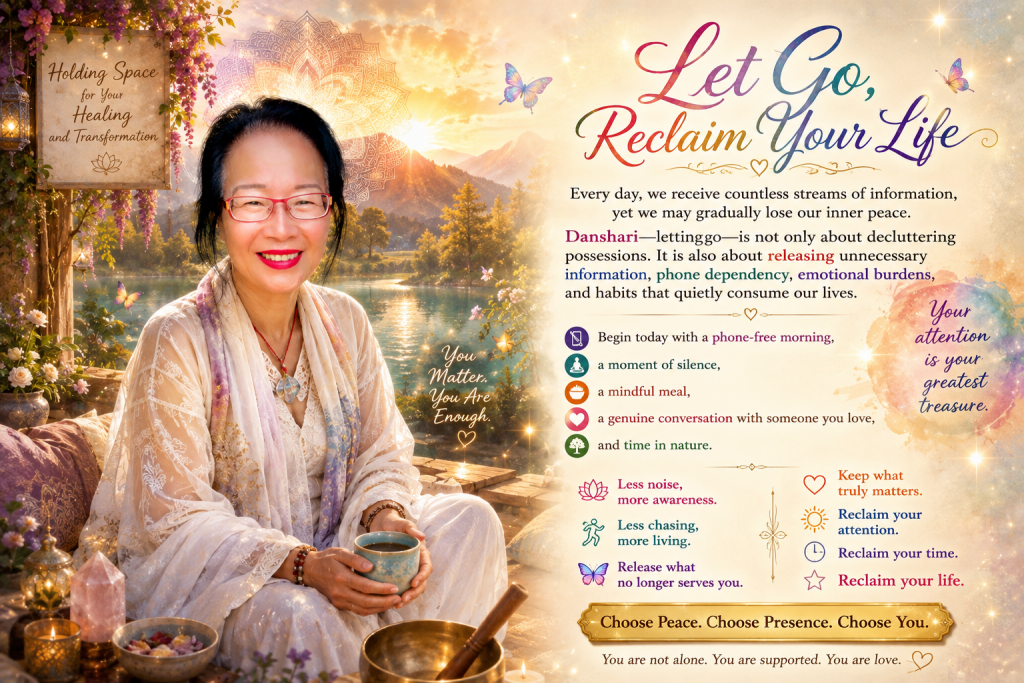
- Don’t look at your phone during the first hour after waking.
- Don’t begin with the news.
- Don’t begin with social media.
- Don’t begin by answering messages.
- Don’t allow the world to immediately tell you what you should care about today.
Give yourself time to wake up.
Drink some water. 🌟 Breathe. 🌟 Stretch. 🌟 Meditate. 🌟 Take a walk. 🌟 Write in a journal. 🌟 Look out the window. 🌟 Feel the sunlight.
Ask yourself: “How do I truly want to experience my life today?”
That first hour is a way of telling your brain: “My attention belongs to me.”
🙏 Give Yourself the Last Hour Before Sleep 🙏
Try to stay away from your phone and other stimulating screens for at least an hour before bed.
- Dim the lights.
- Read something that genuinely nourishes your mind.
- Listen to calming music.
- Practice a few minutes of conscious breathing.
- Talk with your family.
- Think of three things you are grateful for today.
Let your mind know: “The day is complete.” You don’t need to chase any more information.
🙏 When You Eat, Let Food Become Your Companion 🙏
- Put your phone away during meals.
- Don’t scroll while eating.
- Actually taste your food.
- Look at the person sitting across from you.
- Listen to what they are saying.
- Allow a meal to become an opportunity for genuine human connection again.
🙏 Create Phone-Free Spaces 🙏
You can begin by creating a few phone-free areas in your home:
- The dining table.
- The bedroom.
- Your meditation space.
- The place where you talk with your family.
- You can even create a daily “phone-free walk.”
Teach yourself again: “I don’t need constant stimulation in order to be okay.”
🙏 Turn Off Unnecessary Notifications 🙏
This is simple but surprisingly powerful. Not every notification deserves your immediate attention. Turn off unnecessary sounds, vibrations, and pop-ups.
Let the things that truly matter reach you, rather than allowing every application to compete for your attention.
🙏 Practice the 20-20-20 Eye Rule 🙏
If you spend long periods using screens, try the following:
Every 20 minutes, look at something at least 20 feet away, for approximately 20 seconds.
Remember to blink regularly, take appropriate breaks, and adjust your screen brightness and viewing distance.
If you experience persistent eye pain, significant changes in vision, or other concerning symptoms, seek an eye-care professional’s advice.
🙏 Relearn How to Be Bored 🙏
Perhaps this is one of the most important practices of all. We have become so accustomed to filling every empty moment.
- Waiting for a bus? Look at the phone.
- Sitting down? Look at the phone.
- Going to the bathroom? Look at the phone.
- Nothing happening? Look at the phone.
But: Boredom is not the enemy.
👉 Sometimes creativity is born from boredom.
👉 Sometimes insight emerges from silence.
👉 Sometimes our deepest conversations with ourselves require empty space.
When you stop rushing to fill every second, your mind finally has room to speak.
🙏 Create a Daily Digital Detox 🙏
You don’t need to make an extreme change overnight. Start with 30 minutes a day. Then gradually increase it to an hour. During that time:
- No phone.
- No news.
- No social media.
- No following other people’s lives.
👉 Simply return to your own life.
Go for a walk. Read. Exercise. Spend time in nature. Talk with your family. Meet a friend. Create something. Meditate. Breathe. Live.
🙏 Finally, I Want to Say This to Myself and to Everyone Reading 🙏
👉 Your phone has not necessarily stolen your life.
👉 Often, without realizing it, we have given away some of the most precious parts of our lives.
- We gave away our attention.
- We gave away our time.
- We gave away our sleep.
- We gave away our silence.
And sometimes, we even gave away our genuine connection with the people beside us. So, starting today:
- Don’t blame yourself.
- Don’t tell yourself that you simply lack willpower.
And don’t fight with your phone. Instead, slowly reclaim your attention.
🎁 Give the first hour of the morning back to your soul.
🎁 Give the last hour of the evening back to your body.
🎁 Give your attention back to your food and your family during meals.
- When you are with friends, truly be there.
- When you walk through nature, keep your phone in your pocket.
- When you meditate, allow the world to become quiet.
Because life is not truly happening on the screen.
💖 Life is happening in the breath you are taking right now.
💖 Life is happening in the person sitting in front of you.
💖 Life is happening in the sunlight, the trees, the wind, the earth, and the sky.
💖 Life is happening in the moment when you genuinely feel yourself again.
Perhaps digital detox is not about abandoning the world.
Quite the opposite. It is about returning to the world.
👉 Returning to your body.
👉 Returning to your breath.
👉 Returning to your family.
👉 Returning to genuine human connection.
👉 Returning to nature.
👉 Returning to inner stillness.
Don’t let your phone become the first world you see when you wake up.
And don’t let it become the last world you see before you sleep.
💚 Give the first hour back to yourself.
💚 Give the last hour back to yourself.
💚 Give your attention back to yourself.
💚 And then, come back and live your life again.