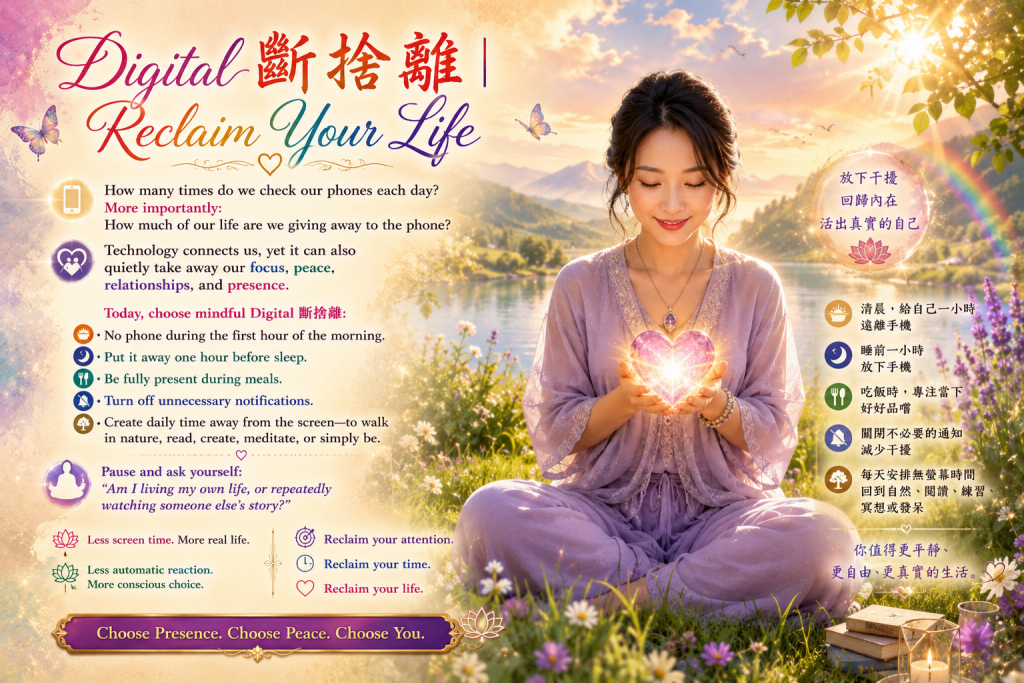
🙏 Are You Living Your Own Life—or Repeatedly Experiencing Someone Else’s Story? 🙏
How many times do we pick up our phones every day?
According to various smartphone-use surveys, Americans may check their phones more than 200 times a day on average, while some studies and surveys estimate even higher numbers among certain groups. Some data also suggest that many people check their phones within minutes of waking up, and some routinely use them while eating, waiting, using the bathroom, or even spending time with family and friends.
The most important question is not simply, “How many times do I check my phone?”
The deeper question is: “How many times a day am I giving my attention away?”
And even deeper: 🙏 “Am I truly living my own life, or am I repeatedly experiencing someone else’s story?” 🙏
We wake up, and before we have truly felt our own body, we check the news.
Before we listen to our inner voice, we listen to everyone else’s voice.
Before we decide who we want to be today, social media has already shown us what other people are doing, buying, eating, thinking about, and arguing over—and what we should supposedly care about.
- One video follows another.
- One story follows another.
- One person’s life follows another person’s life.
👉 We watch other people travel.
👉 We watch their successes.
- Their relationships.
- Their arguments.
- Their fears.
- Their happiness.
Without realizing it, we become spectators of countless stories while forgetting that we are supposed to be the main character in our own life.
🙏 What Does Smartphone Addiction Actually Consume? 🙏
Phone dependency is not simply about losing a few hours. What deserves our attention is the possibility that constant smartphone use can gradually influence how our brain directs attention, processes information, and responds to our environment.
- We may begin to experience: Fragmented attention.
- We read a few pages and suddenly want to check our phone.
- We work for several minutes and feel compelled to look at a notification.
- We are talking to someone while simultaneously wondering whether something new has appeared on our screen.
Sometimes, even when there is no notification, we instinctively reach for the phone.
👉 This is not necessarily a simple matter of having “no self-control.”
Modern digital platforms make extensive use of notifications, recommendation algorithms, infinite scrolling, and immediate feedback, all of which can encourage us to anticipate the next stimulus. Over time, we may develop an automatic loop:
Stimulus → Checking → Brief reward → Boredom → Checking again.
We think we are taking a break. But our brain may never truly stop receiving information.
🙏 How Can Excessive Phone Use Affect the Brain? 🙏
1. Attention Becomes Fragmented
Frequent phone checking can repeatedly interrupt whatever we are doing.
When we are reading, writing, working, or having a conversation, a notification can pull our attention away. Even if we look for only a few seconds, returning to deep concentration may take additional time.
Over time, we may become increasingly accustomed to short, rapid, fragmented information rather than the patience required for deep reading and thoughtful reflection.
2. Deep Thinking Can Become More Difficult
👉 Our most meaningful ideas rarely emerge while rapidly scrolling through a screen.
👉 Creativity needs space.
👉 Insight needs silence.
👉 Wisdom needs time to settle.
If every empty moment is filled with our phones, we rarely give the brain genuine periods of quiet and minimal input.
🧘♂️ And sometimes, our best ideas appear precisely when we are looking at nothing. 🧘♂️
3. The Brain Can Become More Dependent on Instant Stimulation
Short-form videos, notifications, comments, likes, and constantly changing content can provide quick feelings of reward.
The brain can gradually learn: “Whenever I feel bored, reach for the phone.”
Eventually, silence may feel uncomfortable. Waiting may feel unbearable. And without the phone, we may no longer know how to simply be with ourselves.
4. Sleep Quality Can Be Affected
Extended phone use before bedtime, especially stimulating content, can keep the mind active. Screen light can also affect our natural circadian rhythm.
But the issue is not only blue light. It is also what we are consuming before sleep.
If we see upsetting news, anxiety-provoking messages, or stimulating videos before bed, our bodies may be lying down while our minds remain highly alert.
The body is resting, but the mind is still running.
5. Our Emotions Can Become More Easily Influenced
If checking the news and social media is the first thing we do each morning, we may allow the outside world to determine our emotional state before we have even chosen it for ourselves.
- Someone else’s anger becomes our anger.
- Someone else’s fear becomes our fear.
- Someone else’s success becomes our comparison.
- Someone else’s lifestyle becomes the source of our dissatisfaction.
This is why digital decluttering matters.
Not everything that enters your eyes deserves to enter your heart.
6. Relationships Can Be Eroded by the Screen
- We may sit beside the people we love while mentally living somewhere else.
- Checking the phone during dinner.
- Looking at notifications while someone is talking.
- Scrolling while spending time with our children.
- These may seem like small behaviors, but over time they can gradually weaken genuine human connection.
Technology brings distant people closer to us. But without awareness, it can also push the people standing directly in front of us farther away.
7. We Can Lose the Ability to Be Alone With Ourselves
Perhaps this is the deepest issue. When we reach for our phones every time we have a free moment, we lose opportunities to simply be with ourselves.
- We stop thinking while walking.
- We stop observing while waiting.
- We stop feeling while being quiet.
- We stop creating when we are bored.
We fill every empty space with information. But:
💜 Emptiness is not wasted time. 💜
💜 Emptiness is space for the soul to breathe. 💜
🙏 So What Does Digital 斷捨離 Really Mean? 🙏
- It does not mean throwing away your phone.
- It does not mean rejecting technology completely.
True digital decluttering means rebuilding the relationship: “I use my phone. My phone does not use me.”
- We do not need to escape the modern world.
- We simply need to reclaim our ability to choose.
To move from automatic reaction back to conscious choice.
🪷 Practice 1: Create a Phone-Free First Hour
For the first hour after waking up, do not look at your phone. Do not allow the world to tell you immediately:
- What you should care about today.
- What happened to someone else.
- Who succeeded.
- Who failed.
- Who is arguing.
First ask yourself: “How do I want to live today?”
Drink water. Breathe. Stretch. Meditate. Write in your journal. Go outside. Feel the sunlight.
💜 Let your first thoughts belong to you. 💜
🪷 Practice 2: Create a Phone-Free Final Hour
Put your phone away at least one hour before sleep. Allow your mind to gradually withdraw from the information world.
Read. Breathe. Stretch. Take a bath. Talk with your family. Reflect on what happened today. Practice gratitude.
Remind yourself: “Today was enough.”
🪷 Practice 3: Turn Off Unnecessary Notifications
Not every notification deserves an immediate response. Turn off unnecessary:
Sounds. Vibrations. Pop-ups. Social-media notifications. News alerts.
Allow important things to reach you when necessary. Do not allow every application to compete for your attention.
🪷 Practice 4: Create a “Phone Parking Place”
When you arrive home, place your phone in one designated location. Do not allow it to follow you everywhere. Put it there during meals.
During conversations with family. While reading. While meditating.
Let the phone know: “You are not the master of this household.”
🪷 Practice 5: Create a Phone-Free Dining Table
- Do not use your phone while eating.
- Bring your attention back to the food.
- Back to the person sitting across from you.
- Back to conversation.
- Back to the present moment.
Allow a meal to become part of real life again, rather than another moment occupied by a screen.
🪷 Practice 6: Learn to Be Bored Again 🪷
This is an extremely important practice.
- Waiting for a bus? Don’t reach for your phone.
- Walking? Don’t reach for your phone.
- Sitting in a park? Don’t reach for your phone.
Allow yourself to do nothing. At first, it may feel uncomfortable. But don’t immediately escape. Because:
🙏 When the brain is no longer constantly stimulated, it has an opportunity to hear its own voice again. 🙏
👉 Perhaps a new idea suddenly appears.
👉 Perhaps a question you have carried for years suddenly becomes clearer.
👉 Perhaps you rediscover: “I don’t need to be constantly entertained in order to be happy.”
🪷 Practice 7: Schedule Daily “Real Life” Time
Set aside at least 30 minutes to an hour each day without your phone.
No news. 🌱 No social media. 🌱 No scrolling. 🌱 Do something that truly belongs to you. 🌱 Read a book. 🌱 Exercise. 🌱 Cook. 🌱 Paint. 🌱 Write. 🌱 Garden. 🌱 Walk. 🌱 Meet a friend. 🌱 Spend time with family. 🌱 Connect with nature. 🌱 Or simply sit quietly.
🙏 Bring your life back from the screen. 🙏
🪷 Practice 8: Create an “Information Diet”
We care deeply about what we put into our bodies. But how often do we consider what we are feeding our minds?
Ask yourself: “If information were food, what am I feeding myself today?”
Fear? 🌱 Anger? 🌱 Gossip? 🌱 Comparison? 🌱 Arguments? 🌱 Or knowledge, creativity, wisdom, compassion, and meaningful ideas?
You do not need to know everything happening in the world.
🙏 Knowing more does not necessarily mean living better. 🙏
🙏 Sometimes, less information gives us more life. 🙏
🪷 Practice 9: Ask Three Questions Before Picking Up Your Phone
Every time you feel the urge to pick up your phone, pause for three seconds. Ask:
- “Why am I checking this right now?”
- “Do I actually need it?”
- “After I check it, will I feel clearer—or more distracted?”
If the answer is simply:
- “Because I’m bored.”
- “Because it’s a habit.”
- “Because I don’t know what else to do.”
🎁 Then congratulations. You have just seen your pattern. 🎁
🎁 And seeing the pattern is the beginning of changing it. 🎁
🪷 Practice 10: Don’t Pursue Perfection—Pursue Awareness
If you spend two hours scrolling today, don’t attack yourself.
👉 Don’t say: “Why do I have no self-control?”
👉 Instead ask: “What happened just before I started scrolling?”
- What triggered me?
- Was I tired?
- Anxious?
- Lonely?
- Bored?
- Was I avoiding something?
Finding the trigger is more powerful than blaming yourself. Because what we ultimately need to declutter is not merely the phone.
It is the automatic pattern of constantly escaping our own inner state.
🪷 Finally, Ask Yourself One Truly Important Question 🪷
Every day, we watch other people’s lives.
🌟 Their travels.
🌟 Their relationships.
🌟 Their successes.
🌟 Their bodies.
🌟 Their homes.
🌟 Their careers.
🌟 Their opinions.
🌟 Their arguments.
🌟 Their stories.
So today, I invite you to stop and ask:
🪷 “Am I living my own life—or am I repeatedly experiencing someone else’s story?” 🪷
- If we spend enormous amounts of time watching other people’s lives, who is writing ours?
- If algorithms choose the next video for us, who is choosing our attention?
- If every notification makes us immediately react, who truly owns our time?
- If the first thing we do every morning is enter someone else’s world, when does our own world begin?
🙏 Perhaps true digital 斷捨離 does not begin with the phone. It begins with awareness. 🙏
👉 We do not need to reject technology.
👉 We simply need to refuse to let technology decide the direction of our lives.
💜 Give the first hour back to yourself.
💜 Give the final hour back to yourself.
💜 Give mealtimes back to your family.
💜 Give walks back to nature.
💜 Give quiet moments back to your soul.
💜 Give your attention back to yourself.
Because your attention is part of your life.
🪷 Where you place your attention is where a portion of your life is actually being lived. 🪷
So beginning today:
🌱 Less watching other people’s stories. More living your own.
🌱 Less automatic reaction. More conscious choice.
🌱 Less information noise. More inner wisdom.
🌱 Less screen life. More real life.
🌎 斷捨離 does not mean leaving the world. 🌎
🧘♂️ It means returning to your own world. 🧘♂️
🎁 Do not let your phone decide the direction of your life. 🎁
💖 Take back your attention.
💖 Take back your time.
💖 Take back your choices. And then—
🪷 Live your own story again 🪷

Thank you for sharing this very important message, i’m glad i found your blog, your practical tips will be very helpful 🙏
Our awakened soul, thanks for your beautiful acknowledgement; your wise words encourage me to share my light and love with humanity. May we continue to bring the best out of each other and shine our brilliant light.
Much love and blessings to you…. Lai Ping