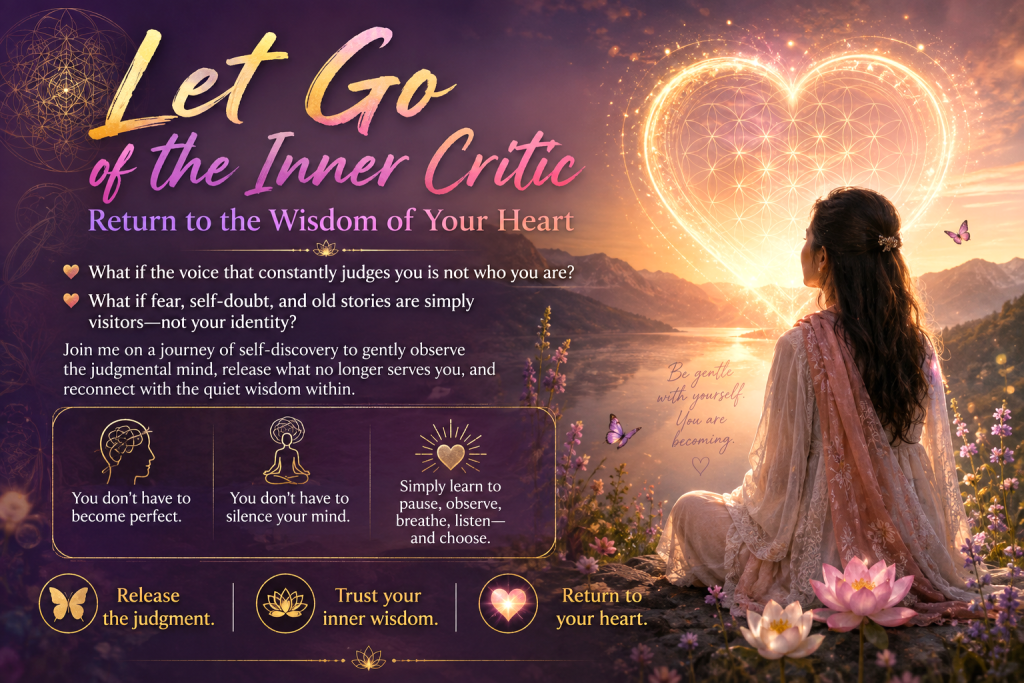
💜 Releasing Judgment, Returning to the Heart, and Remembering the Wisdom Within 💜
For many of us, the loudest voice standing between us and our dreams is not another person.
It is the voice inside our own head. I know this voice well.
I can create something from my heart, feel inspired for a moment, and then suddenly the inner critic arrives:
- Is this good enough?
- Who would care?
- What if people judge me?
- What if I am not talented enough?
- What if my words are not powerful enough?
And before anyone else has even had a chance to respond, I have already judged myself. I have discovered that sometimes the person standing most firmly in the way of our own expression is ourselves.
But I am learning something different.
The answer is not to fight the inner critic.
It is to become aware of it.
- To listen without obeying.
- To recognize the judgment without becoming the judgment.
And, most importantly, to return to a deeper place within ourselves. The heart. 💛
🧠 The Inner Critic Is Not the Enemy 🧠
Our judgmental mind often develops for a reason. It may have been learned to protect us from rejection, embarrassment, failure, disappointment, or criticism. It whispers:
- “Don’t do that. You might fail.”
- “Don’t share that. People might laugh.”
- “Don’t take the risk. Stay safe.”
The problem is that a voice originally created to protect us can eventually become a voice that prevents us from living.
👉 So instead of saying, “I hate my inner critic,”
👉 try saying: “I see you.”
👉 “I know you’re trying to protect me.”
👉 “Thank you.” “But I choose what happens next.”
❤️🔥 This is the beginning of inner freedom. ❤️🔥
💜 Practice One: Become the Observer 💜
When judgment arises, don’t immediately believe it. Pause. Take a breath.
🙏 And notice: “Judgment is happening.”
🙏 There is a profound difference between: “I am a failure.”
🙏 and: “I am having the thought that I am a failure.”
- The first statement identifies you with the thought.
- The second creates space around it.
In meditation, we learn to watch thoughts come and go. We can do the same with judgment. Observe it. Feel where it appears in the body.
- Notice the words.
- Notice the emotional reaction.
And simply say: “This is a thought. I don’t have to become it.”
👉 You are not trying to suppress the mind.
👉 You are developing the awareness that can witness the mind.
💜 Practice Two: Question the Judge 💜
When your inner critic speaks, ask it four simple questions:
· Is this true?
· Is this completely true?
· Where did I learn to believe this?
· Would I speak to someone I love this way?
These questions can interrupt years of unconscious programming.
👉 Perhaps the voice says: “Nobody wants to hear what I have to say.”
👉 Ask: Do I actually know that?
👉 Perhaps it says: “My work isn’t good enough.”
👉 Ask: According to whose definition of good enough?
👉 Perhaps it says: “I am not confident.”
👉 Ask: What would I do today if I didn’t need to feel confident first?
Sometimes we discover that the critic isn’t giving us truth.
🙏 It is giving us an old interpretation of reality. 🙏
💜 Practice Three: Separate the Emotion from Your Identity 💜
An emotion is real. But an emotion is not necessarily your identity.
- Fear can be present without being who you are.
- Self-doubt can be present without defining you.
- Sadness can be present without becoming your personality.
Imagine your emotions as visitors arriving at your home. You can acknowledge them. You can listen. You can learn. But you don’t have to give every visitor permanent residence. You might gently say:
- “I feel you. I hear you. I don’t need to fight you. And I don’t need to carry you forever.”
Then breathe. Let the body soften. Let the emotion move.
💜 Practice Four: Move from the Head to the Heart 💜
- The judgmental mind constantly asks: “Am I good enough?”
- The heart asks a different question: “Is this true for me?”
- The mind asks: “What will people think?”
- The heart asks: “What do I genuinely want to express?”
- The mind asks: “What if I fail?”
- The heart asks: “What is asking to be lived?”
When you feel confused, place your hand gently over your heart. Take three slow breaths. Then ask:
🙏 “What do I already know?”
🙏 “What is true for me right now?”
🙏 “What is my deeper wisdom trying to tell me?”
Don’t force an answer. Listen.
- Sometimes wisdom arrives as words.
- Sometimes as a feeling.
- Sometimes as a quiet knowing.
- Sometimes as nothing at all.
🧘♂️ Silence is also information. 🧘♂️
💜 Practice Five: Give Yourself Permission Before You Feel Ready 💜
One of the greatest traps of the inner critic is: “I’ll begin when I’m confident.”
But confidence often works in the opposite direction.
We act. We learn. We survive the discomfort. We discover that we are capable. And then confidence grows. So instead of waiting for confidence, practice saying:
🙏 “I am allowed to begin before I feel ready.”
🙏 “I am allowed to be imperfect.”
🙏 “I am allowed to learn in public.”
🙏 “I am allowed to change.”
🙏 “I am allowed to be a beginner.”
Your first attempt does not need to represent your final ability.
👣 It only needs to be your next honest step. 👣
💜 Practice Six: Replace Self-Judgment with Self-Inquiry 💜
- Instead of: “Why am I like this?”
- ask: “What is this experience teaching me?”
- Instead of: “What’s wrong with me?”
- ask: “What needs my attention?”
- Instead of: “Why can’t I do this?”
- ask: “What would help me take the next step?”
- Instead of: “I’m not good enough.”
- ask: “How can I support myself right now?”
🪷 This simple shift changes the relationship we have with ourselves. 🪷
The mind becomes less like a courtroom—and more like a laboratory for discovery.
💜 Practice Seven: Let Your Heart Speak Before Your Critic Edits 💜
For those who want to write, create, teach, or tell their story, try this: Set a timer for ten minutes. Write without editing.
No deleting. No correcting. No judging.
- Begin with: “What I really want to say is…” Then keep writing.
- If the critic interrupts, write: “Thank you. I’ll edit later.”
And continue. Your first responsibility is not to create something perfect.
It is to create something true. Editing has its place.
🪷 But don’t allow the editor to silence the storyteller before the story has even been born. 🪷
💚 The Heart Knows Through Experience 💚
Inner wisdom does not always sound like a dramatic revelation. Often, it is extraordinarily quiet. It may sound like:
- “This isn’t right for me.”
- “Take another step.”
- “Rest.”
- “Call that person.”
- “Tell the truth.”
- “Try again.”
- “Let go.”
We don’t necessarily discover inner wisdom by thinking harder.
🧘♂️ Sometimes we discover it by becoming quiet enough to hear what has been there all along. 🧘♂️
💖 A Five-Minute Heart Practice 💖
When you feel overwhelmed by judgment, try this simple practice:
1. Stop. Put down the phone. Close the computer. Pause whatever you’re doing.
2. Breathe. Take five slow, comfortable breaths.
3. Feel. Notice what is happening in your body without trying to change it.
4. Name. Say: “There is fear.” “There is judgment.” “There is uncertainty.”
Rather than: “I am afraid.” This creates space between awareness and experience.
5. Ask. Place your hand over your heart and ask:
“What do I need to know right now?” Then wait.
6. Listen. Don’t force an answer.
7. Choose. Ask:
🪷 “What is one small action aligned with my values that I can take today?” 🪷
Then take that step.
💖 From Self-Criticism to Self-Trust 💖
- Perhaps self-confidence isn’t about finally reaching a place where we never doubt ourselves.
- Perhaps it is something quieter.
Self-confidence is learning that we can trust ourselves even when doubt is present.
- I can be nervous and still speak.
- I can be imperfect and still create.
- I can be uncertain and still move forward.
- I can be criticized and still remain grounded.
- I can make mistakes and still love myself.
That is a different kind of confidence.
🙏 It doesn’t come from believing: “I will never fail.”
🙏 It comes from knowing: “Whatever happens, I will meet myself with compassion and keep walking.”
💖 The Invitation 💖
My fellow seekers,
- perhaps the journey is not about silencing the mind completely.
- Perhaps it is about changing our relationship with the mind.
The judgmental voice may still appear. Let it. Listen. Observe. Question. Then return to the heart.
- You do not have to believe every thought.
- You do not have to obey every fear.
- You do not have to carry every emotion.
And you do not have to wait for someone else to give you permission to become who you are.
🙏 Your inner wisdom has been walking with you all along.
🙏 Your heart has been speaking.
Perhaps the real practice is simply becoming quiet enough to hear it.
🧠 The mind may judge.
💚 The heart can witness.
🧠 The mind may fear.
💚 The heart can remain open.
🧠 The mind may say, “You are not enough.”
💚 The heart can whisper, “You already are.”
And perhaps self-realization begins here: not when the inner critic disappears,
but when we finally stop giving it the final word.
💜 Then we can breathe. Listen. Choose. And take the next step—from the heart. 💜