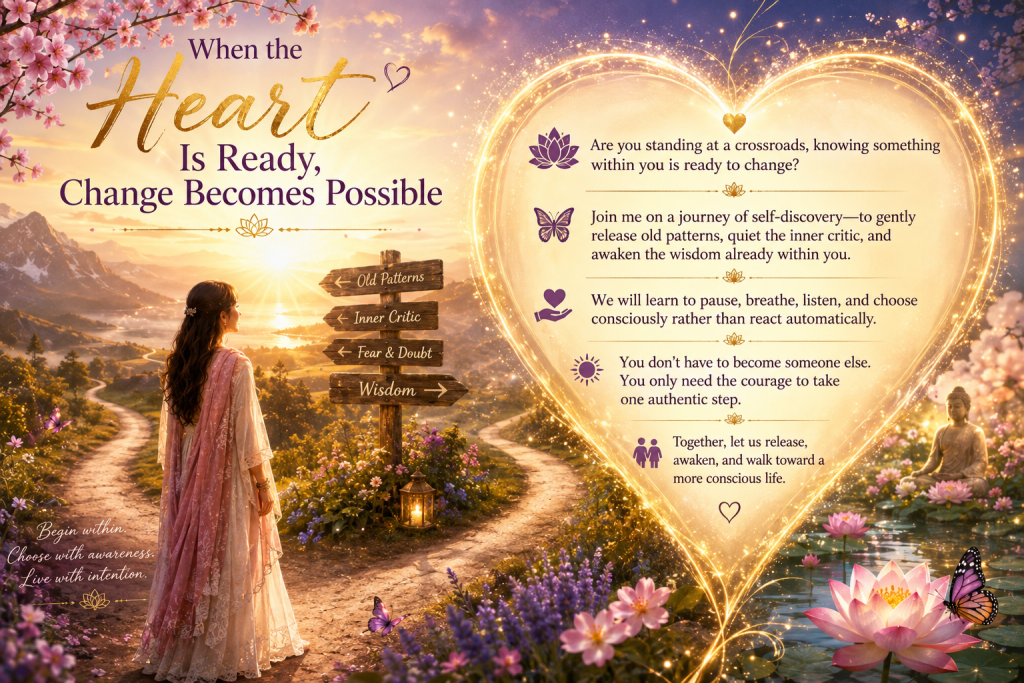
Understanding Resistance, Releasing the Old, and Opening the Door to Transformation
We often say: “I want to change.” We want to become healthier.
- More confident.
- More compassionate.
- More courageous.
- More authentic.
- More alive.
And yet, when the moment comes to actually change, something inside us resists.
- We procrastinate.
- We find excuses.
- We return to familiar habits.
- We doubt ourselves.
- We become uncomfortable.
Sometimes we even know exactly what we need to do—and still cannot seem to do it.
Why?
Because knowing that we want change and feeling safe enough to change are two different things.
🦋 Why Do We Resist Change? 🦋
1. The brain prefers the familiar
The human nervous system is designed to pay attention to potential threats and conserve energy. Familiar patterns require less mental effort than unfamiliar ones.
Even an unhealthy familiar life can feel safer than an uncertain new one. We may unconsciously think:
“I know this pain. I don’t know what is on the other side.”
🙏 And so we remain where we are. Not because we love the old pattern—but because the unknown can feel threatening.
2. Change threatens our identity
Sometimes the hardest thing to change isn’t behavior. It’s a belief about who we are.
- “I am not confident.”
- “I am not creative.”
- “I am not disciplined.”
- “I am too old.”
- “This is just the way I am.”
When a behavior becomes attached to our identity, changing it can feel like losing part of ourselves. Transformation therefore requires more than asking:
“What should I do differently?”
🙏 It can also require asking: “Who am I becoming?”
3. We fear losing something
Every change involves some form of letting go.
- A familiar routine.
- A relationship.
- An old identity.
- A predictable lifestyle.
Even a painful habit may provide something: comfort, certainty, distraction, or protection. So before demanding that ourselves change, we can compassionately ask: “What has this pattern been giving me?”
🙏 Understanding its protective function can reduce the need to fight it.
4. We fear failure—and sometimes success
Failure can trigger shame and disappointment. But success can also be frightening.
- What happens if people notice me?
- What happens if I actually succeed?
- Will expectations increase?
- Will I have to become someone different?
🙏 Sometimes we unconsciously sabotage ourselves because remaining small feels safer than becoming visible.
5. We expect transformation to happen instantly
We often imagine change as a dramatic breakthrough. But most meaningful transformation happens through hundreds of small choices.
- One healthier meal.
- One honest conversation.
- Ten minutes of meditation.
- One courageous post.
- One walk.
- One boundary.
- One moment of choosing awareness instead of an automatic reaction.
🙏 Small changes repeated consistently can eventually become a new way of living.
How Can We Reduce Resistance?
The answer is rarely to force ourselves harder. Resistance often softens when awareness, safety, compassion, and choice increase.
Here are several practices.
💖 Practice One: Don’t Fight the Resistance—Get Curious 💖
Instead of saying: “Why can’t I change?”
Ask: “What is my resistance trying to protect me from?”
- Perhaps it fears rejection.
- Perhaps failure.
- Perhaps uncertainty.
- Perhaps losing control.
- Perhaps being seen.
Approach the resistance with curiosity rather than judgment. You may discover that the part of you resisting change isn’t your enemy. It may simply be afraid.
💖 Practice Two: Make the Change Smaller 💖
Don’t ask: “How do I completely transform my life?”
Ask: “What is the smallest meaningful step I can take today?”
- If you want to write a book, write one paragraph.
- If you want to meditate, begin with five minutes.
- If you want to become a storyteller, tell one story to one person.
- If you want to become healthier, change one meal.
The objective is not to overwhelm the nervous system. It is to create evidence that change is possible.
💖 Practice Three: Use the Language of Choice 💖
Notice the difference between: “I have to.” And “I choose to.” “I have to exercise.”
- becomes: “I choose to care for my body.” “I have to stop this habit.”
- becomes: “I choose something that supports my well-being.”
Choice restores a sense of agency. And agency reduces helplessness.
💖 Practice Four: Visualize the Person You Are Becoming 💖
Close your eyes. Imagine yourself six months or one year from now. Not perfect. Not extraordinary. Simply more aligned.
- How do you walk?
- How do you speak?
- How do you respond to difficulty?
- What habits have you released?
- What qualities have become stronger?
Then ask: “What would that future version of me do today?”
Don’t attempt to become that person overnight. Simply take one step in their direction.
💖 Practice Five: Create a Pause Between Trigger and Reaction 💖
Much of our resistance happens automatically. Something triggers us.
- A thought appears.
- An emotion rises.
- And we immediately return to the old pattern.
Begin practicing a simple sequence: Pause → Breathe → Observe → Choose
Pause before reacting. Take one slow breath. Observe what is happening.
Then ask: “What response serves the person I want to become?”
That tiny space between stimulus and response can become one of the most powerful spaces in our lives.
💖 Practice Six: Replace Self-Judgment with Self-Compassion 💖
If you resist change, don’t immediately attack yourself.
- Instead of: “I failed again.”
- try: “I am learning.”
- Instead of: “Why am I so weak?”
- try: “Something here is difficult for me. What support do I need?”
Self-compassion is not giving ourselves permission to remain stuck. It creates the emotional safety necessary to try again. We are more willing to change when we no longer have to hate ourselves into changing.
💖 Practice Seven: Experiment Instead of Demanding Certainty 💖
You don’t need to know whether a new path will work forever. Try it. Experiment.
Observe. Adjust.
- Instead of: “This must be the answer.”
- say: “Let me explore this and see what I learn.”
Curiosity makes change lighter. You don’t have to leap into an entirely unknown life.
You can take one step and listen. Then another.
💖 Practice Eight: Celebrate Evidence of Change 💖
Our minds often notice what went wrong and ignore what went right. So deliberately record your small victories.
- Today I spoke up.
- Today I meditated.
- Today I didn’t react immediately.
- Today I chose differently.
- Today I created something.
- Today I kept a promise to myself.
These moments become evidence: “I am capable of change.”
And what we repeatedly demonstrate to ourselves becomes part of our new identity.
💜 The Deeper Transformation 💜
👉 Perhaps the purpose of change isn’t to become someone completely different.
👉 Perhaps it is to remove the layers that prevent us from expressing who we already are.
- The fear.
- The conditioning.
- The old stories.
- The automatic reactions.
- The identities we inherited.
- The beliefs we accepted without questioning.
🙏 Transformation can therefore become less about: “How can I become someone else?”
🙏 and more about: “What can I release so that more of my authentic self can emerge?”
💖 That is a very different journey. 💖
🙏 A Simple Daily Practice 🙏
Each morning, ask yourself three questions:
1. What am I ready to release?
A thought? A habit? A fear? An old story?
2. What quality do I want to cultivate?
Courage? Compassion? Wisdom? Patience? Authenticity?
3. What is one small action I can take today?
Then do it. At night, ask: “Where did I choose consciously today instead of reacting automatically?”
Don’t measure your life only by dramatic achievements. Measure it by moments of awareness.
💜 The Invitation to Change 💜
My fellow seekers,
👉 Perhaps resistance is not a wall designed to keep us trapped.
👉 Perhaps it is a doorway asking us to slow down and listen.
- Behind resistance there may be fear.
- Behind fear there may be an unmet need.
- Behind that need there may be an old belief.
And beneath all those layers may be something remarkably simple:
a longing to feel safe enough to become who we truly are. So don’t wage war against yourself.
- Meet yourself.
- Listen to yourself.
- Understand yourself.
And then choose. You don’t have to transform your entire life today.
🙏 You only have to become willing to take one conscious step. 🙏
Tomorrow, another. And another. Until one day you look back and realize:
👉 You didn’t force yourself into becoming someone new.
👉 You simply kept choosing what was more true.
And slowly,
- The old identity loosened.
- The old patterns lost their authority.
- The heart became clearer.
And the person you were always becoming began to emerge.
💜 Change begins when we stop fighting ourselves. 💜
💚 Transformation deepens when we begin listening. 💚
💖 And freedom begins when we realize: “I can choose what comes next.” 💖