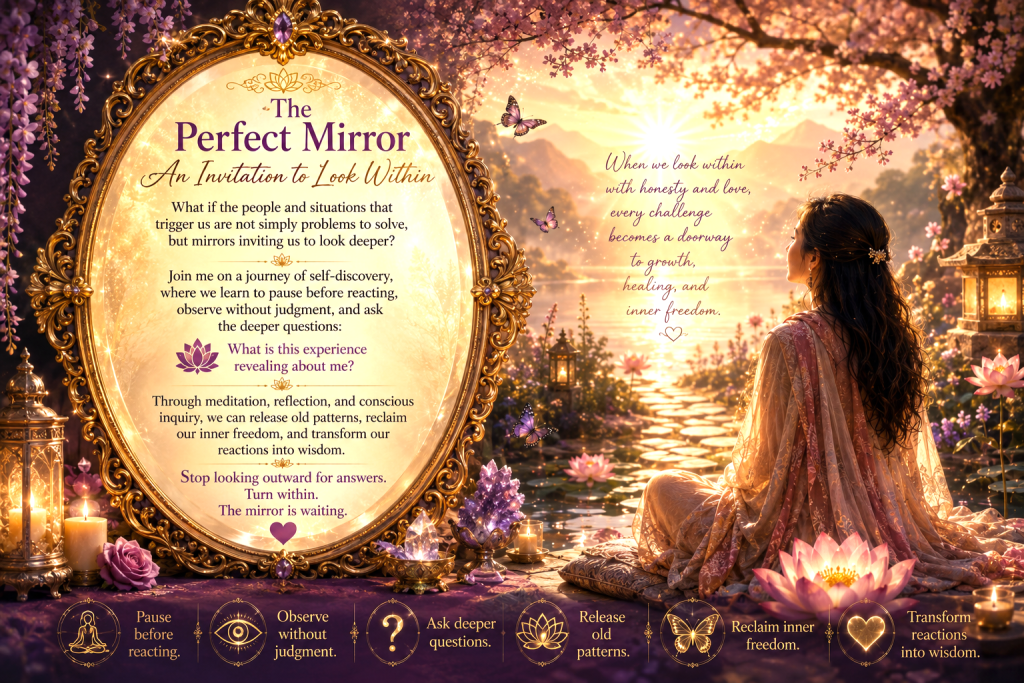
🪞 When Life Stops Being About Who Was Wrong—and Becomes an Invitation to Look Within 🪞
Last week, while I was at a Vipassana meditation center, I noticed a volunteer walking with a limp. I remembered meeting her about nine months earlier. She had been walking with a limp then, too, and although there seemed to be some improvement, she was still struggling.
My heart immediately went out to her. Wanting to help, I approached her and began sharing some of the natural wellness practices I have learned over the years. I mentioned warm foot soaks, gentle massage, and some traditional Chinese acupressure points that might help her relax and care for her feet. I was sharing from a place of genuine compassion and a sincere desire to be useful.
Then, before I had even finished explaining everything, she stood up and said, “That’s too much. I feel overwhelmed. I can’t do this.”
👉 I was surprised.
👉 I had poured my heart into trying to help, and suddenly I felt rejected. For a moment, my mind went exactly where minds often go:
- “But I was only trying to help.”
- “Why did she react like that?”
- “Didn’t she understand that I was coming from a good place?”
I felt upset. And then came the real practice.
🧘♂️ I sat down on my meditation cushion for an hour of Vipassana.
Instead of continuing to analyze her reaction, I turned my attention inward.
I watched. I listened. I observed the sensations in my body. And slowly, something deeper revealed itself.
🧘♂️ She was not the real problem.
The situation was showing me something about me.
🪞 Perhaps the Universe had placed a mirror in front of me.
I began to see how quickly I had attached myself to an old story:
I was helping. I knew what was best. My intentions were good. Therefore, the other person should receive what I was offering.
But was that really true?
🙏 Could my intention have been compassionate while my approach was still too much for another person?
🙏 Could I genuinely want to help someone while forgetting to first ask what kind of help they actually wanted?
And perhaps most importantly: 🪞 Why did her “no” affect me so deeply? 🪞
That question opened a much deeper door. I realized that the discomfort was not simply about what had happened between us. It touched something within me.
- An old identity.
- An old pattern.
- An old need to be understood.
- An old attachment to being helpful.
- An old expectation that when I offer something from my heart, it should be received in the way I intended.
Suddenly, the experience became much bigger than one conversation.
🙏 It became an opportunity for self-inquiry. 🙏
🪞 The Mirror Does Not Always Show Us What We Want to See 🪞
🎁 This is one of the gifts of inner work. 🎁 Life constantly gives us mirrors.
- Sometimes the mirror is a loving person.
- Sometimes it is conflict.
- Sometimes it is rejection.
- Sometimes it is disappointment.
- Sometimes it is someone simply saying: “No.”
Our first instinct may be to look outward:
👉 What did they do wrong?
👉 Why are they behaving this way?
👉 Why don’t they understand me?
But conscious living invites us to ask another question:
🎁 “What is this experience revealing about me?” 🎁
This does not mean blaming ourselves. It does not mean assuming that everything that happens is our fault. And it certainly does not mean ignoring inappropriate behavior or healthy boundaries.
🙏 It means recognizing that every experience contains information about our inner world. 🙏
The event may belong to the outside world. But our reaction belongs to us. And that reaction can become a doorway.
🪞 From Automatic Reaction to Conscious Inquiry 🪞
Before meditation, my reaction was immediate. I felt rejected.
- My mind created a story.
- My emotions followed the story.
But Vipassana gave me something precious: a pause.
Instead of automatically believing the story, I could observe it.
- I could feel the sensations.
- I could notice the disappointment.
- I could watch the desire to defend myself.
- I could notice the need to be understood.
And instead of asking: “Who is wrong?”
🪞 I could ask: “What is happening inside me right now?”
That question changes everything.
Because once we become curious about our own experience, we are no longer simply victims of our reactions.
🪷 We become students of our own consciousness. 🪷
🪞 The Deeper Questions 🪞
When something triggers us, perhaps we can pause before judging the other person and ask:
- What exactly am I feeling?
- What story am I telling myself about what happened?
- What expectation was violated?
- What am I trying to prove?
- Why does this matter so much to me?
Is this reaction completely about what is happening now—or is something older being touched?
What part of me wants to be seen, validated, appreciated, or understood?
And perhaps the deepest question:
🪷 “What is this moment here to teach me?” 🪷
We may not always like the answers. But that is where the real inner work begins.
🙏 Compassion Does Not Mean Control 🙏
This experience also taught me something important about compassion. Sometimes we genuinely want to help. But compassion is not only about what we want to give. It is also about having enough awareness to ask:
“Is this what the other person needs?”
- Someone may not be ready.
- Someone may not want our advice.
- Someone may need something completely different from what we think they need.
- And sometimes the most compassionate thing we can do is simply listen.
Allow. 💜 Respect. 💜 Give space. 💜 Love does not always mean doing more. 💜 Sometimes love means knowing when to step back.
🧘♂️ The Practice Continues 🧘♂️
My realization did not mean that I suddenly became free from all old patterns. Inner work doesn’t happen in one meditation.
It is a lifelong practice.
🧘♂️ Again and again, life will present us with situations that touch our conditioning.
🧘♂️ Again and again, the mind will want to react.
🧘♂️ And again and again, we have an opportunity to pause.
To breathe. To observe. To inquire. To release. To choose differently.
🧘♂️ This is why meditation is so precious to me. 🧘♂️
It teaches me not necessarily to prevent life from triggering me, but to become more conscious of what happens when I am triggered.
🪷 That awareness creates freedom. 🪷
🪞 Thank You for Being My Mirror 🪞
After my meditation, my feelings toward that woman had changed.
- I no longer saw her simply as the person who had rejected my attempt to help.
- I saw her as someone who had unknowingly revealed something within me.
And from my heart, I felt gratitude.
- Not because she had behaved in a particular way.
- Not because I was right or wrong.
- But because the experience gave me an opportunity to see myself more clearly.
🪞 She became my mirror. 🪞
And perhaps that is one of life’s greatest gifts:
- The people who trigger us can sometimes become our greatest teachers.
- Not because everything they do is right.
- Not because we must accept everything.
- But because our reactions can reveal places within ourselves that still need awareness, compassion, and healing.
🎁 The Invitation 🎁
The next time someone disappoints you, before immediately deciding that they are the problem, pause. Take a breath. Feel your body. Notice the story forming in your mind.
And ask: “What is this moment showing me about myself?”
- Perhaps you will discover an old wound.
- An unmet need.
- An expectation.
- An attachment.
- A fear.
- An identity.
- Or simply a habit of reacting automatically.
Whatever you discover, meet it with compassion.
- You don’t have to judge it.
- You don’t have to suppress it.
- You don’t have to become it.
- You can simply observe it.
🪷 And through observation, you create space. Through space, you create choice. Through choice, you create transformation. 🪷
🪞 Perhaps the greatest spiritual practice is not learning how to make everyone around us behave differently.
🪞 Perhaps it is learning how to meet life differently.
🙏 Not every conflict is an invitation to prove who is right. Some are invitations to look within. 🙏
And sometimes, the person we thought had disturbed our peace, has actually shown us, where our peace was not yet free.
🪞 That is the gift of the perfect mirror. 🪞
🪞 Life keeps reflecting.
🪞 Our practice is to keep looking.
🪷 And our freedom begins when we stop reacting automatically—and start asking deeper questions. 🪷
My personal experience using these natural Remedies to restore my feet: First, use hot water with Epsom salt, apple cider vinegar, and ginger to soak our feet; this method can also pull impurities and toxins out of our feet, and it can help improve blood circulation and restore our health. Second, use Chinese acupuncture points to massage our meridian points in the feet to increase blood flow and loosen up all the knots that are blocking our body from healing. Third, use black castor oil to massage meridian points in our feet, as castor oil not only penetrates deeper tissue in the body but also loosens the tightness in the muscles.
Do this for 7 days consistently; the result will amaze you.
This was very useful to read! I enjoy when you write of your vipassana practice, and where it’s a useful tool.