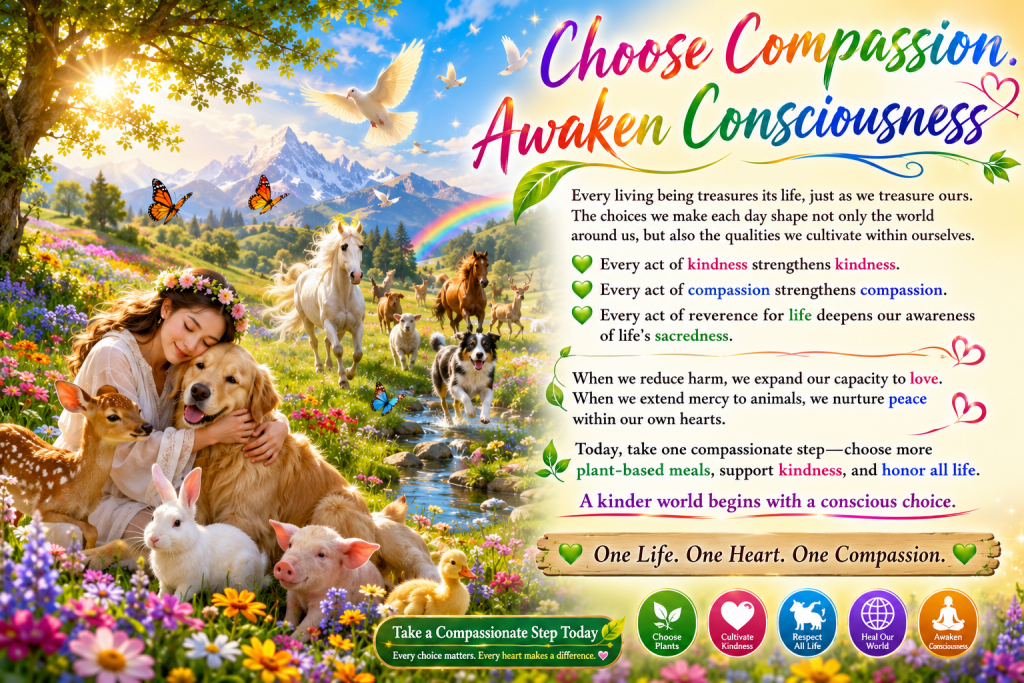
Humanity has long searched for the path to greater peace, wisdom, and wellbeing. Throughout history, spiritual teachers, philosophers, and seekers have asked a profound question: How should we treat other living beings? The answer we arrive at may shape not only the world around us, but also our own inner experience.
This article is not intended to condemn or judge anyone for their dietary choices. Rather, it is an invitation to reflect on a deeper principle: when we cause suffering to other beings, whether directly or indirectly, we may also affect our own consciousness, wellbeing, and relationship with life itself.
💚 The Mirror of Compassion 💚
Many spiritual traditions teach that life is interconnected. The principle often appears in different forms: “As you sow, so shall you reap,” “Do unto others as you would have them do unto you,” or the Eastern understanding of karma.
The central idea is simple: the energy we bring into the world eventually returns to us.
When we cultivate kindness, compassion, and respect for life, those qualities tend to enrich our own hearts and communities. When cruelty becomes normalized, we risk becoming disconnected from empathy and from the natural bond we share with other living creatures.
This does not mean that every hardship a person experiences is a direct consequence of their actions. Rather, it suggests that our choices shape our character, our consciousness, and the kind of world we collectively create.
💚 One Life Flows Through All Beings 💚
Animals, like humans, seek safety, comfort, companionship, and the continuation of life. They feel fear. They experience stress. They care for their young. They struggle when threatened and seek relief when suffering.
The ancient Indian scripture states:
“There is nothing more precious to a living creature than his own life. Therefore, he who kills an animal kills himself. Or, he who slays an animal slays himself.”
This teaching points toward a spiritual truth rather than a literal one. When we disregard the value of another being’s life, we diminish our awareness of the sacredness of life itself. In doing so, something within us may become less sensitive, less connected, and less awake.
🙏 If we do not wish to suffer, and animals likewise do not wish to suffer, then compassion becomes a bridge between us. 🙏
💚 Why Animals Suffer in Modern Food Systems 💚
Today, approximately 92 billion land animals are killed for food every year worldwide. In addition, estimates suggest that roughly one to two trillion fish and other aquatic animals are killed annually.
These numbers are difficult to comprehend.
Many animals raised for food spend significant portions of their lives in industrial farming systems where space, natural behaviors, and quality of life may be severely restricted. Conditions vary by country and farming method, but concerns raised by animal welfare organizations include overcrowding, stress, painful procedures, transportation hardships, and slaughter practices.
For many people, learning about these realities creates an ethical question: If suffering can be reduced, should we not strive to reduce it?
Does Eating Animals Make Humans Stronger?
One common belief is that humans must consume animals to be healthy, strong, and intelligent. The scientific evidence paints a more nuanced picture.
Major health organizations acknowledge that well-planned vegetarian and vegan diets can support health across all stages of life, including adulthood, pregnancy, and athletic performance. Plant foods provide protein, fiber, vitamins, minerals, antioxidants, and countless beneficial compounds associated with lower risks of several chronic diseases.
This does not mean that every vegetarian diet is automatically healthy, nor that every omnivorous diet is unhealthy. Health depends on overall dietary quality. However, the claim that animal products are absolutely required for human strength, vitality, or survival is not supported by current nutritional science.
Many successful athletes, scholars, physicians, and high-performing individuals thrive on vegetarian or plant-based diets. The real question is not whether humans can survive without eating animals. The evidence shows that many can.
🙏 The deeper question is whether we can thrive while causing less suffering. 🙏
💚 The Connection Between Compassion and Inner Peace 💚
Some spiritual perspectives suggest that consuming products associated with fear, stress, and suffering may subtly affect our emotional and psychological state.
Science does not establish that emotions experienced by animals are directly transferred to humans through food. Claims that animal suffering literally becomes human emotions after consumption remain matters of spiritual belief rather than scientific fact.
Yet there is another perspective worth considering.
When we know that another being suffered for our convenience, we may experience a conflict—consciously or unconsciously—between our values and our actions. Psychologists sometimes refer to this tension as cognitive dissonance.
Many people report feeling greater alignment, peace, and emotional clarity when their lifestyle choices more closely reflect their compassion for animals.
🙏 Whether understood spiritually, psychologically, or ethically, reducing harm often brings a greater sense of integrity. 🙏
💚 What Jesus and Buddha Taught About Compassion 💚
Interpretations of religious teachings vary, and scholars debate many details. However, compassion stands at the heart of both Christian and Buddhist traditions.
Jesus taught: “Blessed are the merciful, for they shall obtain mercy.” (Matthew 5:7) He consistently emphasized love, kindness, forgiveness, and care for the vulnerable.
Buddha taught the principle of ahimsa—non-harming—and encouraged compassion toward all sentient beings. The cultivation of loving-kindness (metta) extends beyond human beings to encompass all creatures capable of experiencing suffering.
While historical debates continue regarding whether Jesus or Buddha themselves followed strictly vegetarian diets, their teachings undeniably encourage compassion, mercy, and reverence for life.
The spirit of these teachings invites us to ask: How can we reduce suffering wherever possible?
💚 The Environmental Cost of Animal Agriculture 💚
The discussion is not only about animals. Animal agriculture is associated with significant environmental impacts, including: Large land requirements
- Extensive freshwater usage
- Greenhouse gas emissions
- Deforestation in some regions
- Habitat loss affecting wildlife populations
While sustainable livestock systems exist and impacts vary by production method, reducing overall consumption of animal products is widely recognized as one strategy for lowering environmental pressures.
When we disconnect from nature, we often experience the consequences collectively.
🙏 In that sense: When we disconnect from nature, the universe appears to disconnect from us. 🙏
💚 Breaking Free from Conditioning 💚
For generations, many societies have normalized the consumption of animals. Cultural traditions, advertising, habits, convenience, and social expectations all influence our choices.
Questioning these norms can feel uncomfortable. Yet every major moral advancement in history began with people asking whether accepted practices truly aligned with compassion and wisdom. Breaking free from conditioning does not require anger toward others. It requires awareness. It begins by asking:
- What values do I wish to embody?
- Do my actions reflect those values?
- Can I reduce suffering through my choices?
- When We Liberate Animals, We Liberate Ourselves
Many people who adopt vegetarian or plant-based lifestyles describe a profound inner shift. They often report feeling:
- More aligned with their values
- More connected to nature
- More aware of the interconnectedness of life
- More compassionate toward themselves and others
Whether one views this through spirituality, ethics, or psychology, compassion has a transformative quality. As the saying goes:
- When we liberate the animal, we liberate our soul.
- When we give up the flesh, our heart opens.
- When we do harm to others, the universe mirrors our activities.
These statements are spiritual reflections rather than scientific claims, yet they speak to a timeless intuition shared across many wisdom traditions: kindness elevates consciousness.
💚 A Call to Conscious Living 💚
The purpose of this message is not to shame anyone. Most people were raised within cultural systems they did not create. Instead, it is an invitation.
🙏 An invitation to consider that every living being values its life.
🙏 An invitation to recognize that compassion may be one of humanity’s highest expressions of consciousness.
🙏 An invitation to explore whether a vegetarian or plant-based lifestyle could bring greater harmony to your body, mind, spirit, and relationship with the world.
If there is indeed one life flowing through all beings, then every act of kindness becomes an act of honoring that shared life.
The choice before us is not merely about food.
It is about the kind of world we wish to create and the kind of people we wish to become.
🙏 May we choose compassion where we can, wisdom where we are able, and a deeper reverence for all life. 🙏