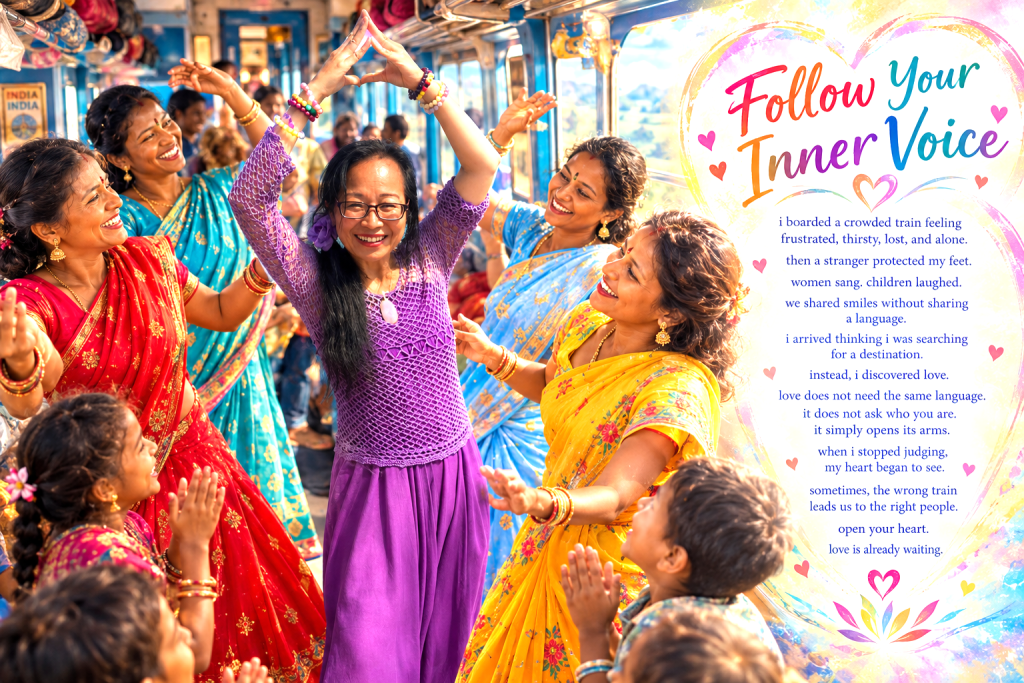
💜 The train ride that taught me what love looks like 💜
Have you ever had one of those days when everything seems to go wrong?
You make one mistake. Then another. You get frustrated.
You start asking yourself, “Why am I doing this to myself?”
I had one of those days in India. And at the time, I had no idea that this terrible day was about to become one of the most beautiful days of my life.
1. AN IMPERFECT BEGINNING
I was on a pilgrimage through India, trying to learn a simpler way of living.
I was traveling alone with my backpack. And I had decided to take a train from Mumbai to Nashik. That sounds simple. It wasn’t. Mumbai’s central railway station was overwhelming. Hundreds of long-distance trains passed through every day.
There were very few signs. And most of them were written in Hindi, which I couldn’t read. There were no maps telling me clearly where to go. I stood there with my backpack, looking completely lost. But something beautiful happened.
People noticed me. Strangers came up and asked where I wanted to go. I would show them my ticket. They would point. This platform. That direction. This train. Somehow, with the help of strangers, I found my way 15 minutes later.
Then I waited. Half an hour. The Mumbai heat was thick, muggy, and sticky. I was hungry. I was thirsty. But I didn’t want to drink too much because I was afraid to use the filthy railway bathroom. And slowly, my frustration returned. I started complaining inside my head.
- Why am I here?
- Why do I have to make everything so difficult?
- Why is my journey full of obstacles?
Finally, around five o’clock, the train arrived. I climbed aboard.
2. THE MOMENT I DIDN’T KNOW HOW IT WOULD END
I entered the women’s compartment. It was packed. Absolutely packed. But I found a little space near the doorway.
I sat on my backpack and thought, “Maybe this won’t be so bad.”
For about twenty minutes, I was actually happy. I smiled. I used paper to fan myself. I watched the world outside.
Then the train stopped. And suddenly—hundreds of people rushed inside.
People pushed. People squeezed. People shouted.
There was nowhere for me to move. I was sitting directly in their path. And one by one, people began stepping on my feet.
I remember thinking: What am I supposed to do?
Should I push them away? Should I yell? Should I get off? Then my mind became even louder.
- Why did I make such a stupid decision?
- Why didn’t I just take a taxi?
- Why am I suffering like this?
- I should get off this train.
I was angry. I was uncomfortable. I was judging everything around me. And then two women stepped over my legs and sat down beside me. One of them caught my attention. She was probably around fifty. She had red hair, round eyes, puffy cheeks, and scars around her chin. She wore a bright pink sari covered with large polka dots. And I noticed myself judging her appearance.
Then something inside me stopped. I thought: “Oh… I’m being my old self again.”
I closed my eyes. I took a breath. Then another. I stopped fighting at that moment. And I began observing. That was my Vipassana practice. Feel it. Don’t react to it.
I didn’t know what was going to happen next. But I decided to stay.
3. THE MIND SHIFT
A few moments later, I heard someone speaking. Then I felt someone pushing people away from my feet. I opened my eyes. It was the woman in the pink polka-dot sari. She was protecting my feet. She looked at me and said: “Namaste. Hindi?”
Do you speak Hindi? I smiled. “No. I’m sorry.” And I thanked her. Then several people started asking me questions.
I couldn’t understand a word. I thought they wanted to know where I was from.
So I said, “I’m Canadian.” They looked confused. And then I realized why.
I wasn’t what they expected a Canadian to look like. So I smiled and said: “I’m Chinese-Canadian.”
They smiled. Someone translated. And suddenly, I felt a little island of peace inside this enormous, chaotic train. But the noise continued behind us. People were shouting. People were pushing. And I took a deep breath.
Then I asked God: “What am I supposed to learn from this?”
And then something came to me. One word. Learning.
It was almost like an invitation. So I decided: If I’m going to spend the next few hours on this train, why not learn something?
I stood up as much as I could and called out: “Does anyone speak English?”
No one answered. So, I asked again. Eventually, a young woman wearing a black scarf came forward. She could understand a little English, but she couldn’t speak much.
I said, “Thank you. Could you please ask the children if they can teach me some Hindi words? Or maybe teach me a song?”
She translated. The children looked at me. They were shy. Nobody volunteered.
I asked again. “Please?” They smiled. And shook their heads.
I was disappointed. I had no idea what to do next.
Then, suddenly—the woman in the pink polka-dot sari began to sing.
4. THE PERSONAL DISCOVERY
Her voice was beautiful. I looked at her. She smiled. Then she sang louder. And began to dance. There was hardly any room, so she could only move her hands. Then another woman joined her. Then another. Then another. And suddenly, several women were singing. The children began clapping. People from the back of the train started moving toward us.
The shouting disappeared. The pushing disappeared. The entire atmosphere changed. It was as if the train had become another world.
I didn’t understand a single word they were singing. But I understood everything.
Love. Joy. Compassion. Connection.
I sat there completely overwhelmed. I remember thinking: “What is happening?”
These people didn’t know me. We couldn’t speak the same language. We came from different cultures. And yet, somehow, I felt completely embraced.
I felt as if I had entered an ocean of human kindness.
Then the singing stopped. I stood up and applauded. And they pointed at me.
I thought, “What?” They pointed again. They wanted me to sing. Oh, no.
I didn’t know any Indian songs. I didn’t know what to do. There was no escape. So, I cleared my throat. And I began singing Canada’s national anthem.
Except—I was so nervous that I forgot the words. I started making up my own version. Everyone laughed. I laughed. I couldn’t even finish the song. But they clapped anyway.
And in that moment, I understood something: The words didn’t matter.
Participation mattered. Giving mattered. Love mattered. They had given me their music. Now I was giving them mine.
They showered me with unconditional love, and I returned pure bliss.
Maybe it wasn’t perfect. But it was sincere. And somehow, that was enough.
THEN CAME THE SURPRISE
After the singing, I took out my camera. The children were shy. So, I took a picture and turned the camera around to show them. They saw themselves on the screen. And suddenly they burst into laughter.
They began posing. I took another picture. They laughed again. Soon everyone wanted to see themselves. We didn’t share the same language. But we were laughing together. Taking pictures. Singing. Clapping. Smiling. Dancing. Giggling.
For a few hours, something extraordinary happened.
We became a family without sharing a family name.
Then the woman in the pink sari began asking me questions.
Where was I going? “Nashik,” I said.
She looked concerned. She made a gesture indicating: “Why are you going there at night?”
Then she noticed my meditation posture. She pointed at me. “Buddhist?”
I nodded. Then she said: “Igatpuri.”
I didn’t understand. She tried again. “Igatpuri. Buddha. Namaste.” Still nothing.
I showed her my ticket. It said: Nashik.
The women began talking among themselves. They were trying to figure out where I was actually supposed to go.
Then the woman in the pink sari looked at me and said: “Dhamma Giri?”
My eyes opened wide. Yes!
She said: “Pagoda. Vipassana?”
I nodded excitedly. Yes! Yes!
And then she pulled me toward the open door. She pointed outside.
It was completely dark. I couldn’t see anything. She kept pointing. So, I waited. I looked into the darkness.
And then—she suddenly pointed and shouted: “Pagoda!”
I looked. And there it was. A golden pagoda shining in the darkness.
Like a light. Like a beacon. Like someone had just shown me the way home.
THE REALIZATION
That’s when I discovered something important. I had bought the wrong ticket.
The Vipassana center was at Igatpuri, not Nashik. Nashik was another fifty kilometers away. I had copied the wrong address.
If that woman had not understood where I was going, I might have arrived in the middle of the night in the wrong place.
I looked at her. And tears came. I held her hands.
All I could say was: “Dhanyavad. Dhanyavad. Thank you.”
She smiled. Then she helped me get off the train. And as I stepped onto the platform, I looked back at the women and children.
About 200 women and kids were all waving. “Bye! Namaste!”
I waved back. And I realized something that changed me.
I know I am in the ocean of Love,
and I discovered the world’s most beautiful and pure joy smile on this epic train ride.
5. YOUR TURN
Let me ask you something. Have you ever judged someone before you knew their heart?
Have you ever looked at a person and decided who they were because of their appearance, their clothes, their accent, their background, their education, or their social status?
I had.
That day, I realized that I had almost missed one of the most beautiful human connections of my life because of my own judgment.
The woman I had noticed first because of her appearance—was the very woman who protected me.
- Who sang for me.
- Who danced for me.
- Who helped me discover my mistake.
- Who made sure I didn’t get lost.
And suddenly I saw her differently. Her outer appearance had never been the important thing.
Her inner beauty was shining all along.
The problem was not that I couldn’t see it. The problem was that I wasn’t looking.
- So I want to ask you: Who might you be judging too quickly?
- And what might happen if, instead of judging, you became curious?
- Instead of closing your heart—you opened it?
- Instead of asking, “What is wrong with this person?”
- You asked, “What can I learn from this person?”
6. TENSION RELEASE — WHAT I LEARNED
As I stood on that platform, watching the train disappear into the darkness, I felt something I had longed for much of my life. I felt loved.
- Not because I had accomplished something.
- Not because someone knew my achievements.
- Not because I had earned it.
Simply because I was human.
A stranger had cared for another stranger. And somehow, that simple act opened my heart. I realized that I had spent so much of my life looking for love. But perhaps love had been around me all along.
Maybe I had simply been too busy judging, protecting, controlling, and worrying about receiving it.
That train taught me something my meditation practice had been teaching me in another way: When I stop reacting, I begin to see.
- When I stopped fighting the train—I discovered the people.
- When I stopped judging the women—I discovered their hearts.
- When I opened myself to them—they opened themselves to me.
And when I gave a little love—I received more than I could have imagined.
I learned that sometimes obstacles are not the obstacle.
Sometimes the obstacle is the doorway.
The crowded train was my doorway. The wrong ticket was my doorway. My frustration was my doorway. Even my judgment was my doorway.
And behind that doorway was something I had been searching for a very long time: belonging.
THE LAST WHISPER
As I stood alone on that platform, holding my backpack, a quiet voice seemed to arise from somewhere deep inside me:
“You are beautiful. You are worthy of love.” I stood there in tears.
- I didn’t have to become someone else to deserve love.
- I didn’t have to speak the right language.
- I didn’t have to be perfect.
- I only had to open my heart.
And I finally understood something: Love does not always speak our language.
- Sometimes it sings.
- Sometimes it protects our feet.
- Sometimes it points toward a golden pagoda in the darkness.
- Sometimes it arrives from a complete stranger.
- And sometimes—it is simply the courage to follow your inner voice.
WHAT THIS JOURNEY TAUGHT ME
Today, when life becomes difficult, I try to remember that train. When I feel frustrated, I ask: “What can I learn here?”
- When I catch myself judging someone, I ask: “What am I not yet seeing?”
- When I feel lost, I ask: “Can I trust the next step?”
And when my heart closes, I remember those women. We didn’t speak the same language. But we understood one another perfectly.
Because underneath all our differences, we were human beings.
And perhaps that is the greatest lesson my pilgrimage has given me:
The road doesn’t always lead us where we think we are going.
Sometimes we take the wrong train, meet the right people, and discover the right destination.
So, if you’re going through a difficult moment right now—don’t rush to ask, “Why is this happening to me?”
Try asking: “What is this moment here to teach me?” Pause. Breathe. Listen.
Follow your inner voice.
You may discover that what looks like an obstacle—is actually leading you somewhere your mind could never have imagined. And sometimes, in the middle of the darkness,
a light is already waiting for you.
🤎❤️🧡💛💚💎💙💜❤️🧡💛💚💎💙💜❤️🧡💛💚💎💙💜🤎
This chapter of life’s transformation is found in the book Travelling Inwards
this is fascinating to me