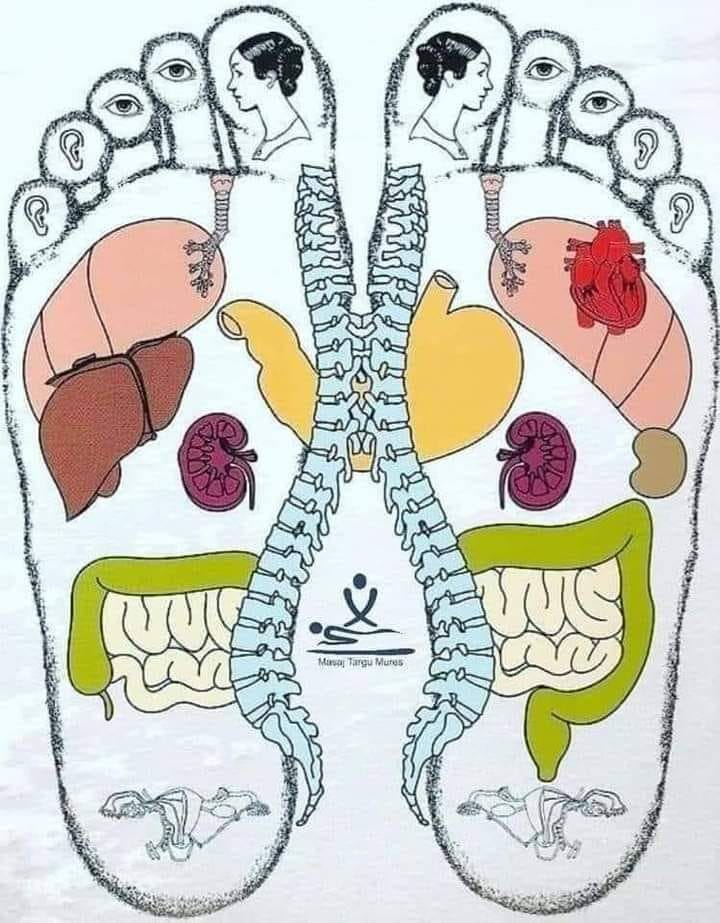
How Working the Feet Helps Regulate the Nervous System and Restore Natural Balance
1. What Reflexology Actually Is (Historically & Practically)
🦶🖐️ Reflexology is a somatic pressure therapy developed independently in China, Egypt, and India, based on one central observation:
Certain areas of the feet and hands are neurologically dense, richly innervated, and correlate with autonomic reflex pathways connected to organs, posture, and emotional regulation.
This does not require belief in cosmic memory to function.
It works through neurovascular, fascial, and autonomic pathways.
In Traditional Chinese Medicine (TCM), reflexology overlaps with:
Meridian theory
Acupressure
Somato-visceral reflexes
2. The Feet: Why They Matter So Much
🦶 From a physiological standpoint, the feet contain:
🦶 Over 7,000 nerve endings per foot
Dense mechanoreceptors (pressure sensors)
Strong connections to the vagus nerve via spinal reflex arcs
Major fascial lines running from toes → calves → spine → neck
In TCM terms:
6 Yin meridians either begin or end in the feet
The feet are considered the “grounding poles” of the nervous system
When the feet are tense, numb, or ignored:
The nervous system stays in sympathetic dominance (fight/flight)
Trauma patterns stay somatically stored
Sleep, digestion, and emotional regulation suffer
3. Meridian Points in the Feet (Key Ones Only)
🟢 Kidney Meridian (K1 – Yongquan)
precise Location:
Center of the sole, just below the ball of the foot
Function (TCM):
Regulates fear, stress, and survival energy
Associated with adrenal response and exhaustion
Modern interpretation:
Strong calming effect on the autonomic nervous system
Often used to reduce anxiety and hyperarousal
How to use:
Slow, deep thumb pressure
30–60 seconds per foot
Breathe slowly while pressing
🟢 Liver Meridian (L3 influence via toes & arch)
precise Location:
Between the big toe and second toe, extending into the arch
Function (TCM):
Emotional processing (anger, frustration)
Tendons, fascia, and hormonal regulation
Modern interpretation:
Fascia release affects posture and spinal tone
Helps discharge stored muscular tension
How to use:
Gentle kneading, not sharp pressure
Especially effective if feet feel tight or painful
🟢 Spleen Meridian (medial arch)
precise Location:
Inside arch of the foot
Function (TCM):
Digestion, rumination, worry
Blood and fluid regulation
Modern interpretation:
Connects to the gut–brain axis
Stimulation often improves digestion and emotional settling
🟢 Bladder Meridian (heel & outer edge)
precise Location:
Heel, outer edge of foot
Function (TCM):
Nervous system, spine, stress pathways
Modern interpretation:
Strong link to spinal reflexes
Heel work often releases low-back and sacral tension
4. Reflex Zones (Organ Mapping Without Mythology)
The reflex maps you mentioned are approximate somatic correlations, not literal organ storage.
A simplified, grounded view:
Foot Area Common Reflex Association Nervous System Effect
Toes Head, neck Calming mental overactivity
Ball of foot Chest, lungs Improves breathing patterns
Arch Digestive organs Settles gut–brain loop
Heel Pelvis, lower back, Grounding, safety signals
When pressure is applied:
Sensory input travels to the spinal cord
The brain down-regulates threat responses
Muscles and organs receive relaxation signals
This is neuroregulation, not magic.