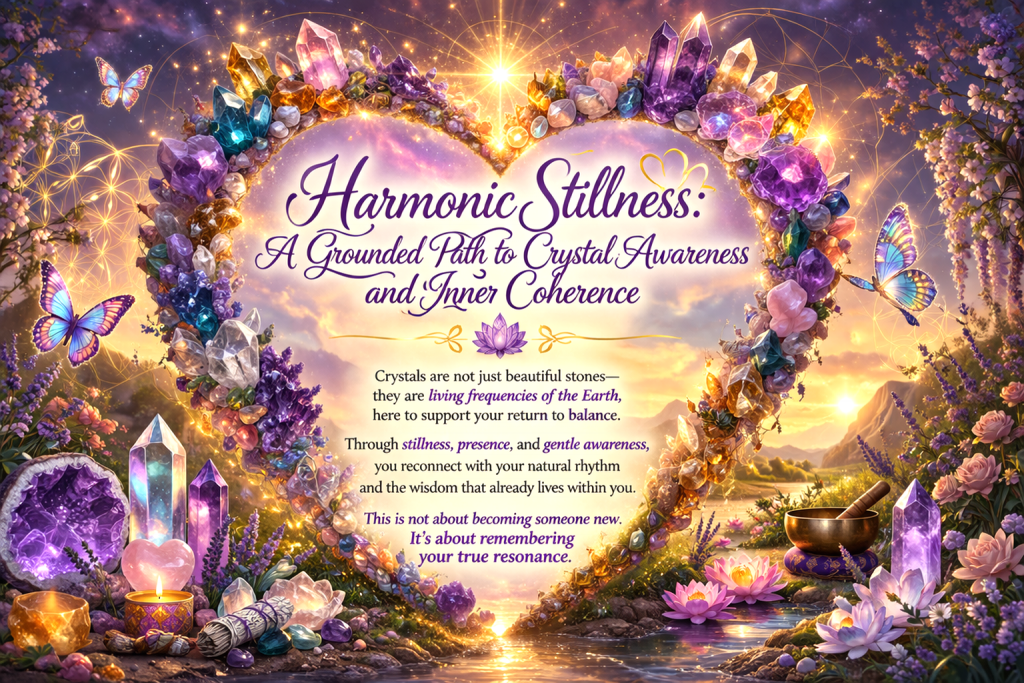
Crystals have long been regarded as objects of beauty and symbolic meaning. Some traditions suggest they carry “healing properties,” while others view them as tools for focus, intention, and reflection.
It is important to approach this space with clarity:
crystals do not replace medical care, nor do they independently “heal” the body.
However, they can serve as anchors for attention, intention, and emotional regulation—which may support overall well-being.
Let us explore this with grounded awareness.
1. Five Crystals Commonly Associated with Healing Qualities
These crystals are widely referenced across cultures for their symbolic and experiential effects:
1.) Amethyst
Often associated with calmness and mental clarity.
It is commonly used as a reminder to slow down and soften mental overactivity.
2.) Rose Quartz
Linked to themes of compassion and emotional openness.
It may support reflection around relationships and self-kindness.
3.) Clear Quartz
Sometimes called a “focus stone.”
It is used to bring attention to clarity of thought and intention.
4.) Black Tourmaline
Associated with grounding and stability.
It can serve as a physical reminder to stay present and rooted.
5.) Citrine
Connected symbolically to vitality and optimism.
Often used to reinforce constructive thinking patterns.
2. Aligning with Crystal Use (A Grounded Approach)
Rather than “aligning with crystal power,” it is more stable to understand this as aligning your own attention and state, using the crystal as a focal point.
Step 1: Set a Clear, Simple Intention
Hold the crystal and define a grounded intention such as:
“I want to feel calmer today.”
“I will focus clearly on my work.”
The clarity comes from you—not the object.
Step 2: Pair It with Breath Awareness
Sit quietly and:
Inhale slowly
Exhale longer than the inhale
Hold the crystal lightly. Let it become a physical anchor for presence.
Step 3: Use Consistent Placement
Keep the crystal in a place you often see:
Desk
Bedside
Repetition builds association, and association builds effect.
Step 4: Observe, Don’t Expect
Notice:
Does your state shift when you pause with it?
Does it remind you to regulate your thoughts or breath?
The benefit arises through awareness—not belief alone.
Step 5: Integrate with Daily Action
No object replaces:
Sleep
Nutrition
Movement
Relationships
The crystal becomes supportive only when life itself is supported.
3. Which Crystals May Support Well-Being?
Different crystals may resonate with different aspects of your experience:
For calmness → Amethyst
For emotional reflection → Rose Quartz
For focus → Clear Quartz
For grounding → Black Tourmaline
For motivation → Citrine
Yet the key principle remains:
The crystal does not create the state.
It reminds the system to return to it.
4. A Coherent Understanding
When seen clearly, crystals are not sources of external power.
They are tools of attention.
They work, if they work at all, by:
Slowing the mind
Anchoring awareness
Encouraging intentional living
In this way, their “healing” is indirect—emerging through the body’s own regulatory intelligence.
This aligns with a grounded truth:
The body already seeks balance
The mind already shapes perception
Attention influences experience
A crystal, then, is simply a mirror of focus—a small, tangible object that helps organize your internal state.
Closing Reflection
If you choose to work with crystals, do so without dependency or projection.
Let them be:
Quiet companions
Visual reminders
Anchors of stillness
Not sources of authority.
The real alignment is not with the stone—
But with your own capacity to return to clarity, breath, and steady awareness.