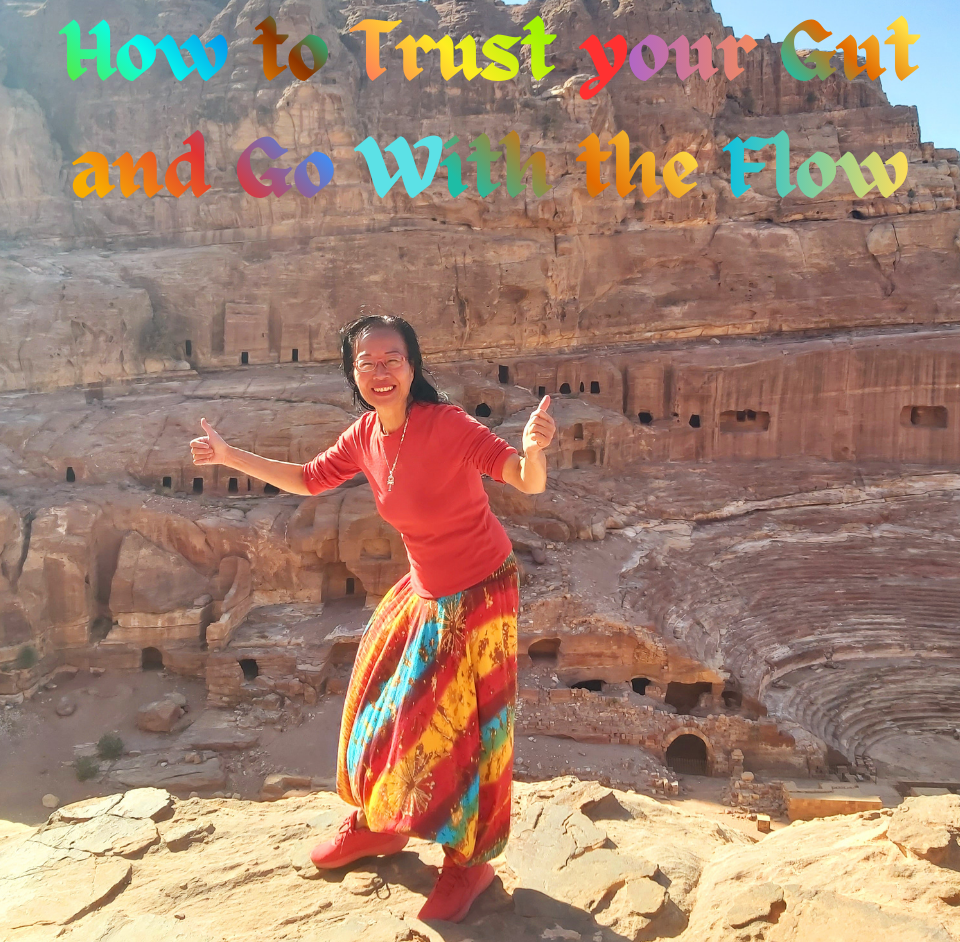
A Practical Guide for Real Life
“Trust your gut” and “go with the flow” are phrases we hear often—but they can sound vague or unrealistic unless we understand how they work in everyday situations.
From lived experience, these are not mystical skills. They are learnable practices rooted in attention, self-trust, and calm decision-making.
Here is how to cultivate them.
1. Understand what your “gut” actually is
Your gut feeling is not a sudden impulse or emotional reaction.
It is usually:
quiet
steady
calm rather than urgent
accompanied by a sense of rightness, even if there is uncertainty
It often shows up as:
a bodily sensation (relaxation, tension, ease)
a subtle “yes” or “no”
a feeling of clarity without a long explanation
Important distinction:
Fear is loud and urgent.
Intuition is quiet and grounded.
Before acting, ask:
“Does this feel steady—or rushed?”
2. Create space before deciding
Gut feelings are easiest to hear when we slow down.
Simple practices:
take one deep breath before responding
pause before saying yes or no
give yourself a few moments of silence
You don’t need to meditate for hours. Even five seconds of pause can shift a reactive decision into an intuitive one.
Flow does not mean speed.
Flow means timing.
3. Stay oriented to the present moment
When traveling—or navigating life without certainty—panic often comes from imagining future problems.
Instead, focus on:
where you are right now
what is actually needed in this moment
the next practical step only
For example:
Find the street you’re on, not the entire route.
Ask one person for help, not everyone.
Solve one problem, not ten imaginary ones.
Trust grows when we handle what is real, not what is feared.
4. Ask for help without shame
Going with the flow does not mean doing everything alone.
In fact, flow often includes other people.
Practical steps:
ask clear, simple questions
accept help when it’s offered
say thank you without over-explaining
Most people genuinely want to help—but they respond best when we are calm, respectful, and open.
Receiving help is not weakness.
It is participation.
5. Hold plans lightly
Planning is useful. Attachment to plans is stressful.
When something doesn’t go as expected:
avoid immediately labeling it as “bad”
stay curious instead of rigid
adjust rather than resist
Flow is the ability to adapt without self-blame.
Ask:
“What’s available now that wasn’t before?”
Sometimes a closed door quietly opens another one.
6. Protect your joy deliberately
One of the most important skills is guarding your inner state.
This means:
not internalizing other people’s negativity
not replaying criticism
not letting minor setbacks define the whole experience
Joy is not denial.
Joy is choosing not to let disappointment dominate attention.
You can acknowledge difficulty without surrendering your love for life.
7. Replace “everything happens for a reason” with something stronger
A more grounded belief is this:
“Whatever happens, I can respond.”
This mindset:
builds resilience
avoids magical thinking
reinforces self-trust
Life does not need to be perfect to be workable.
And you do not need guarantees to move forward.
8. End each day by noticing what worked
Trust grows through reflection.
At the end of the day, ask:
What did I handle well?
Where did I adapt?
What support showed up?
What did I learn about myself?
This rewires attention away from fear and toward capability.
A final reminder for readers
Going with the flow does not mean surrendering your judgment.
Trusting your gut does not mean ignoring reality.
It means:
staying present
responding calmly
listening inwardly
staying open to help
and refusing to let fear run the story
When you live this way, life often feels less like a battle—and more like a conversation.
💖 🌎 💫 🌄 ⭐ 🕌 🔆 🌅 🌕⭐🌎 🕊️ ⏳ 🌇 ✨ 💖💡🌀