🪷 Reclaiming the True Meaning of Karma 🪷
Thanks for allowing me to share something deeply personal.
I was volunteering at a Vipassana silent retreat for the last few days. One day, as I sat quietly on the meditation cushion and began scanning my body, I discovered a sensation of resistance in my heart.
🧘♂️With that awareness, I began to surrender. 🧘♂️
I remained still and neutral, silently looking deeper within. And then I realized something unexpected: I was having difficulty accepting the idea of karma.
I was born in China, and throughout my life I had been educated, trained, conditioned, accustomed, and programmed to think and react in certain ways. Whenever unfortunate things happened, I would often label them as my “bad karma.”
At the time, I did not recognize what was happening within my own mind.
I was unknowingly allowing a judgmental mind to interpret my experiences. I was unconsciously playing the blame game. I allowed this way of thinking to become a pattern, the pattern to become a habit, and the habit to become an automatic way of living.
But I had forgotten to look deeper. I had forgotten to ask:
🙏 What is the true “因” — the cause — and what is the “果” — the effect?
🙏 What actually created this experience?
🙏 Was it truly “bad karma,” or was I simply applying an inherited label to something I did not yet Comprehend ?
Over time, I began to question whether some of the meanings I had inherited from tradition, culture, religion, and society were genuinely serving my highest good. I also began to see how, when spiritual or religious teachings become distorted by human fear, control, or the pursuit of personal power, they can sometimes leave people feeling fearful, powerless, guilty, or dependent on external authority.
- I am not here to debunk religion.
- I am not here to debate anyone’s beliefs.
- I am simply sharing a deep self-realization and raising a question for you to ponder:
👉 What is karma?
👉 Where does our understanding of karma come from?
👉 Is it truth, belief, conditioning, or a program running in the mind?
For me, karma is becoming something much deeper than a sentence handed down by some external force.
🙏 Perhaps karma is not about being punished.
🙏 Perhaps it is about cause and effect.
Every thought, intention, word, and action has consequences. What we repeatedly think and do can create patterns. Those patterns influence our behavior, our relationships, our emotional responses, and ultimately the direction of our lives.
In that sense, karma can be understood as a chain of cause and effect — not necessarily as punishment, but as an opportunity to become conscious of what we are creating.
🪷 And if we become conscious of the causes, perhaps we also become capable of changing the effects. 🪷
🙏 That realization is empowering. 🙏
Playing the blame game and refusing to take responsibility may sometimes seem like an easier way to live. If everything is simply “my bad karma,” then perhaps I do not have to look deeply at myself. But true self-inquiry asks something more courageous:
- What part did I play in creating this?
- Can I own my mistakes without condemning myself?
- Can I acknowledge my actions without turning them into an identity?
- Can I recognize, “I created this situation, consciously or unconsciously, and therefore I can begin to create something different”?
That does not mean we control everything that happens to us. Life contains circumstances beyond our control. But we can become responsible for how we meet those circumstances, what we learn from them, what we repeat, and what we choose next.
That may require tremendous courage.
💜 Because sometimes the hardest thing to release is not the pain itself, but the story we have been taught to tell about the pain. 💜
Maybe what we once believed — or were conditioned to believe — no longer serves our collective best interest or our highest good.
- If so, are we willing to examine it?
- Are we willing to release narratives that keep us small?
- Are we willing to question inherited beliefs rather than blindly carrying them forward?
- Are we willing to free the mind from old programs and, in doing so, free ourselves?
I invite you to ask yourself some deeper questions:
🙏 What do I truly believe?
🙏 Where did this belief come from?
🙏 Does this belief empower me or diminish me?
🙏 Who benefits when I remain afraid, guilty, or powerless?
🙏 What supports my soul’s development?
🙏 What am I choosing to focus on at this moment?
🙏 What kind of experience do I want to create in this lifetime?
- Perhaps karma is not a life sentence.
- Perhaps karma is an invitation to become conscious.
💜 We plant seeds every day — through our thoughts, intentions, choices, words, and actions. And when we plant seeds with awareness, compassion, integrity, and the intention to benefit humanity, we increase the possibility of harvesting a more wholesome life. 💜
- We cannot always choose the soil we were born into.
- We cannot always choose the seeds that were planted in us by our families, cultures, religions, experiences, or circumstances.
But as awareness grows, perhaps we can choose which seeds we continue to water.
And perhaps we can choose which ones we no longer nourish.
🪷 This, for me, is where freedom begins. 🪷
👉 I choose to stop blindly accepting the role that others have given me.
👉 I choose to stop mindlessly accepting old narratives simply because I was told they were true.
👉 I choose to stop unconsciously obeying inherited programs and unknowingly buying into beliefs that no longer serve me.
👉 I choose awareness over conditioning.
👉 I choose responsibility over blame.
👉 I choose inquiry over blind acceptance.
👉 I choose compassion over judgment.
👉 I choose the courage to look within.
💜 And I choose to remember:
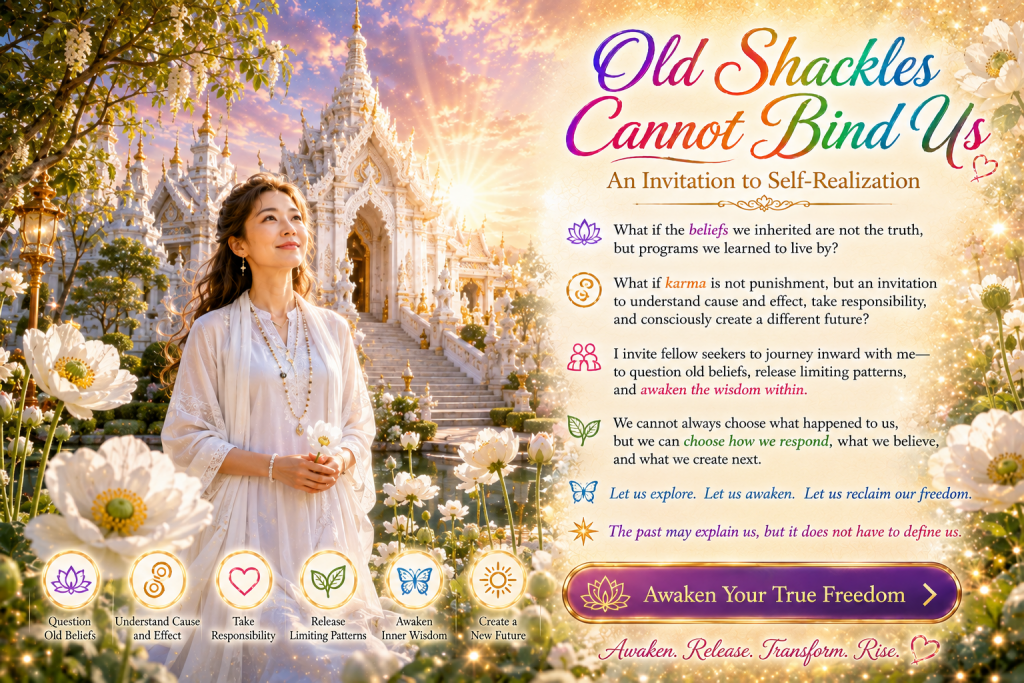
💚 Old shackles cannot bind us once we become conscious that they are there. 💚
- Perhaps freedom does not begin when the world changes.
- Perhaps freedom begins when we become aware of the programs within ourselves — and finally realize that we have the power to choose what comes next.
🪷 The past may explain it to us, but it does not have to define us. 🪷
💖 The seeds of tomorrow are being planted by what we choose today. 💖