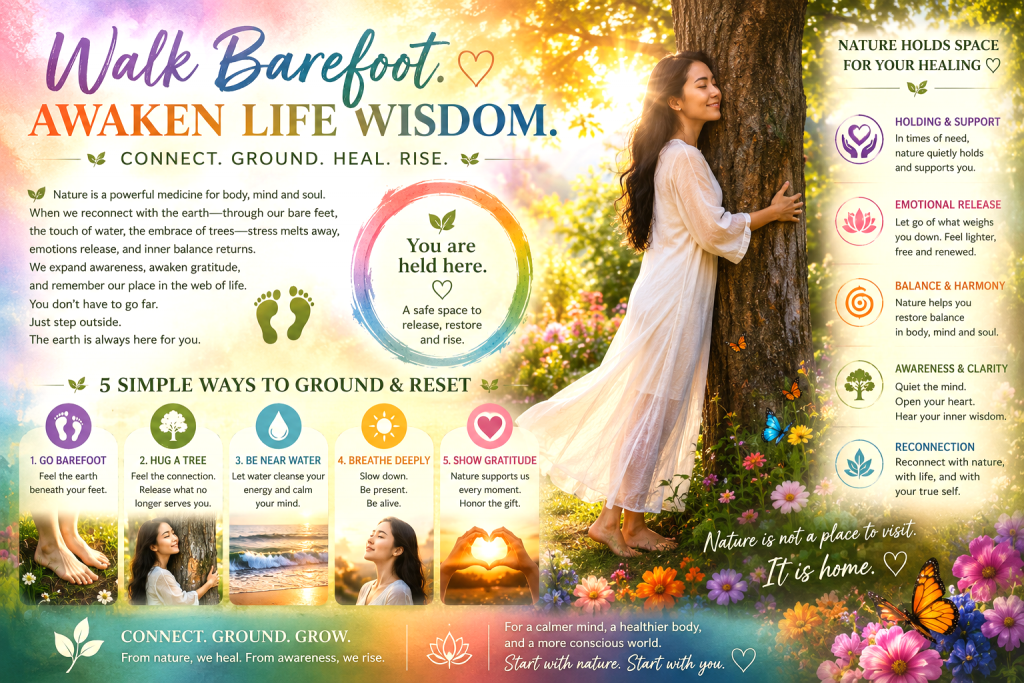
In today’s fast-paced world, many people feel disconnected—not only from nature, but from their own bodies, emotions, and inner wisdom. We live surrounded by technology, constant stimulation, and endless demands on our attention. As a result, stress, anxiety, emotional overwhelm, and digestive issues have become increasingly common.
Yet one of the simplest and most accessible forms of healing may be found in something humanity has known for thousands of years:
👣 Reconnecting with the Earth 👣
Grounding, also known as earthing, is the practice of consciously connecting with nature and the natural world. While walking barefoot on grass or sand is one of the most well-known forms of grounding, the deeper principle is about restoring our relationship with the rhythms and intelligence of nature.
When we reconnect with the Earth, we often begin to reconnect with ourselves.
👣 The Connection Between Grounding and Emotional Health 👣
Emotions are not simply thoughts; they are experiences that move through the body.
When stress accumulates, emotions can become trapped within our nervous system. Many people carry unprocessed feelings such as grief, fear, frustration, sadness, or anxiety without fully realizing it.
Nature offers a safe and non-judgmental space for emotional release.
When we sit beneath a tree, listen to ocean waves, or walk slowly through a forest, the nervous system often begins to relax. As the body shifts out of a chronic stress response, buried emotions may naturally rise to the surface and move through us. This is why many people report:
- Feeling calmer after spending time outdoors
- Crying unexpectedly while in nature
- Experiencing emotional relief after walking on a beach
- Feeling lighter and more peaceful after time in a forest
Grounding does not force emotions away. Instead, it creates a supportive environment where emotions can be acknowledged, felt, and released naturally.
💚 Nature holds space for healing 💚
👣 How Grounding May Support Gut Health 👣
Modern science increasingly recognizes the intimate connection between the gut and the brain.
Often called the gut-brain axis, this communication network links emotional well-being, nervous system regulation, digestion, and overall health. When we experience prolonged stress:
- Digestion can slow down
- Inflammation may increase
- Gut function can become disrupted
- Sleep quality may decline
- The body’s healing capacity may decrease
Grounding practices often help activate the parasympathetic nervous system, sometimes called the “rest and digest” state. When the body feels safe:
- Digestion improves
- Nutrient absorption becomes more efficient
- The gut can function more effectively
- Inflammation may be reduced
- Sleep quality often improves
While grounding should not be viewed as a replacement for medical care, many people find that spending time in nature becomes an important part of a holistic approach to digestive wellness.
💚 A relaxed body is often a healthier body 💚
👣 Grounding and Mental Clarity 👣
The human brain was not designed for constant information overload.
Every day we process notifications, emails, news, social media content, conversations, and countless decisions. Over time, this mental saturation can contribute to:
Anxiety 🌱 Mental fatigue 🌱 Difficulty concentrating 🌱 Overthinking 🌱 Feelings of overwhelm
Nature has a remarkable ability to quiet the mind. Research has shown that spending time in natural environments can help reduce stress, improve mood, and restore attention.
When we ground ourselves, our awareness shifts from constant thinking toward direct experience. Instead of worrying about tomorrow, we notice:
- The sound of birds
- The movement of clouds
- The feeling of wind on the skin
- The rhythm of our breath
As attention returns to the present moment, mental clarity often emerges.
- Solutions appear more easily.
- Creativity flows.
- Perspective expands.
- The mind becomes less crowded.
👣 Beyond Barefoot Walking: Natural Ways to Ground Yourself 👣
Although barefoot walking and tree hugging are wonderful grounding practices, there are many other ways to connect with the Earth naturally.
1. Sit Against a Tree
Rather than hugging a tree, simply lean your back against its trunk.
Close your eyes. 🧘♂️ Feel the stability of the tree supporting you. 🧘♂️ Allow yourself to rest. 🧘♂️ Many people find this deeply calming and centering.
2. Spend Time Near Water
Rivers, lakes, waterfalls, oceans, and streams naturally draw attention into the present moment. The sound of flowing water can calm the nervous system and reduce mental chatter.
🙏 Water reminds us to let life flow 🙏
3. Garden With Your Hands
Touching soil, planting flowers, growing vegetables, or caring for plants creates a direct relationship with the Earth. Gardening encourages mindfulness, patience, and connection. 🧘♂️ Many people describe it as a form of meditation. 🧘♂️
4. Watch the Sunrise or Sunset
Nature’s daily transitions invite stillness and reflection. Spending even ten minutes observing a sunrise or sunset can help restore perspective and reconnect us with natural rhythms.
5. Practice Conscious Breathing Outdoors
Find a quiet natural space. 🧘♂️ Sit comfortably. 🧘♂️ Breathe slowly and deeply. 🧘♂️ Allow the breath to synchronize with the environment around you.
🧘♂️ The Earth is not separate from your experience—it becomes part of your awareness. 🧘♂️
6. Forest Bathing
Originating from the Japanese practice of Shinrin-yoku, forest bathing involves immersing yourself in a forest environment without any specific goal.
No exercise. 🙏 No phone. 🙏 No agenda. 🙏 Simply walk slowly and absorb the atmosphere. This practice has been associated with reduced stress and improved well-being.
💚 A Story of Returning to Balance 💚
Sarah had spent years living in a constant state of pressure. Her work was demanding, her schedule was packed, and her mind never seemed to stop. Over time, she began experiencing anxiety, emotional exhaustion, digestive discomfort, and poor sleep.
She tried productivity systems, supplements, podcasts, and countless self-help strategies. Some helped temporarily. None addressed the deeper issue.
One day, after a particularly stressful week, she decided to leave her phone behind and visit a nearby nature reserve. At first, she felt restless. Her mind continued racing. But after sitting beside a stream for nearly an hour, something shifted. The sound of water softened her thoughts. Her breathing slowed. Her shoulders relaxed. For the first time in months, she felt fully present. Over the following weeks, Sarah created a simple daily ritual:
- Morning walks in nature
- Sitting beneath a favorite tree
- Watching sunsets several times a week
- Gardening on weekends
Gradually, she noticed changes. Her anxiety lessened. Her digestion improved. She slept more deeply. Most importantly, she felt connected again—to herself and to life. The transformation was not dramatic. It was gentle. And perhaps that is the way nature often works.
👣 The Wisdom Beneath Our Feet 👣
Grounding is not merely a wellness practice. It is a remembrance.
- A remembrance that we belong to something larger than our worries.
- A remembrance that healing often begins when we slow down.
- A remembrance that the wisdom we seek is not always found by adding more information, but by creating space to listen.
👣 The Earth does not ask us to become someone else. It simply invites us to come home. 👣
- To breathe.
- To connect.
- To trust.
💚 And to remember who we truly are. 💚
🌎 Sometimes the path to greater emotional balance, mental clarity, and physical well-being begins with a simple act: stepping back into nature and allowing the Earth to hold us once again. 🌎