“Man suffers only because he takes seriously what the gods made for fun.” —Alan Watts
This well-known reflection by philosopher Alan Watts is not an invitation to become careless or irresponsible. Rather, it points toward a profound spiritual insight: much of our suffering arises because we mistake the game of life for our true identity. We become so absorbed in our roles, achievements, fears, and expectations that we forget we are the awareness experiencing them. The mask becomes more important than the face beneath it.
From a spiritual perspective, life can be understood as a living expression of Infinite Consciousness continually exploring itself through countless forms and experiences. Like waves rising from the same ocean, every person appears unique while remaining inseparable from the whole. We arrive in this world without titles, possessions, or identities. Yet as we grow, we learn to define ourselves through success and failure, wealth and status, approval and rejection. Gradually, we begin to believe these temporary identities are who we truly are.
This is where suffering quietly begins.
The mind becomes attached to winning, avoiding failure, controlling outcomes, and protecting an image of itself. Life becomes a problem to solve instead of a mystery to experience. Every setback feels personal. Every uncertainty feels threatening. Every comparison becomes another measure of our worth.
Alan Watts often suggested that existence is more like music than a destination. The purpose of music is not simply to reach the final note. If it were, the greatest musicians would play as fast as possible. Music is meaningful because of the experience of each note, each pause, each movement. In the same way, life may be less about arriving somewhere and more about fully participating in the unfolding of each moment.
Awakening begins when a person notices they have been living almost entirely inside their thoughts. They realize that their endless worrying has never truly guaranteed safety, and their constant striving has not brought lasting peace. For the first time, they become curious instead of reactive. They pause before responding. They observe their thoughts instead of believing every one of them. They begin to see that life is happening with them as much as it is happening around them.
Imagine someone who has spent years believing that every mistake defines their value. They work relentlessly, constantly comparing themselves with others and fearing they will never be enough. Then one ordinary day, while sitting quietly beneath a tree, watching children laugh without needing a reason, something shifts within them. They suddenly recognize that the children are completely absorbed in the joy of playing. They are not trying to become worthy of life—they are simply alive.
In that quiet realization, the person begins to understand that perhaps they, too, have forgotten how to play.
Nothing external changes overnight. They still go to work. They still pay bills. They still face challenges. Yet everything feels different because they no longer carry the crushing belief that every moment must prove their worth. They begin walking more slowly. They notice birdsong they once ignored. They laugh more easily. They become kinder toward themselves when they make mistakes. They stop treating every inconvenience as a personal battle. They discover that peace is not found after life is solved; it is found while life is being lived.
🙏 This is not indifference. It is freedom 🙏
👉 To become playful is not to escape responsibility. It is to release unnecessary heaviness. Playfulness is the natural expression of a mind that is no longer imprisoned by fear. It allows curiosity to replace certainty, wonder to replace control, and gratitude to replace endless striving.
👉 Living playfully means meeting each day as an adventure rather than as another test. It means allowing room for surprise. It means smiling at your own imperfections instead of fighting them. It means understanding that you are participating in life, not carrying the entire universe upon your shoulders.
🙏 You can begin cultivating this spirit in simple ways 🙏
👉 When you wake each morning, ask yourself, “What can I discover today?” instead of “What do I have to survive today?” Curiosity gently opens the heart.
👉 Once each day, do something without needing a result. Watch clouds drift across the sky. Listen to the wind moving through the trees. Draw, sing, dance, or write simply because the act itself is joyful. Let experience be enough.
👉 When you notice yourself becoming tense, pause for one mindful breath and quietly ask, “Am I responding to this moment, or am I reacting to a story my mind is telling?” Often, this simple question creates space for wisdom to emerge.
👉 Practice laughing at your own perfectionism. Notice how often the mind insists everything must be controlled. Then gently smile, remembering that even nature grows without anxiety.
👉 Spend time with children, animals, or anyone who naturally lives in the present. They remind us that wonder is not something we achieve; it is something we remember.
👉 At the end of each day, reflect not only on what you accomplished but also on where you felt most alive. Those moments often reveal what the soul has been quietly teaching all along.
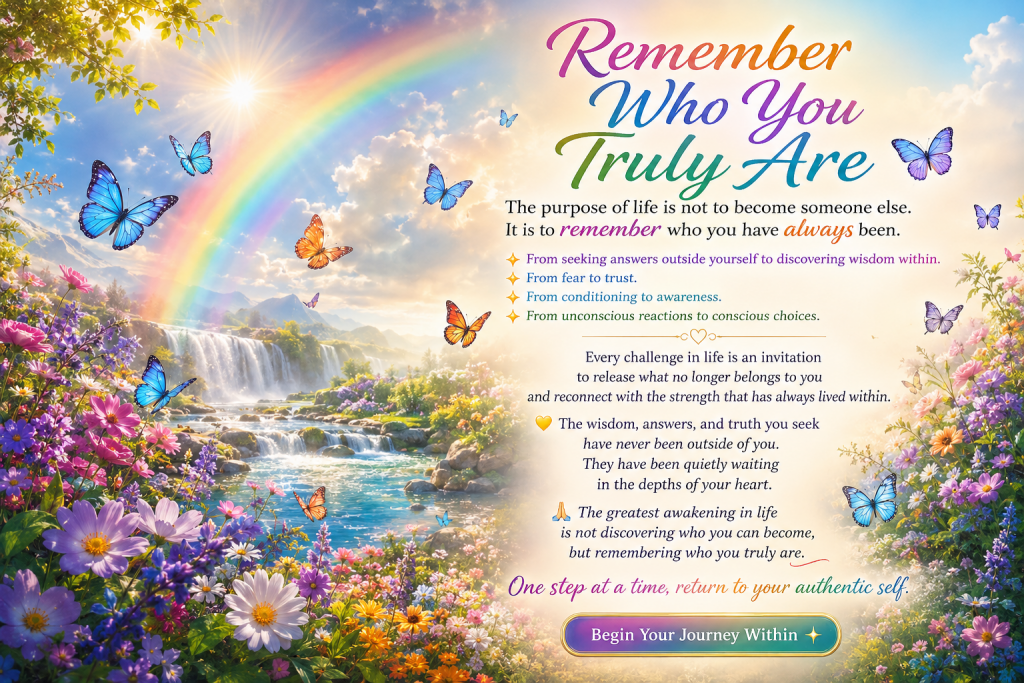
- Perhaps awakening is not about becoming someone extraordinary.
- Perhaps it is remembering the freedom that existed before fear convinced you that life was a burden.
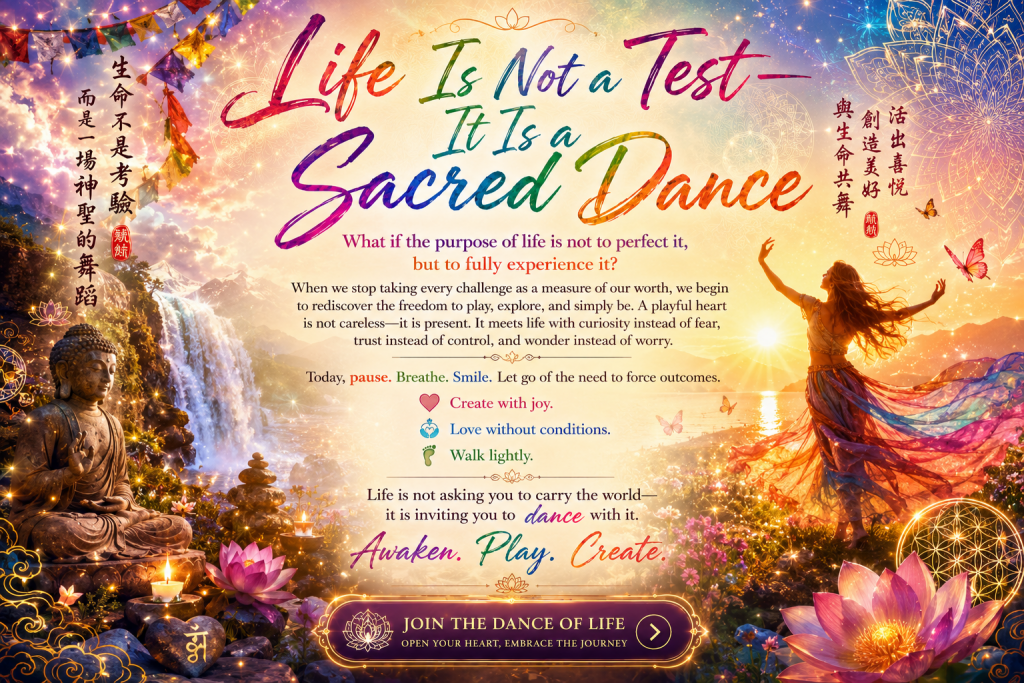
- Perhaps enlightenment is not found by escaping the dance.
- Perhaps it is finally realizing that you have always been the dancer, never separate from the music.
When you stop trying to conquer life and begin to move with it, something remarkable happens. The world may look the same, but your experience of it becomes lighter, freer, and more deeply alive.
The game has not changed.
💚 Only the player has awakened 💚
And in that awakening, life is no longer something to endure.
It becomes something sacred to experience,
💚 something beautiful to explore, and something joyful to share 💚
This perspective echoes a theme found across many wisdom traditions: when we loosen our attachment to identity and outcomes, we often experience greater presence, compassion, and ease. Living more playfully does not mean ignoring suffering or responsibility—it means meeting life with openness, humility, and a heart that has remembered how to wonder.