For the past few days, during meditation, an unexpected emotion has been surfacing—sadness.
It is not the sadness of a recent loss. Rather, it is the quiet ache that comes from looking back over a lifetime and remembering moments when I wish I had chosen differently.
One memory keeps returning.
Years ago, while attending a second-language school, I had a wonderful opportunity to immerse myself in English. Instead of dedicating myself fully to learning, I spent much of my time enjoying the social experiences that naturally come with being young. At the time, it seemed harmless. There was always tomorrow, another class, another chance.
Today, I sometimes wonder how different my life might have been if I had embraced that opportunity with greater focus.
That memory is only one among many.
Like everyone else, I have made choices that I am not proud of. Some were small. Others carried consequences that lingered far longer than I expected.
During meditation, these memories rise to the surface, and my first instinct is often to criticize myself.
- “Why didn’t I know better?”
- “Why did I waste those years?”
- “If only I had…”
These questions are familiar companions for many of us.
Yet I am beginning to realize something important. The purpose of remembering the past is not to punish ourselves. It is to understand ourselves.
The Illusion of Judging Yesterday with Today’s Wisdom
One of the greatest traps of the human mind is believing that our younger self should have possessed the wisdom we have today. But wisdom is not something we are born with.
It is earned. Sometimes painfully.
The person I was back then had different priorities, different experiences, and a different understanding of life. That younger version of me could not see what I see now.
If she had possessed today’s wisdom, he would have been today’s person—not yesterdays. Realizing this does not erase regret. But it softens it.
Every Regret Reveals Growth
There is an encouraging truth hidden inside regret. If I can recognize a mistake today, it means I have already changed. Growth often arrives quietly.
- We become more patient.
- More compassionate.
- More intentional.
Then, one day, we look back and notice that the old version of ourselves would no longer make the same choice. That realization is not proof of failure. It is proof of transformation.
Self-Forgiveness Is Not Forgetting
Many people believe forgiving ourselves means pretending nothing happened. It doesn’t.
Self-forgiveness means acknowledging the past honestly while refusing to let it define our future. It sounds like saying:
- “Yes, I made mistakes.”
- “Yes, I missed opportunities.”
- “And yes, I am still worthy of kindness.”
These truths can exist together.
Five Practices That Have Been Helping Me
1. Speak to Your Younger Self Like a Friend
Imagine meeting the younger version of yourself. Would you insult him?
Or would you understand that he was simply trying to navigate life with the knowledge he had? Offer yourself the same compassion you would naturally extend to someone you love.
2. Notice the Lesson Hidden Inside the Regret
Instead of asking: “Why did I do that?”
Ask: “What has this experience taught me?” Every painful memory can become a teacher rather than a prison.
3. Return to the Present
Meditation reminds us that life unfolds only here, in this moment. The past cannot be relived. The future cannot be guaranteed. But today can always be lived with greater awareness than yesterday.
4. Celebrate Small Steps
Perhaps my English isn’t as fluent as I wish it were. Yet every book I read… Every conversation I have… Every article I write… is evidence that I am still learning. Growth has no expiration date.
5. Let Regret Become Gratitude
Instead of saying, “I wasted those years,” I can gently say, “Those years eventually brought me here.” Without those experiences, I might never have developed the humility, curiosity, and appreciation I possess today.
The Tree That Keeps Growing
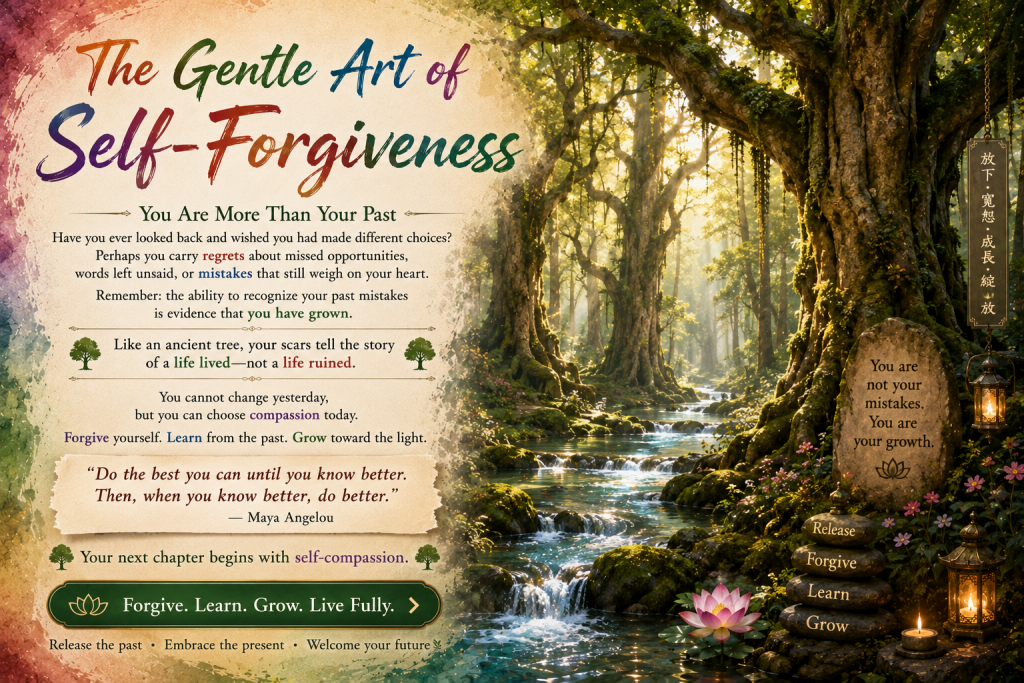
Recently, I read about a town in Quebec that recognized trees as living beings deserving of rights. That story stayed with me. An old tree carries scars. Broken branches. Storm damage. Years of drought and harsh winters. Yet it does not spend its energy wishing it had grown differently decades ago.
It simply continues reaching toward the light. Perhaps we can learn from that. Our scars are not evidence that we have failed. They are evidence that we have lived.
A New Beginning
As I continue meditating, I know more memories will arise.
Some will make me smile. Some may still bring sadness. But instead of meeting them with judgment, I hope to greet them with understanding.
- I cannot change the choices I made many years ago.
- I can only choose how I meet this moment.
Today, I choose to keep learning.
To keep growing.
To keep forgiving.
Like an old tree, I cannot return to my earliest rings. But I can still grow toward the light.
I would leave you with a thought from the poet Maya Angelou that beautifully captures the spirit of self-forgiveness:
“Do the best you can until you know better. Then when you know better, do better.”
Those words don’t excuse the past, nor do they condemn it. They recognize that learning and becoming are lifelong processes. I can see myself doing exactly that—continuing to learn, reflecting honestly, and seeking to live with greater intention. That is not the path of someone trapped by their past; it is the path of someone still growing. Like the old trees that have inspired me, I continue to add new rings, one season at a time. 🌳