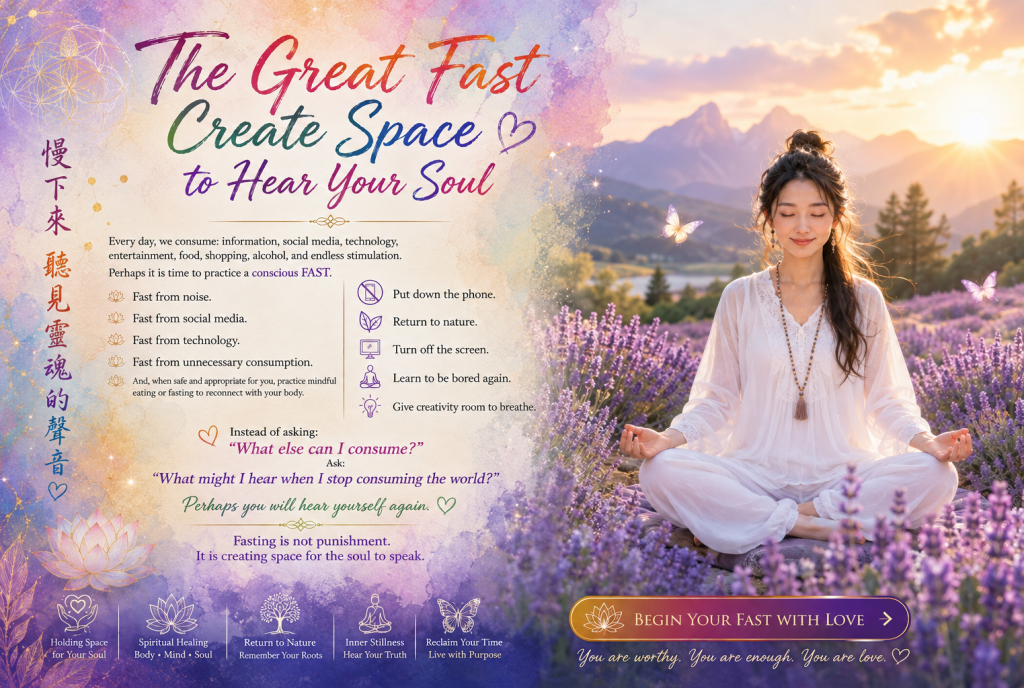
There comes a moment in our journey when we realize that we have been consuming the world almost continuously. We consume information, entertainment, opinions, notifications, food, shopping, alcohol, social media, and other people’s stories. We fill every quiet moment with something. We wake up and reach for our phones. We feel bored and search for stimulation. We feel uncomfortable and reach for consumption. We feel lonely and enter the digital world. We feel uncertain and search for another answer. We keep filling the space, yet somewhere deep inside, a quieter question remains: When will I finally have enough silence to hear myself?
👉 Perhaps the deeper meaning of fasting is not simply going without something.
👉 Perhaps it is creating enough space to discover what we have been unable to hear because there has been too much noise.
Fasting from the world does not mean rejecting humanity or escaping life. It means occasionally stepping away from the constant stream of opinions, headlines, arguments, expectations, comparisons, and other people’s definitions of reality. For a little while, we stop asking the world who we should be and begin asking ourselves:
🦋 Who am I when nobody is telling me who to become? 🦋
Fasting from social media can become a powerful form of attention reclamation. We may discover how often we instinctively reach for the screen whenever there is an empty moment. Instead of immediately filling that space, we can allow ourselves to experience it. We can walk without photographing everything. Eat without documenting it. Sit without scrolling. Listen to someone without checking notifications. We begin to discover that life does not need to be constantly witnessed by others to be meaningful.
And perhaps one of the most profound practices is learning to be bored again.
We have become so accustomed to stimulation that boredom can feel almost uncomfortable. Yet boredom may be an entrance into creativity. When the mind is no longer being entertained every second, something deeper can begin to emerge. A forgotten idea may return. A creative impulse may arise. An unresolved emotion may finally become visible. We may suddenly notice the trees, the sky, the sound of birds, our breathing, or the person sitting beside us.
🙏 Boredom is not emptiness. It is unoccupied space. 🙏
And unoccupied space can become sacred. Fasting from technology offers another doorway. We do not have to hate technology or abandon modern life. Technology can serve us beautifully when we consciously use it. The question is whether we are using technology as a tool—or allowing it to become the environment in which our consciousness lives.
Try beginning the morning without immediately entering the digital world. Give yourself the first hour before giving your attention to everyone else. Before opening the phone, breathe. Stretch. Meditate. Walk. Write. Pray. Sit quietly. Look outside. Ask yourself what kind of person you want to be today.
Give yourself the first part of the day before giving yourself to the world.
Then, at night, create another sacred boundary. Put the technology down before sleep. Allow the mind to become quiet. Let the nervous system understand that it no longer needs to process the entire world.
🙏 The world can wait. Your inner life cannot. 🙏
Fasting from food can also become a practice of conscious relationship with the body. But fasting should be approached wisely and safely. It is not appropriate for everyone, and people with certain medical conditions, those who are pregnant or breastfeeding, people with a history of eating disorders, children, and others may need to avoid fasting or seek medical guidance. The purpose should never be punishment or self-denial for its own sake. Instead, the deeper invitation is awareness.
- Can we notice the difference between physical hunger and emotional hunger?
- Can we recognize when we are eating because our body needs nourishment and when we are eating because we are tired, stressed, lonely, bored, or seeking comfort?
- Can we slow down enough to listen?
Sometimes the greatest nourishment is not another thing we consume, but the ability to become present with ourselves. There is also another kind of fasting that may be even more difficult:
Fasting from our addictions.
Alcohol. Compulsive shopping. Constant entertainment. Endless scrolling. Unnecessary consumption.
- The need to be validated.
- The need to always be busy.
- The need to escape uncomfortable feelings.
We often think addiction is simply about substance or behavior. But sometimes the deeper question is:
🙏 What feeling am I trying not to feel? 🙏
- What am I trying to escape?
- What am I trying to soothe?
- What am I trying to fill?
Alcohol may temporarily soften anxiety. Shopping may temporarily create excitement. Social media may temporarily relieve loneliness. Food may temporarily comfort emotional pain. Endless entertainment may temporarily protect us from facing ourselves.
The behavior may not be the original wound. It may be the strategy we developed to avoid experiencing the wound. Therefore, the invitation is not to attack ourselves.
We do not heal through shame.
We heal through awareness, compassion, support, and healthier choices. And when alcohol dependence is present, suddenly stopping can be medically dangerous. Professional support may be necessary. Asking for help is not failure; it is wisdom.
The same principle applies to shopping and other compulsive behaviors. Instead of simply saying, “I must stop,” we can become curious:
🙏 What am I truly seeking when I reach for this? 🙏
Perhaps we are seeking excitement.
Connection. Security. Recognition. Comfort. Escape. When we understand the underlying need, we can begin finding healthier ways to meet it.
This is where fasting becomes spiritual. We stop asking: “What can I consume to feel better?”
🦋 And begin asking: “What is my life asking me to understand?” 🦋
Silence can be uncomfortable because it removes our distractions.
When there is no phone, no television, no shopping, no alcohol, no constant conversation, and no endless stream of information, we may finally encounter the person underneath all the noise. At first, that person may feel unfamiliar.
- Thoughts may become louder.
- Old emotions may surface.
- Restlessness may appear.
We may suddenly discover how much we have been avoiding. But don’t immediately run. Sit. Breathe. Observe. Let the wave pass.
- You do not have to believe every thought that appears.
- You do not have to solve every emotion immediately.
- You can simply witness.
“This is what is here right now.”
That simple awareness can become profoundly transformative.
Meditation is not necessarily about forcing the mind to become completely empty. It can be the practice of becoming aware of thoughts without allowing every thought to become our identity. We begin to discover:
- I have thoughts, but I am not every thought.
- I experience emotions, but I am not every emotion.
- I have desires, but I do not have to obey every desire.
- I have habits, but I can choose differently.
This is where conscious freedom begins. And perhaps this is what surrender truly means. Surrender does not mean becoming passive. It does not mean giving up responsibility. It means releasing the exhausting need to control every outcome while remaining fully present for the next right action.
- We stop forcing life to follow our exact script.
- We listen.
- We observe.
- We respond.
- We allow.
- We act when action is required.
- We rest when rest is required.
- We trust that not every unanswered question needs to be solved today.
And slowly, something begins to shift.
- The noise becomes quieter.
- The cravings become information rather than commands.
- The phone becomes a tool rather than a master.
👉 Food becomes nourishment rather than emotional anesthesia.
👉 Shopping becomes a choice rather than an escape.
👉 Alcohol loses its role as the answer to feelings that needed to be understood.
👉 Silence becomes comfortable.
👉 Boredom becomes creative.
👉 Solitude becomes restorative.
👉 And our inner voice becomes easier to recognize.
🦋 Perhaps this is where the question of soul purpose begins. 🦋
We often imagine purpose as something grand: a mission, a career, a destiny, a special calling. But perhaps purpose first reveals itself through simplicity.
- What brings you alive?
- What kind of person do you want to become?
- What do you naturally care about?
- What pain have you transformed into wisdom?
- What gifts are you carrying that could benefit someone else?
- What would you do if you no longer needed everyone’s approval?
- What would you create if you were not constantly consuming what everyone else created?
These questions cannot always be answered through more information. Sometimes they require silence.
🙏 You cannot hear a whisper while standing inside a storm of noise. 🙏
- Perhaps your soul has been speaking all along.
- Perhaps the problem was never that you lacked guidance.
- Perhaps you simply had too many voices competing with it.
So consider creating your own personal period of conscious fasting.
👉 One day without social media.
👉 An evening without technology.
👉 A morning without your phone.
👉 A walk without headphones.
👉 A meal eaten slowly and mindfully.
👉 An hour of silence.
👉 A day without unnecessary shopping.
Time in nature. Meditation. Journaling. Prayer. Creative expression.
A period of mindful abstinence from whatever habit has been consuming more of your attention than you want to give it.
👉 Do not make it a punishment.
👉 Make it an invitation.
👉 An invitation to come home. Because ultimately, the purpose of fasting is not to become empty.
🙏 It is to discover what deserves to fill the space. 🙏
When we stop consuming everything around us, we begin to notice what we have been missing.
- Our own thoughts.
- Our own breath.
- Our own creativity.
- Our own body.
- Our relationships.
Nature. Stillness. Gratitude. Presence. And perhaps, beneath all of these, something even quieter:
the wisdom that was never actually absent.
So today, perhaps we can put down the phone. Close the browser. Turn off the screen. Leave the shopping cart empty.
Choose not to drink simply because we are uncomfortable—while seeking appropriate professional support if dependence is present.
Eat consciously. Walk slowly. Sit quietly. Be bored.
- Let the mind wander without immediately directing it.
- Let yourself feel.
- Let yourself breathe.
- Let yourself listen.
And then ask: “What is left when I stop consuming the world?”
- Perhaps what remains is not emptiness.
- Perhaps what remains is you.
- And perhaps that is where the next chapter begins.
👉 Fast from the noise.
👉 Fast from the distraction.
👉 Fast from unconscious consumption.
👉 Fast from the need to escape yourself.
Create space. Enter the silence. Listen deeply.
And allow your life to become an expression of what you discover there.
🙏 You do not have to chase your soul’s purpose. 🙏
🙏 Sometimes you simply have to become quiet enough to hear it. 🙏