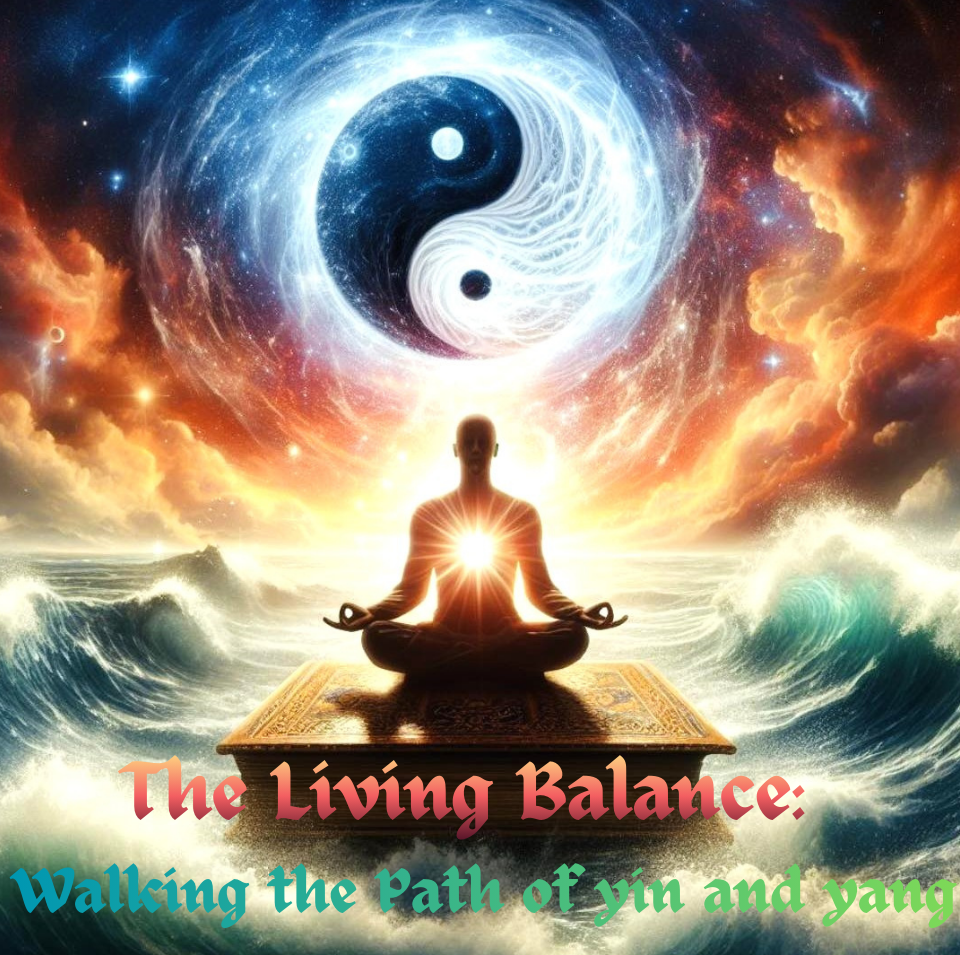
☯ To seek balance is not to eliminate contrast, but to harmonize it. The ancient symbol of Yin and Yang arises from the wisdom tradition of Taoism, rooted in early Chinese cosmology and crystallized through the teachings attributed to Laozi in the Tao Te Ching. It is not merely a design of black and white halves, but a living map of reality’s rhythm.
☯ Historically, the concept of Yin and Yang emerged during China’s Warring States period (5th–3rd century BCE), when scholars observed nature’s cyclical intelligence: day transforms into night, summer yields to winter, activity returns to rest. Yin represents the receptive, dark, inward, cooling, and reflective principle. Yang embodies the active, bright, outward, warming, and expressive force. Neither is superior; each contains the seed of the other, symbolized by the small opposing dot within each half. This is not dualism—it is dynamic complementarity.
☯ The ancient sages did not view harmony as static equilibrium, but as fluid adjustment. When Yang excess dominates—constant striving, noise, productivity without pause—burnout follows. When Yin becomes stagnant—withdrawal without renewal, stillness without direction—life loses vitality. The symbol teaches that imbalance is not failure; it is feedback. Nature always self-corrects through oscillation.
☯ To live in balance, then, is to become aware of your inner oscillations. Notice when you push without rest, speak without listening, and give without receiving. Notice when you retreat without returning. Yin and Yang invite conscious participation in this rhythm.
☯ Below are practical techniques to cultivate this living balance ☯
1. The Daily Polarity Check (Action Step: 5-Minute Evening Reflection)
Each evening, sit quietly and ask:
Where was I overly active today?
Where did I avoid necessary action?
☯ Write one sentence for each. Then choose one small corrective step for tomorrow. If you overworked (Yang excess), schedule one restorative pause. If you avoided a conversation (Yin stagnation), take one courageous outward step. Balance grows through micro-adjustments, not dramatic overhauls.
2. Rhythmic Breathing Alignment (Action Step: 4–4 Breath Practice)
☯ Inhale for four counts. Exhale for four counts. Continue for three minutes. The inhale reflects Yang—gathering energy. The exhale reflects Yin—releasing and softening. Equal breath trains the nervous system toward equilibrium. When breath becomes symmetrical, perception stabilizes.
3. Alternating Focus Practice (Action Step: Structured Work Cycles)
☯ Work with full engagement for 50 minutes (Yang), then rest intentionally for 10 minutes (Yin). During rest, step away from screens. Walk, stretch, or simply gaze outward. Productivity without recovery fractures vitality; recovery without engagement dulls purpose. Structured alternation honors both forces.
4. Relational Balance (Action Step: Listen First Rule)
☯ In one conversation daily, commit to listening without interruption for at least two minutes. This activates Yin receptivity. Then respond clearly and directly—Yang expression. Healthy relationships are living Yin–Yang exchanges.
5. Seasonal Awareness (Action Step: Align With Natural Cycles)
☯ Notice the time of year. Winter invites inward planning and reflection (Yin). Spring encourages initiation (Yang). Align major goals with these natural arcs rather than forcing constant intensity year-round. You are not separate from nature’s timing.
☯ Balance is not perfection. It is responsiveness. The Yin–Yang symbol teaches that light curves into shadow and shadow carries hidden light. When difficulty arises, ask: What opposite quality is being invited? When exhaustion appears, rest is wisdom—not weakness. When stagnation appears, movement is medicine.
☯ Yet let discernment remain. Balance does not mean passivity in the face of injustice nor withdrawal from necessary growth. It means meeting life with calibrated energy rather than reactive extremes. ☯
☯ If this teaching resonates, test it gently in lived experience rather than adopting it as belief. Harmony is verified through embodiment. ☯
☯ The circle of Yin and Yang reminds us that wholeness includes contrast. You are not meant to eliminate your intensity nor suppress your softness, but to weave them consciously in service of a stable, compassionate life. ☯
☯☯☯☯☯☯☯☯☯☯☯☯☯☯☯☯☯☯