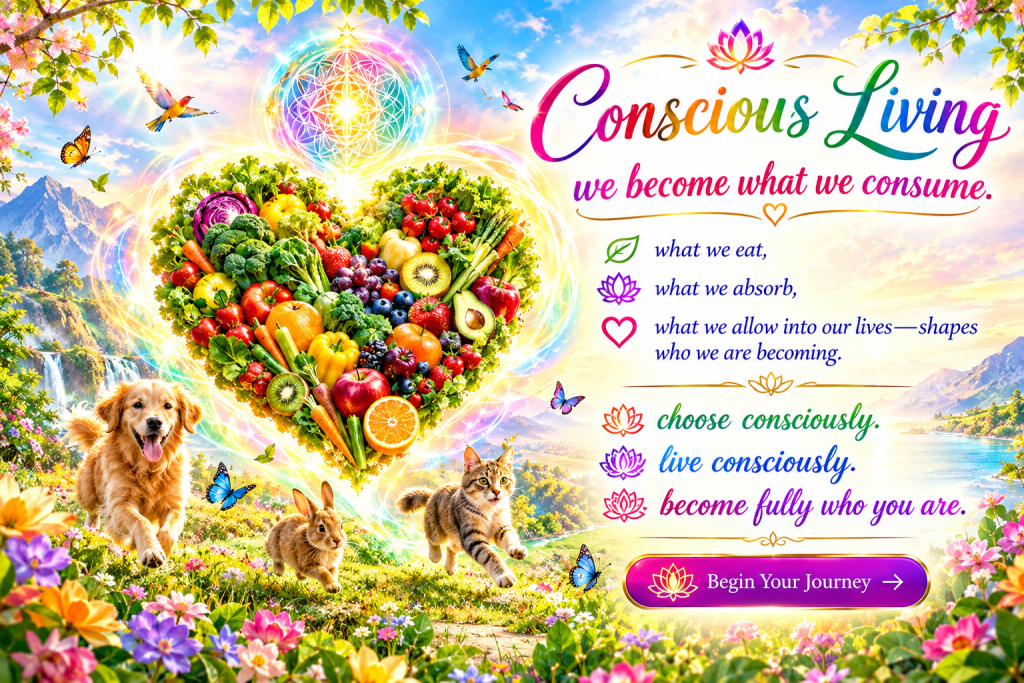
🧠 Nourishing the Body, Quieting the Mind, and Choosing a Wholesome Life 🧠
I have come to comprehend that food is much more than something we consume to satisfy hunger. From my perspective, food is one of the ways we participate in the relationship between ourselves, nature, and life. Every meal gives us an opportunity to ask: What am I putting into this body that carries me through my journey? What kind of energy, nourishment, and vitality do I wish to cultivate? This is why the simple expression, “We are what we eat,” has become much more meaningful to me.
It does not mean that a single food determines who we are. Rather, our everyday choices can gradually influence our physical health, energy, habits, relationship with food, and even the way we experience our lives.
Two weeks ago, I volunteered at a meditation centre. During lunchtime, several ladies noticed what I had chosen for my meal. They were surprised by my food choices and became curious about what I eat. They asked me what I believed contributed to my slim figure and the healthy appearance of my skin. I smiled because I was happy that their curiosity had opened a conversation about nourishment and conscious living. Soon, they wanted to sit together for lunch and learn more.
🥣 During our meal, they asked me about the secret behind my youthful appearance. I simply answered,
“For me, the secret is remembering that we are what we eat.” 🥣
I shared that I have been vegetarian for 18 years and that, as part of my personal approach to wholesome living, I choose to avoid or greatly limit seed oils, highly processed foods, foods containing numerous additives and preservatives, refined sugar, and highly refined bread and other refined flour products. My intention is not to tell everyone that they must follow exactly the same diet. It is to share what has worked for me and encourage people to become more conscious of the relationship between what they eat and how they feel.
💖 Eat With Awareness 💖
There is another dimension to nourishment that is just as important to me as the food itself: the way we eat. 🥣
When I sit down for a meal, I try to slow down. I breathe. I become aware of the colours, aromas, textures, and flavours.
I remember the sunlight, rain, soil, farmers, animals, plants, water, and countless human hands that have contributed to bringing food to my table. Then I give thanks.
From my spiritual perspective, eating can become a small meditation. Instead of rushing through another meal while looking at a phone, watching television, or worrying about the next task, we can allow ourselves to become fully present with the food in front of us.
🙏 Food becomes nourishment.
🙏 Nourishment becomes gratitude.
🙏 Gratitude becomes presence.
And presence changes the experience of eating.
I believe mindful eating also invites us to listen to our bodies rather than blindly following every craving, trend, advertisement, or diet philosophy. We can learn to distinguish between physical hunger, emotional hunger, boredom, habit, and genuine nourishment.
💖 Wholesome Living Is Not About Perfection 💖
When I share my own food journey, I am not asking anyone to become perfect. I am inviting people to become more conscious.
A wholesome lifestyle is not about creating another set of rigid rules and judging ourselves whenever we do not follow them perfectly. It is about developing a loving relationship with our body and becoming increasingly aware of how our choices affect our well-being. Ask yourself:
- Does this food nourish me?
- Does it give me sustained energy?
- How do I feel after eating it?
- Am I eating because I am hungry, or because I am stressed, lonely, bored, or conditioned to reach for something?
- Could I choose something more nourishing this time?
These simple questions can gradually change our relationship with food.
💖 The Body as a Sacred Vessel 💖
From my spiritual perspective, our body is the vessel through which we experience this extraordinary human life. Therefore, caring for the body is not vanity. It can be an act of gratitude.
When we nourish ourselves well, move our bodies, rest adequately, breathe deeply, spend time in nature, and cultivate a peaceful mind, we are honouring the extraordinary instrument through which we experience life. But nourishment is never only physical.
- Our minds also consume.
- Our eyes consume images.
- Our ears consume sounds.
- Our minds consume information.
- Our hearts consume relationships.
- Our consciousness consumes the stories we repeatedly tell ourselves.
🥣 So perhaps the deeper question is not simply: “What am I eating?” 🥣
👉 It is: “What am I allowing into my entire being?”
💖 The Lesson I Learned From an Empty Zoom Room 💖
After our conversation at the meditation centre, the ladies became enthusiastic and asked whether I would teach a class about vegetarian and wholesome living.
I happily said yes. I prepared. I created a Zoom meeting. I waited. And the following week, no one came.
- Interestingly, I wasn’t offended.
- I didn’t chase anyone.
- I didn’t try to persuade anyone.
- I didn’t take it personally.
Instead, I smiled and understood something important. Changing our daily habits is not easy.
Our food choices are often connected to childhood, family, culture, emotions, convenience, social relationships, memories, comfort, and years of repetition. To change a deeply established routine can feel like standing at the bottom of a very large mountain.
🥣 We may intellectually comprehend what would be healthier for us, yet understanding something and embodying it are two very different things. 🥣
- Real change requires readiness.
- It requires patience.
- It requires self-compassion.
- And ultimately, it requires our own conscious choice.
💖 Respecting Free Will 💖
This experience also reminded me of one of the principles I value most deeply:
We have to respect one another’s free will.
- I can share what I have learned.
- I can offer an example.
- I can open a door.
- I can invite.
- I can encourage.
- But I cannot walk through the door for another person.
Each person has their own timing, circumstances, beliefs, body, history, and path.
👉 My responsibility is not to force someone to live according to my choices.
👉 My responsibility is to live my own life as authentically and compassionately as I can.
🙏 Perhaps the most powerful teaching is not telling people what they should do.
🙏 Perhaps it is becoming an example of what we are inviting others to explore.
- If my way of living inspires someone, wonderful.
- If it does not, I can still honour their journey.
🌱 Plant Better Seeds 🌱
- Every meal is an opportunity to plant a seed.
- We can choose nourishment over neglect.
- Awareness over autopilot.
- Gratitude over taking life for granted.
- Whole foods over excessive dependence on highly processed foods.
- Presence over distraction.
- And compassion over judgment.
We don’t have to transform everything overnight. We can begin with one meal.
- One glass of water.
- One mindful breath.
- One healthier choice.
- One moment of gratitude.
- One conversation with our body.
- One decision to listen.
Then tomorrow, we can choose again.
🪷 Wholesome living is not a destination. It is a relationship with life. 🪷
🥣 And perhaps the deepest meaning of “We are what we eat” is not simply that food becomes part of our bodies. 🥣
💖 It is that our daily choices become part of the person we are becoming. 💖
- So let us nourish ourselves with greater consciousness.
- Let us eat with gratitude.
- Let us listen to our bodies.
- Let us question the habits we inherited.
- Let us release what no longer serves us.
- Let us choose what genuinely supports our well-being.
- And let us remember that everyone has their own path.
🥬 I can plant the seed.
🥕 I can water my own garden.
🍇 I can share what I have learned.
🍊 But I cannot force another garden to bloom.
What is meant to be, will be.
🪷 And perhaps the most beautiful form of service is simply to live the lesson ourselves, keep the door open, and allow others to enter when they are ready. 🪷
🎯 Five Foods and Food Categories I Choose to Limit 🎯
🍊 1. Seed oils: I personally choose to minimize highly refined industrial seed oils and pay attention to the overall quality and balance of fats in my diet. Rather than fearing every seed oil, I believe it is wiser to comprehend how a particular oil is produced, how it is used, and how it fits into an overall nourishing diet.
🥬 2. Highly processed foods: Many packaged foods are designed for convenience and intense palatability. When highly processed foods become the foundation of our diet, we may crowd out whole foods that provide fibre, vitamins, minerals, and other beneficial nutrients. I choose to make whole, minimally processed foods at the center of my meals whenever possible.
🥕 3. Foods with numerous additives and preservatives: I personally prefer simple foods with recognizable ingredients and no additives. Reading labels can become a powerful practice of conscious choice.
🍇 4. Refined sugar and excessively sweet foods: Excessive added sugar can make it easy to consume more calories than we need and can contribute to several health problems when consumed regularly in large amounts. I have found that reducing my dependence on sweetness helps me appreciate the natural flavors of fruits, vegetables, grains, legumes, and other whole foods.
🥔 5. Highly refined bread and flour products: My personal choice has been to avoid highly refined bread and flour products and to focus more on whole-food sources of carbohydrates. The deeper lesson for me is not to fear a particular food, but to become aware of what my body genuinely needs.
❤️🧡💛💚💎💙💜 ❤️🧡💛💚💎💙💜 ❤️🧡💛💚💎💙💜
💖「覺知生活」與「斷捨離」理念:不是要求別人改變,而是先活出自己的選擇,讓生命本身成為最有力量的示範. 💖
📓 The philosophies of “mindful living” and “Danshari” (decluttering/letting go) are not about demanding change from others; rather, they are about living out your own choices first, allowing your life itself to serve as the most powerful example. 📓