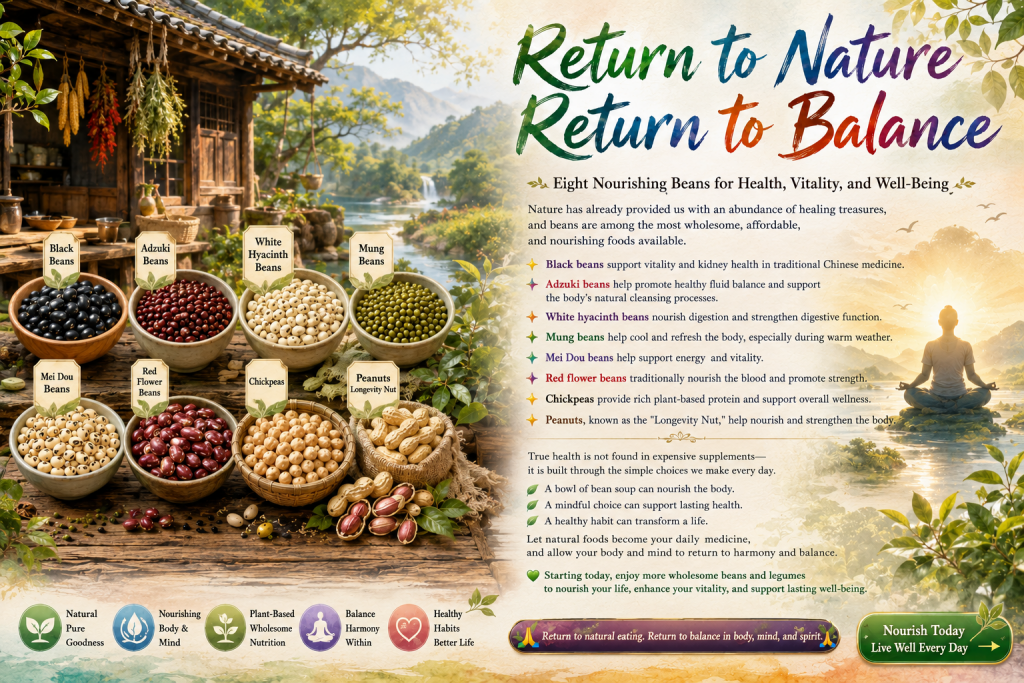
In Traditional Chinese Medicine (TCM), there is a well-known saying: “Grains nourish, fruits assist, animal foods support, and vegetables complete the diet.” 🙏
Among these foods, beans and legumes have long been regarded as valuable ingredients that serve as both food and medicine. Rich in nutrients and therapeutic properties, they are believed to help regulate organ function, strengthen vitality, and support the body’s natural balance.
🙏 The Huangdi Neijing (The Yellow Emperor’s Inner Classic) emphasizes that the highest form of health care is to prevent illness before it arises. Rather than waiting for disease to develop, we can cultivate health through our daily dietary choices.
Among nature’s gifts, beans and legumes are some of the most affordable, accessible, and effective foods for supporting wellbeing. Different varieties offer unique benefits that can help nourish different aspects of the body.
🙏 Let us explore several of the most commonly used and highly valued beans in TCM, along with their traditional health benefits and food therapy recipes.
🌿 Black Beans — Nourishing the Kidneys and Promoting Healthy Hair
In TCM, there is a principle that: “Black foods enter and nourish the Kidney system.”
Black beans are often called “the grain of the kidneys” and have been highly praised by physicians throughout Chinese history. Traditional Benefits:
✅ Nourishes kidney energy
✅ Supports healthy hair and may help maintain natural hair color
✅ Strengthens bones and tendons
✅ Promotes circulation
✅ Helps regulate fluid metabolism
✅ Supports healthy aging
The Compendium of Materia Medica (Ben Cao Gang Mu) states:
“Regular consumption of black beans nourishes the kidneys, supports yin energy, and promotes longevity.”
Traditionally Recommended For : Lower back and knee weakness, Fatigue and low vitality, Hair thinning or premature graying,
Symptoms associated with kidney deficiency in TCM, Mild water retention,
Nourishing Recipe : Black Bean and Walnut Kidney-Nourishing Soup
Ingredients: 50g black beans, 30g walnuts, 5 red dates (jujubes)
Directions: Simmer all ingredients for approximately one hour.
Traditional Benefits: Supports kidney energy, nourishes the blood, promotes healthy hair, and enhances vitality.
🌿 Adzuki Beans (Red Adzuki Beans) — Masters of Removing Dampness
In TCM, adzuki beans are highly valued for helping the body regulate excess moisture. Traditional Benefits :
✅ Supports healthy fluid balance
✅ Helps reduce swelling
✅ Assists detoxification processes
✅ Strengthens the spleen according to TCM theory
✅ Supports weight management related to water retention
Traditionally Recommended For : Feeling heavy or sluggish, Mild swelling, Excess dampness according to TCM diagnosis, Certain skin conditions associated with dampness
Nourishing Recipe : Adzuki Bean and Coix Seed (Job’s Tears) Soup
Ingredients: 50g adzuki beans, 50g coix seeds (Job’s tears), A small piece of dried tangerine peel
Traditional Benefits: Helps remove dampness, reduce bloating, and support digestive balance.
🌿 White Hyacinth Beans — The “Grain of the Spleen and Stomach”
White hyacinth beans (Bai Bian Dou) are known in TCM as: “The grain of the spleen and stomach.”
In TCM, a healthy spleen and stomach are considered the foundation of energy and vitality. Traditional Benefits
✅ Strengthens digestion
✅ Supports healthy appetite
✅ Helps regulate loose stools
✅ Supports digestive comfort
✅ Tonifies qi (vital energy)
Traditionally Recommended For: Poor appetite, Loose stools, Digestive weakness, Fatigue
Nourishing Recipe : White Hyacinth Bean and Chinese Yam Porridge
Ingredients: 30g white hyacinth beans, 50g Chinese yam, Rice as desired
Traditional Benefits: Supports digestion, strengthens qi, and nourishes the stomach.
🌿 Mung Beans — Nature’s Cooling and Detoxifying Bean
Mung beans are especially popular during the hot summer months. Traditional Benefits
✅ Clears internal heat according to TCM
✅ Relieves summer heat
✅ Supports hydration
✅ Promotes urination
✅ Helps calm irritability associated with heat
Traditionally Recommended For : Feeling overheated, Summer heat discomfort, Dry mouth and thirst, Minor skin eruptions associated with excess heat
Nourishing Recipe : Mung Bean and Lily Bulb Soup
Ingredients: 50g mung beans, 20g dried lily bulbs, Rock sugar to taste
Traditional Benefits: Helps cool the body, calm the mind, and promote relaxation.
🌿 Black-Eyed or White Kidney Beans (Mei Dou) — Natural Energy Builders
Mei Dou beans are commonly used in Cantonese medicinal soups. Traditional Benefits
✅ Tonifies qi
✅ Supports digestion
✅ Helps reduce fatigue
✅ Enhances physical strength
Traditionally Recommended For : Low energy, High work stress, General weakness
Nourishing Recipe : Mei Dou and Lotus Seed Vitality Soup
Ingredients: 50g Mei Dou beans, 30g lotus seeds, 5 red dates
Traditional Benefits: Supports energy, nourishes the heart, and strengthens vitality.
🌿 Scarlet Runner Beans (Red Flower Beans) — Supporting Blood and Vitality
Red flower beans are rich in plant protein and minerals. Traditional Benefits
✅ Nourishes the blood according to TCM
✅ Supports healthy energy levels
✅ Strengthens digestion
Nourishing Recipe : Red Flower Bean and Red Date Soup
Traditionally used for individuals experiencing fatigue or signs of blood deficiency according to TCM.
🌿 Chickpeas — The King of Plant Protein
Chickpeas have become increasingly popular among health-conscious individuals worldwide. Traditional Benefits
✅ Supports digestive health
✅ Nourishes qi and vitality
✅ Helps maintain stable energy levels
✅ Promotes satiety
✅ Supports cardiovascular health
Traditionally Recommended For “ Vegetarians and vegans, Individuals managing body weight, Older adults seeking nutrient-dense foods
Nourishing Recipe : Chickpea Vegetable Soup
Combine chickpeas with carrots and pumpkin and simmer until tender.
Benefits: Nutritious, satisfying, and easy to digest.
🌿 Peanuts — The “Longevity Nut”
Peanuts have long been known in Chinese culture as: “The Longevity Nut.” Traditional Benefits
✅ Nourishes the lungs according to TCM
✅ Supports digestion
✅ Helps nourish the blood
✅ Promotes healthy skin
✅ Supports cardiovascular wellbeing
Traditionally Recommended For : Blood deficiency according to TCM, Dry skin, Postpartum nourishment
Nourishing Recipe : Peanut and Red Date Soup
Ingredients: 50g peanuts, 10 red dates,
Traditional Benefits: Nourishes the blood, supports skin health, and promotes vitality.
🌱 The Wisdom of Bean Therapy 🌱
TCM teaches: “The five colors nourish the five organ systems.”
Different colored beans are traditionally associated with different organ systems:
- Black beans nourish the kidneys
- Mung beans clear heat
- Adzuki beans reduce dampness
- White hyacinth beans strengthen digestion
- Mei Dou beans support qi
- Red flower beans nourish the blood
- Chickpeas support vitality
- Peanuts nourish the lungs and blood
No single food is a cure-all.
The true wisdom of health cultivation lies in understanding your individual constitution, adapting to the seasons, and enjoying a balanced variety of natural foods.
🌸 The Highest Wisdom of Self-Care 🌸
Many people believe that health comes from expensive supplements or complicated treatments. Yet some of the most powerful remedies can be found in our own kitchens.
🍲 A bowl of black bean soup can support vitality.
🍲 A pot of adzuki bean and coix seed soup can help restore balance.
🍲 A bowl of mung bean and lily bulb soup can provide cooling comfort during hot weather.
💚 True wellbeing is built through consistent daily care. 💚
By incorporating these nourishing beans into your meals, you can support your body’s natural balance and vitality.
💚 To care for your body is to honor life itself.
💚 To care for your health is to care for your future.
🙏 May we all embrace the wisdom of simple, nourishing foods and cultivate strong digestion, balanced energy, and vibrant wellbeing. 🙏
🍲 The best medicine is often found not in the pharmacy, but in the choices we make every day at our dining table and in our lifestyle. 🍲
🌱 Note: The health benefits described above are based on traditional Chinese medicine theory and traditional use. They are not intended as medical advice or as substitutes for professional healthcare. If you have a medical condition, consult a qualified healthcare professional. 🌱