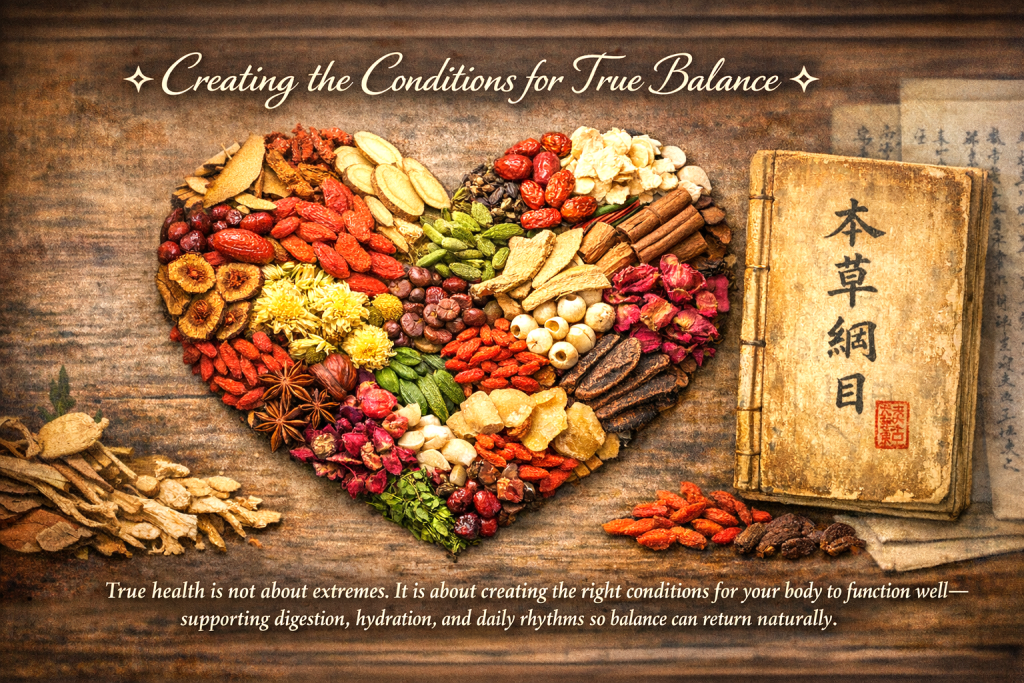
Across different medical traditions, one principle quietly repeats: health is not maintained by a single intervention, but by the relationship between internal regulation and external support.
Classical Chinese medicine expresses this through two complementary lenses. The Huangdi Neijing emphasizes internal cultivation—regulating breath, stabilizing emotions, and aligning daily life with natural rhythms. The Bencao Gangmu, in contrast, focuses on external nourishment—using herbs, food, and environmental inputs to support the body when imbalance arises.
Seen together, they describe a simple but often overlooked truth.
The body does not rely solely on what is done to it, nor solely on what it does within itself. It depends on both.
Internal regulation forms the foundation. When breathing is steady, sleep is consistent, and emotional states are not chronically reactive, the body maintains a degree of stability. This stability does not eliminate all illness, but it creates conditions where recovery is more possible.
External nourishment provides reinforcement. Food supplies the raw materials for repair. Herbs, when used appropriately, can support specific functions such as digestion or immune response. Environment—air, movement, and exposure—further shapes how the body operates.
Neither dimension is sufficient alone.
Focusing only on internal practices while neglecting nutrition or medical care can leave the body under-resourced. Relying only on external interventions without addressing chronic stress or lifestyle patterns can limit long-term improvement.
Health, then, is not a fixed state to be achieved, but a dynamic balance to be maintained.
Restoration begins with small consistencies:
→ Regular sleep, steady breathing, simple nourishment, and gradual reduction of excess strain. Over time, these shifts accumulate—not dramatically, but reliably.
In this way, the classical teachings do not point toward complexity, but toward integration. And integration, sustained gently, becomes the path back to balance.
The “Inner School” and “Outer School” View in Classical Chinese Medicine
“Inner work” and “outer support” are not separate paths. They are two directions of the same regulation.
The pairing of:
Huangdi Neijing
Bencao Gangmu
as 內家 (inner cultivation) and 外家 (external nourishment) is not a literal classification from the texts themselves, but a later interpretive lens.
Still, it is a meaningful one.
Inner School (內家) — Regulation from Within
The Huangdi Neijing focuses on:
Qi (vital function, not mystical substance)
Emotional balance
Rhythms of nature (day/night, seasons)
Organ system relationships
When described as “內家功法” (inner practice), it points toward:
1. Regulating Breath (養氣)
Breath influences:
- Nervous system tone
- Circulation
- Internal stability
2. Regulating Mind (調心)
Emotions are seen as physiological influences:
Excess anger → affects liver function patterns
Excess worry → affects digestion patterns
This is not symbolic—it reflects observed mind–body interaction.
3. Living in Rhythm
- Sleeping in alignment with circadian cycles
- Eating in moderation
- Avoiding extremes
Core idea: The body maintains health when internal regulation is stable.
Outer School (外家) — Support from Outside
The Bencao Gangmu, compiled by Li Shizhen, catalogs:
- Herbs
- Foods
- Minerals
Their observed effects
As “外家功法,” it emphasizes:
1. Herbal Intervention
Using substances to:
- Reduce inflammation
- Support digestion
- Restore energy
2. Food as Medicine
Diet is not secondary—it is continuous therapy.
3. Targeted Correction
When an imbalance is present, external inputs help shift it.
Core idea: When internal balance is disrupted, external support can assist restoration.
The Relationship Between Inner and Outer
This is where the model becomes practical:
→ Inner regulation sets the terrain
→ Outer inputs provide tools
If the terrain is unstable, tools have a limited effect.
If tools are absent, regulation may not be enough.
So the classical insight is not dualistic—it is interdependent.
Applying These Insights in a Grounded Way
To “return to wholeness” is not to reach perfection, but to reduce fragmentation across systems.
A. Inner Regulation (Daily Foundations)
→ Breath and Nervous System
→ Slow, steady breathing (e.g., 4–6 breaths per minute)
- Reduces chronic stress activation
- Emotional Awareness
- Not suppression, not indulgence—recognition
- Naming emotions reduces physiological intensity
- Rhythm Stabilization
- Consistent sleep timing
- Regular meals
- Exposure to natural light
These are simple, but not trivial. They form the base layer.
B. Outer Support (Practical Inputs)
- Food as Primary Medicine
- Warm, digestible foods for weak digestion
- Fiber-rich foods for metabolic support
- Adequate protein for repair
- Herbal Support (with guidance)
Examples from traditional use:
Astragalus membranaceus → supports immune function
Glycyrrhiza uralensis → harmonizing herb in formulas
Zingiber officinale → digestion and circulation
These are supportive, not curative in isolation.
- Environment
- Clean air
- Reduced toxin exposure
- Physical movement
C. The Integrative Principle
From a modern perspective, what these traditions describe aligns with:
→ Homeostasis (internal balance)
→ Allostasis (adaptive regulation)
From the Codex language, health is described as coherence, and illness as incoherence .
Whether one uses that language or not, the functional idea is similar: systems work best when they are coordinated.